
T: +86-21-55896873
E: info@youguard.cn
E: info@youguard.cn
8th Floor, Building 3, 999 Jiangyue Road, Minhang District, Shanghai
Views: 0 Author: Site Editor Publish Time: 2026-11-23 Origin: Site


Minor contamination or static discharge during cell, module, or pack assembly triggers catastrophic consequences. A single stray particle or micro-spark can lead to immediate scrap. It can also cause delayed field failures or catastrophic thermal runaway. Standard industrial robots are not inherently designed for these environments. They lack native protection for stringent, cleanroom-like conditions.
Specifying the right robot covers for EV battery assembly is not just an equipment protection measure. It is a critical yield-protection strategy. This approach requires rigorous evaluation of electrostatic discharge (ESD) mitigation. You must also account for particulate control and dynamic cable routing to ensure safe, continuous operations. We will explore how proper material selection, custom tailoring, and strategic cable management prevent costly manufacturing disruptions. You will learn actionable frameworks to specify, deploy, and maintain automation protection across your battery production lines.
ESD Compliance is non-negotiable: Effective covers must utilize verifiable static-dissipative materials that maintain continuous grounding throughout high-speed multi-axis movements.
Contamination control goes both ways: Covers must prevent external metallic dust from degrading robot joints while simultaneously guaranteeing zero particle shedding from the fabric itself.
Cable management defines uptime: Proper routing prevents umbilical snags, reduces friction-induced wear, and extends the lifespan of sensitive vision and end-effector wiring.
Custom fit dictates durability: Poorly tailored covers introduce snag risks and localized abrasion, neutralizing their protective benefits and increasing maintenance downtime.
Electric vehicle battery assembly creates uniquely hostile environments for automation equipment. Battery module and pack assembly stages present highly specific operational risks. Robots operate in close proximity to exposed busbars and delicate cell tabs. Laser welding stations generate abrasive metallic spatter. Assembly cells demand pristine conditions to prevent internal battery cell contamination.
Standard industrial covers cannot survive these conditions. Facility managers often attempt to repurpose foundry, painting, or food-grade robot covers. These general-purpose options consistently fail in EV applications. They lack essential ESD properties. They do not meet strict cleanroom IP ratings. Furthermore, their bulky designs restrict the agility needed for precise battery component placement. Using standard covers creates a false sense of security while actively introducing new hazards.
The cost of automation failure in this sector remains staggeringly high. Unprotected or improperly protected automation directly impacts your bottom line. Scrapped battery modules frequently result from micro-shorts caused by static discharge. Unplanned downtime skyrockets when severed cables halt the production line. In worst-case scenarios, localized fires ignite due to short circuits. Investing in specialized protection mitigates these severe financial risks directly.
Electrostatic discharge presents an invisible threat to battery manufacturing. Surface resistance metrics define the safety threshold for protective materials. The required electrical resistance ranges typically fall between 10⁵ to 10⁹ ohms. This specific range allows safe static dissipation. Materials below 10⁵ ohms become highly conductive, creating shock hazards. Materials above 10⁹ ohms act as insulators, trapping dangerous static charges.
Material composition dictates how well a cover performs under friction. High-quality ESD robot protective clothing relies on specialized base fabrics. Manufacturers interweave these fabrics with carbon or metallic threads. This creates a continuous conductive grid across the fabric surface. The grid prevents static build-up during rapid, repetitive robotic articulation.
Grounding mechanics determine the actual effectiveness of the suit. Protective clothing must interface flawlessly with the robot's grounding points. You must assess the reliability of grounding snaps and conductive straps. Conductive zippers must maintain continuity during continuous motion. A break in the grounding path instantly neutralizes the fabric's protective qualities.
Engineers must also plan for material longevity and degradation. ESD properties naturally degrade over time. Wear, stretching, and maintenance washing break down conductive fibers. You must establish strict baseline expectations for testing cycles. Routine surface resistance testing ensures the fabric remains within the safe ohmic range. Proactive replacement cycles prevent sudden ESD failures on the assembly line.
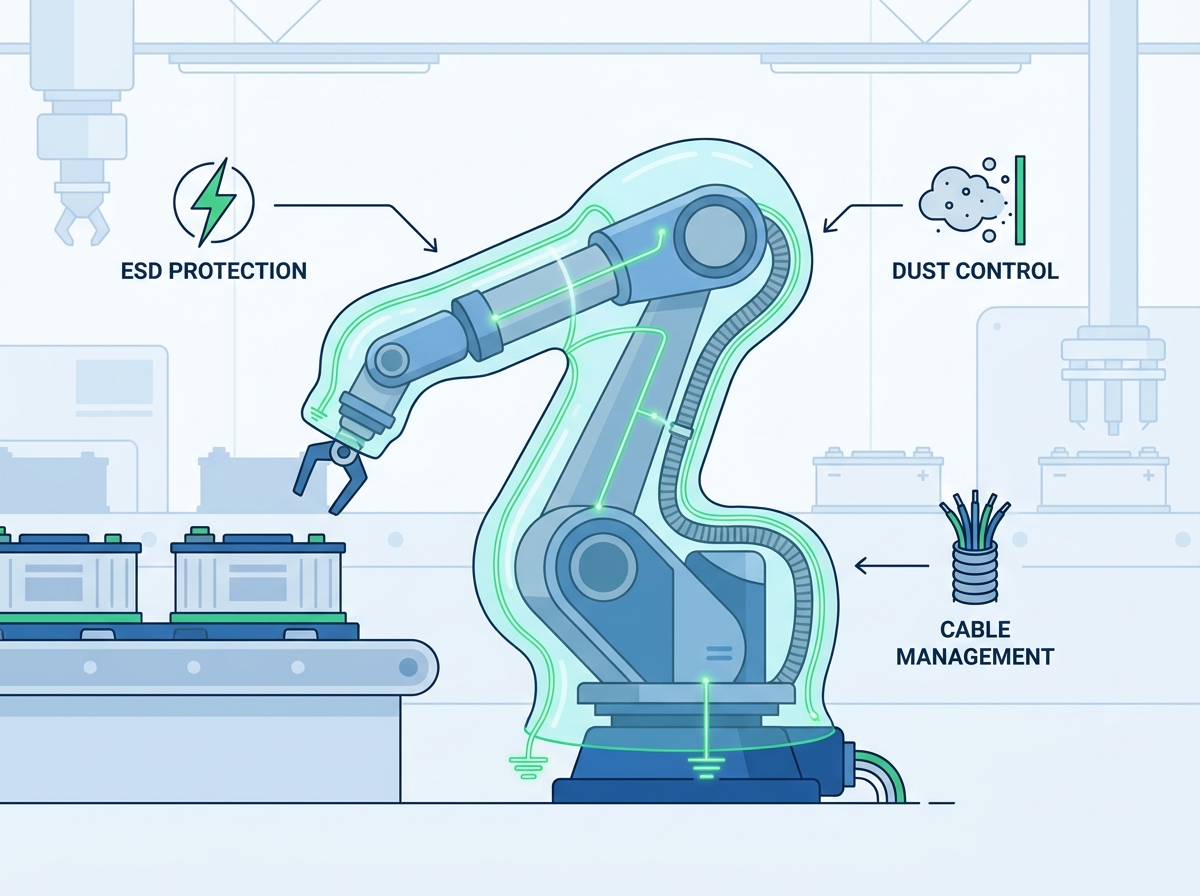
Contamination control forms the backbone of battery quality assurance. Preventing metallic dust ingress extends robotic lifespan significantly. Structural assembly and laser welding generate abrasive metallic dust. Covers must seal critical robot joints securely against these harsh particulates. Dust entering servo motors or gearboxes accelerates mechanical wear and forces premature rebuilds.
Non-shedding material requirements represent the other side of contamination control. The protective cover itself cannot introduce lint into the environment. Micro-plastics falling into a battery cell cause catastrophic chemical imbalances. You must specify ISO Class compatible fabrics. Cleanroom-certified materials undergo rigorous testing to guarantee zero particle shedding during extreme physical flexing.
Sealing and closures dictate the final protection rating. Overlapping seams and concealed zippers prevent particulate bypass. Tight elastic or drawstring cuffs maintain a continuous barrier at the wrist. The assembly stage determines the necessary ingress protection level. Depending on the process, engineers typically target IP54 to IP66 equivalent protection.
Comparison Chart: Sealing Requirements by Assembly Stage
Battery Assembly Stage | Primary Contamination Risk | Recommended Protection Level | Key Closure Features |
|---|---|---|---|
Cell Stacking & Alignment | Lint, micro-plastics, hair | ISO Class 5 / IP54 | Concealed zippers, non-shedding fabric |
Busbar Laser Welding | Metallic spatter, weld smoke | ISO Class 6 / IP65 | Flame-retardant overlaps, tight cuffs |
Thermal Interface Application | Adhesive overspray, silicones | IP66 equivalent | Sealed seams, smooth wipeable exterior |
The complexity of EV end-effectors complicates routing strategies. Battery assembly utilizes heavy payloads and intricate tooling. Vacuum grippers, high-resolution vision cameras, and ultrasonic welders demand extensive external cabling. Exposed cables remain highly vulnerable to snags and repetitive stress. A single pinched camera cable stops the entire inspection process instantly.
Friction and abrasion reduction require specialized engineering. Dynamic movements drag cables across robot castings continuously. Advanced robot arm cable protection systems utilize low-friction internal layers. Manufacturers often integrate PTFE or Teflon linings inside the sleeves. These slick layers allow cables to glide smoothly during high-speed articulation. Reduced friction directly translates to longer cable lifespans.
Managing bend radius and torsion prevents internal wire fatigue. Repeated twisting cracks cable jackets and degrades signal integrity over millions of cycles. Structured protection solutions maintain proper cable bend radii. They guide umbilical cords through safe motion paths. This prevents extreme kinking during aggressive six-axis movements.
Modular umbilical management significantly accelerates line repairs. Segregated cable channels prevent power lines from physically chafing delicate data cables. Hook-and-loop access panels offer immense maintenance advantages. Technicians can replace a single failing cable without removing the entire suit. This modular approach shrinks repair times from hours down to minutes.
Deploying fabric protection introduces unavoidable engineering trade-offs. Thermal retention represents the most critical risk. Covers naturally trap heat generated by hard-working servo motors. You must balance sealing requirements against cooling needs. Integrating breathable material zones helps dissipate ambient heat. High-payload applications often necessitate forced-air cooling integrations to prevent servo motor overheating and drive faults.
Installation speed impacts your Mean Time To Repair (MTTR). Rollout friction determines whether maintenance teams embrace or reject the solution. You must evaluate how long it takes a technician to install or remove the cover during a shift. Split-designs drastically outperform slip-on models. Velcro and robust zipper closures allow rapid deployment without disassembling the robot tooling.
Strategic deployment follows a predictable operational sequence. Implementing these suits requires coordinated effort across maintenance teams.
Audit cell constraints: Measure ambient temperatures and identify the hardest-working axes.
Establish baseline metrics: Record current MTTR for cable replacements and baseline servo temperatures.
Conduct dry runs: Practice installing the suit during planned weekend maintenance windows.
Monitor initial cycles: Run the robot at 50% speed to observe fabric bunching or snag risks.
Document procedures: Create standardized visual checklists for daily visual inspections.
Inspection windows preserve visibility into machine health. Maintenance teams need to read servo dials and check limit switches frequently. They also need to inspect internal cables for wear. Strategically placed clear vinyl panels solve this issue. Technicians can perform routine visual inspections without unzipping or removing the suit. This feature maintains the cleanroom seal while supporting preventive maintenance schedules.
Vetting suppliers separates industrial partners from basic textile vendors. Engineering and procurement teams must request empirical data before purchasing. Buyers should demand certified surface resistivity test reports. You must also review fabric abrasion cycle data to gauge physical durability. Material safety data sheets (MSDS) confirm the absence of prohibited chemicals in the fabric.
Choosing between custom and universal fit determines your return on investment. Universal bags seem cost-effective initially. However, they introduce severe snag risks and localized abrasion due to excess material. OEM-specific or custom-measured covers yield much higher ROI. A tailored fit guarantees motion repeatability. It prevents baggy fabric from obstructing vision cameras or catching on safety fences.
Evaluating a supplier requires a structured criteria checklist. Use these benchmarks when comparing vendor proposals.
Material Certification: Can they provide third-party ESD and cleanroom validation?
Engineering Support: Do they offer on-site measurement and 3D CAD modeling integration?
Prototyping Speed: How quickly can they iterate a design if it snags during testing?
Repair Services: Do they offer localized repair programs for torn suits, or only full replacements?
Industry Pedigree: Can they demonstrate proven success specifically within EV battery manufacturing environments?
Pilot programs reduce enterprise-wide deployment risks. We strongly recommend testing covers on a single workcell first. Run the pilot program for 30 to 60 days. Monitor thermal performance across different production shifts. Verify ESD stability through weekly surface resistance testing. Gather operator feedback regarding cleaning procedures and ease of access before approving full-line deployment.
The automation landscape has fundamentally shifted. Plant managers no longer view robot covers as optional aesthetic accessories. They are now essential components of the EV battery quality control architecture. Protecting sensitive robotic equipment directly safeguards your product yield and line uptime.
Balancing ESD compliance, dust control, and dynamic cable routing presents a complex engineering challenge. However, achieving this balance is entirely possible. It requires strict supplier vetting, empirical material testing, and custom engineering. Off-the-shelf solutions simply introduce unacceptable levels of risk into the battery assembly process.
We encourage engineering and procurement teams to act immediately. Audit your current assembly cells for contamination and static risks. Evaluate your baseline cable replacement frequencies and thermal faults. By integrating purpose-built protective solutions today, you ensure resilient, highly profitable automation for tomorrow.
A: You should test ESD covers monthly as part of standard preventive maintenance schedules. Use a certified surface resistance meter to check high-friction zones. If the resistance reading exceeds 10⁹ ohms, the material has degraded and requires immediate replacement to ensure safe static dissipation.
A: Poorly designed covers can trap heat and trigger drive faults. However, custom-engineered solutions mitigate this risk. Suppliers use thermal mapping to place breathable, particulate-filtering fabrics near servo motors. You must also factor in factory ambient temperature and robot payload when selecting material thickness.
A: We strongly advise against routing them together without internal separation. Mixing power cables, data lines, and pneumatics causes signal interference and physical chafing. Proper protective systems feature segregated internal channels to isolate these lines, preventing premature wear and electrical noise.
A: The base fabrics can be certified to specific ISO cleanroom standards (e.g., ISO Class 5). However, the fully assembled suit must be tested in situ. Seams, zippers, and mechanical friction alter shedding rates. The complete robotic assembly dictates the final cleanroom compliance level.


