
T: +86-21-55896873
E: info@youguard.cn
E: info@youguard.cn
8th Floor, Building 3, 999 Jiangyue Road, Minhang District, Shanghai
Views: 0 Author: Site Editor Publish Time: 2026-11-18 Origin: Site


Industrial robots operate in brutal conditions. You deploy them into harsh environments expecting flawless performance. However, they face premature failure if you specify them improperly. Buyers often assume a high native IP rating guarantees total environmental protection. This remains a dangerous misconception. Standard IEC 60529 IP ratings originate from static, controlled lab tests. Technicians use pure water and standardized dust during these evaluations. They rarely account for dynamic movement, chemical coolants, or severe thermal shock.
We wrote this guide to establish a clear evaluation framework. You will learn how to accurately interpret factory IP ratings. You will discover exactly when aftermarket protective covers become operationally necessary. Facility managers need this knowledge to prevent unexpected breakdowns. Proper protection strategies keep production lines moving efficiently. We will explore real-world failures and effective countermeasures. You can then make confident engineering decisions to protect your automation assets.
Lab vs. Reality: A factory IP67 rating protects against pure water and static dust, but does not guarantee resistance to CNC coolants, corrosive chemicals, or abrasive metal shavings.
The Degradation Factor: Robot joint seals naturally wear out through dynamic movement; relying solely on built-in IP ratings in highly abrasive environments accelerates maintenance cycles.
When to Use Covers: Protective covers are essential for extreme thermal environments (foundries), high-chemical exposure (washdowns/machining), and heavy particulate applications.
Let's demystify the IEC standard. The IP system uses two specific digits. The first digit measures resistance to solid particles like dust. The second digit measures resistance to liquid ingress. Most baseline factory arms offer IP54 protection. They handle light dust and occasional splashing easily. Specialized foundry or washdown arms often achieve IP67. They withstand temporary immersion in perfectly clean water.
When evaluating a robot ingress protection IP65 rating, buyers must understand the exact nuances. It means the equipment is completely dust-tight. It also deflects low-pressure water jets. However, this applies strictly under controlled test conditions. Real factory floors present much harsher variables.
This brings us to the "static" flaw. IP testing occurs while the robot remains completely stationary. Industrial robots move constantly. Dynamic movement stretches and compresses the rubber joint seals. This rapid motion creates temporary vacuums inside the arm. These vacuums actively pull airborne contaminants past the seals. Once inside, dust and moisture ruin the internal motors. This dynamic reality renders static lab tests highly optimistic. You must account for continuous motion when planning your protection strategy.
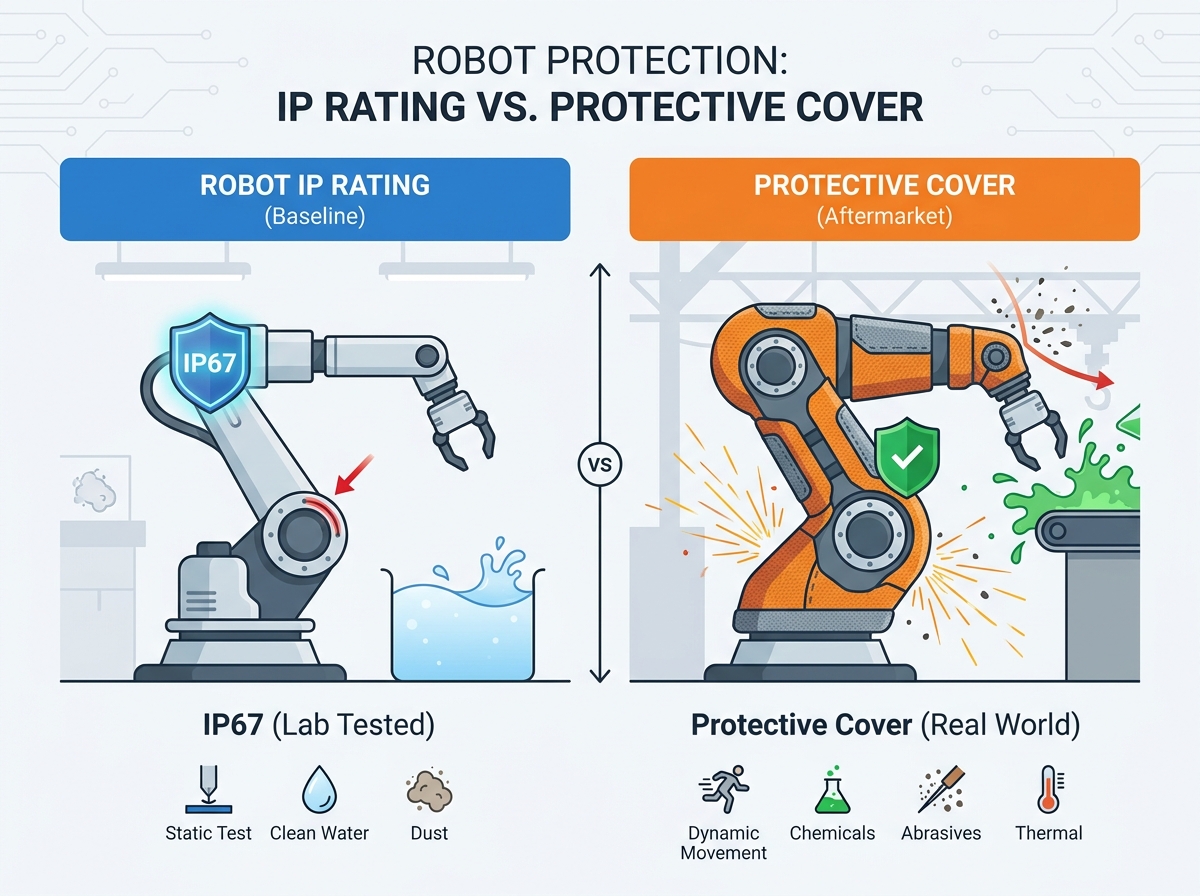
Factory seals face massive challenges on the factory floor. Chemical incompatibility represents a major blind spot. Standard robot gaskets rely on nitrile or synthetic rubber. These materials degrade rapidly upon exposure to synthetic CNC coolants. Hydraulic oils and aggressive cleaning agents also break them down. The rubber absorbs the chemicals. The seals swell, crack, and eventually crumble.
Abrasive particulate creates another severe mechanical hazard. Micro-abrasives include foundry sand, fiberglass, and cast iron dust. These tiny particles act exactly like sandpaper on moving joint seals. Over time, they carve microscopic grooves directly into the rubber. Proper industrial robot dust protection becomes absolutely vital here. Without external barriers, abrasive dust quickly penetrates the mechanical joints. It contaminates the grease and destroys the internal gearing.
Thermal shock also compromises native ratings significantly. Extreme ambient heat expands the internal air pressure of the robot arm. When the arm cools rapidly between shifts, internal pressure drops. This sudden drop pulls moist external air inside the casting. This causes severe internal condensation. An exterior IP rating cannot prevent this internal moisture buildup. Water droplets form directly on the sensitive circuit boards.
Finally, high-pressure washdowns defeat standard seals. An IP67 rating implies safe submersion in calm water. However, sanitation crews use focused, high-temperature, high-pressure washdowns. These IP69K environments physically strip paint off the metal. The intense pressure easily forces water past standard IP67 seals over time. The seals simply cannot withstand the mechanical force of the water jet.
When native seals fall short, aftermarket solutions step in. We define this solution category as custom-engineered physical barriers. These include full robotic suits, protective jackets, and flexible bellows. Manufacturers craft them from highly specialized technical textiles. Common materials include Kevlar, aluminized fiberglass, and heavy-duty PTFE.
These barriers provide targeted hazard mitigation for specific industrial applications.
Chemical & Fluid Deflection: The fabric acts as an impenetrable umbrella. It sheds corrosive coolants and sticky oils. The fluids bounce off before they ever reach the physical joints.
Thermal Insulation: Aluminized fabrics provide excellent radiant heat protection. They reflect extreme temperatures away from sensitive internal electronics. This keeps the internal servo motors running smoothly.
Air-Purged Systems: Advanced suits utilize external air supply lines. This airflow creates constant positive internal pressure inside the suit. The pressure actively pushes dust and moisture outward away from the robot.
Always specify the exact chemical exposure when ordering a cover. A fabric designed for extreme heat might dissolve if exposed to synthetic cutting fluids. You must match the textile chemistry to your specific factory environment. Consult material compatibility charts before making a purchase. Avoid generic fabrics in highly corrosive work cells.
Engineers must constantly weigh native seals against external barriers. A direct robot IP rating vs protective cover comparison reveals distinct operational strengths. You must understand these differences for different application scenarios.
Let's look at Evaluation Dimension 1: Environmental Match. You should rely on the native IP rating when the environment involves dry, non-abrasive dust. It works well for occasional clean water splashing. It also suits standard ambient temperatures. Standard packaging and palletizing applications fit this profile perfectly. Conversely, you must add a protective cover for aggressive applications. These include flying hot sparks, harsh chemical washdowns, sticky paint overspray, or heavy metal machining.
Evaluation Dimension 2 covers Maintenance & Scalability. Native IP ratings require zero daily maintenance. You just wipe them down occasionally. However, they carry a catastrophic failure risk. If a primary seal breaks unobserved, the motor dies abruptly. Production halts completely. Protective covers require periodic visual inspection. They act as a consumable maintenance part. They also provide a highly visible failsafe. Operators can easily see if a fabric cover rips. You can fix it before the robot suffers internal damage.
Evaluation Dimension 3 compares CapEx and OpEx models. Upgrading to an OEM "Foundry Grade" robot carries a very high initial capital expense. Buying a standard IP54 robot and adding a high-end protective cover lowers your initial CapEx significantly. It does add a recurring operational expense for replacement covers. However, this strategy shifts maintenance tasks to external, easily accessible components. It preserves the expensive internal hardware.
Table: Protection Strategy Comparison
Evaluation Dimension | Native IP Rating Reliance | Protective Cover Addition |
|---|---|---|
Environmental Fit | Light dust, clean water, ambient temp. | Abrasives, chemicals, extreme heat. |
Maintenance Style | Zero daily effort, high catastrophic risk. | Routine inspection, clear visual failsafe. |
Resource Allocation | High upfront equipment cost. | Lower upfront, manageable recurring cost. |
While highly effective, protective fabrics introduce new variables into the robot cell. Heat retention stands out as the primary operational risk. Thick protective covers act as strong thermal insulators. They trap heat generated naturally by the moving servo motors. You must actively manage the risk of servo motor overheating. Often, you will need to route cold air-cooling lines directly inside the suit. This maintains safe operating temperatures during continuous production shifts.
Payload and articulation restrictions also require careful attention. Thick, multi-layered protective fabrics restrict extreme joint articulation. They physically resist tight bending. They also add physical weight to the end of the arm. You must factor this added mass into the robot's overall payload calculations. Failing to do so can cause axis overload faults. It can also reduce the operational lifespan of the gearing.
Finally, you must evaluate snag hazards. Poorly tailored or "one-size-fits-all" covers present major physical dangers. Excess baggy fabric can easily catch on end-of-arm tooling (EOAT). It can also snag on surrounding cell infrastructure. This includes safety fences, welding fixtures, or conveyor belts. Custom 3D tailoring prevents these dangerous interferences. It ensures the fabric hugs the arm tightly during complex motion paths.
Follow this systematic logic to choose your optimal protection strategy. It removes guesswork from the engineering process.
Audit the Contaminants: Identify the exact chemicals, fluid temperatures, and particulate types active in the cell. Do not rely on generic material safety data sheets. Measure the exact temperature of the fluids hitting the robot. Collect physical samples of the dust.
Check OEM Warranty Terms: Review your purchasing documentation carefully. Does the manufacturer cover coolant damage under their standard IP67 warranty? Often, they explicitly exclude chemical fluid ingress. They only cover clean water damage. This leaves you financially responsible for chemical failures.
Assess Downtime Impacts: Compare the labor effort required for different repair scenarios. Swapping an external suit during scheduled maintenance takes just a few minutes. Tearing down a robot to replace an internal joint seal takes days. Calculate lost production volume. Choose the strategy that maximizes machine uptime.
Many buyers assume higher IP ratings solve all environmental problems. They purchase IP67 robots for heavy machining cells. They ignore the chemical makeup of the cutting fluids. The fluids melt the seals within months. Always separate liquid resistance from chemical compatibility during your evaluation.
A robot's native IP rating measures baseline laboratory endurance. It does not provide an absolute guarantee against harsh industrial realities. Dynamic motion stretches seals. Abrasive dust grinds down rubber. Aggressive chemicals dissolve synthetic gaskets. These factors break down factory seals much faster than lab tests suggest. We highly recommend treating native IP ratings as your last line of defense. You should deploy customized protective covers as your primary, first line of defense in aggressive environments. This layered approach ensures maximum reliability.
Take immediate action to protect your automation investments. Audit your specific manufacturing environment today. Document every chemical and abrasive present in the cell. Consult an experienced application engineer. They can design a specialized protective strategy perfectly matched to your unique production risks. Proactive protection eliminates reactive maintenance nightmares.
A: No, proper installation rarely voids the warranty. In fact, many manufacturers encourage external covers for harsh environments. However, you must manage heat retention. If the cover causes the servo motors to overheat, the resulting thermal damage might void warranty claims. Always follow OEM cooling guidelines.
A: You cannot retroactively upgrade a robot's native factory IP rating. The internal seals and mechanical tolerances are set during manufacturing. Aftermarket protective covers remain the only viable post-purchase solution to increase environmental resistance.
A: An IP67 robot is not entirely waterproof. The IEC standard tests submersion in clean water up to one meter for 30 minutes. It does not account for pressurized industrial fluids, synthetic coolants, or extended submersion times commonly found in factory washdowns.
A: Replacement frequency depends heavily on application severity. In heavy machining or foundry environments with sparks and sharp shavings, expect to replace covers every six months. In light dust or dry packaging applications, high-quality covers can easily last two or more years.


