
T: +86-21-55896873
E: info@youguard.cn
E: info@youguard.cn
8th Floor, Building 3, 999 Jiangyue Road, Minhang District, Shanghai
Views: 0 Author: Site Editor Publish Time: 2026-11-14 Origin: Site


Automated paint lines operate in a highly volatile, high-stakes environment. A single material failure on a robotic arm can completely halt production lines. It can contaminate entire paint supply systems or create severe factory safety hazards. Selecting protective gear based purely on physical fit falls dangerously short of industrial requirements. Paint shops require rigorous chemical compatibility evaluation. You must prevent rapid degradation from aggressive solvents and harsh cleaning agents.
This guide provides a technical, evidence-based framework for evaluating paint shop materials. We will explore how to test, analyze, and specify protective fabrics accurately. You will learn to deploy specialized solutions that survive your specific chemical environment without introducing costly surface defects.
Compatibility must be evaluated against both the applied coatings and the aggressive purge/cleaning solvents used during maintenance.
"Silicone-free" and "lint-free" are absolute prerequisites; chemical resistance is useless if the cover's material matrix degrades and introduces surface defects (e.g., cratering or fisheyes).
Testing requires analyzing both chemical permeation (breakthrough time) and material degradation (loss of physical integrity) over standard operational cycles.
Procurement should mandate Safety Data Sheet (SDS) cross-referencing and ATEX/ESD compliance documentation from suppliers.
Industrial paint lines punish materials relentlessly. When you deploy incompatible fabrics, you face immediate and severe consequences. The polymers break down rapidly under extreme solvent stress. Understanding these hidden failures helps engineers justify better material investments.
Premature degradation acts as the first warning sign. Incompatible materials quickly become brittle. They swell, crack, or dissolve completely upon chemical contact. This causes frequent replacement cycles. It leads to unpredictable downtime on the production line. Maintenance teams spend hours swapping out ruined gear instead of performing vital preventative maintenance on the robots themselves.
Contamination risks compound the problem significantly. Chemical breakdown releases micro-particulates into the sterile spray environment. Worse, incompatible solvents extract plasticizers from cheap covers. These chemical leachates float into the paint mist. This causes devastating paint defects like fisheyes, cratering, and seediness. Reworking these defects wastes valuable production hours. You lose thousands of dollars per scrapped chassis or industrial component.
Safety hazards present the most critical risk. High volatile environments require strict electrostatic discharge (ESD) control. Compromised ESD properties are incredibly dangerous. Incompatible solvents can easily strip away a cover's superficial antistatic coating. Once this coating washes off, static electricity builds up rapidly on the fabric surface. This creates a severe explosion hazard in vapor-rich environments.
Engineers must map the entire chemical landscape meticulously. Compile a master list of all chemicals the robot will encounter daily. Robots face continuous airborne paint mists. They take direct liquid splashes from faulty spray nozzles. They endure aggressive manual wipe-downs. You must account for every single exposure type.
Evaluate material resistance against common high-strength aggressive purge solvents. These include Methyl Ethyl Ketone (MEK), Acetone, Xylene, Toluene, and Isopropyl Alcohol (IPA). These solvents are highly reactive by design. They destroy weak plastics and standard commercial polyurethanes almost instantly.
You must also evaluate water-based versus solvent-based coatings. Water-based paints boast much lower volatile organic compounds (VOCs). However, they remain highly alkaline. Their specific co-solvents and amines can degrade certain polymers slowly over time. Do not underestimate water-based systems. They often cause insidious, long-term material failure if the base fabric lacks alkaline resistance.
Understanding specific cleaning protocols is equally vital. Differentiate between continuous low-level exposure and high-concentration events. Overspray provides low-level, continuous exposure. Conversely, scheduled maintenance involves high-concentration, high-friction exposure. Maintenance crews rely on potent paint shop robot cleaning chemicals to scrub off heavily cured paint. The mechanical friction combined with these chemicals accelerates material breakdown exponentially.
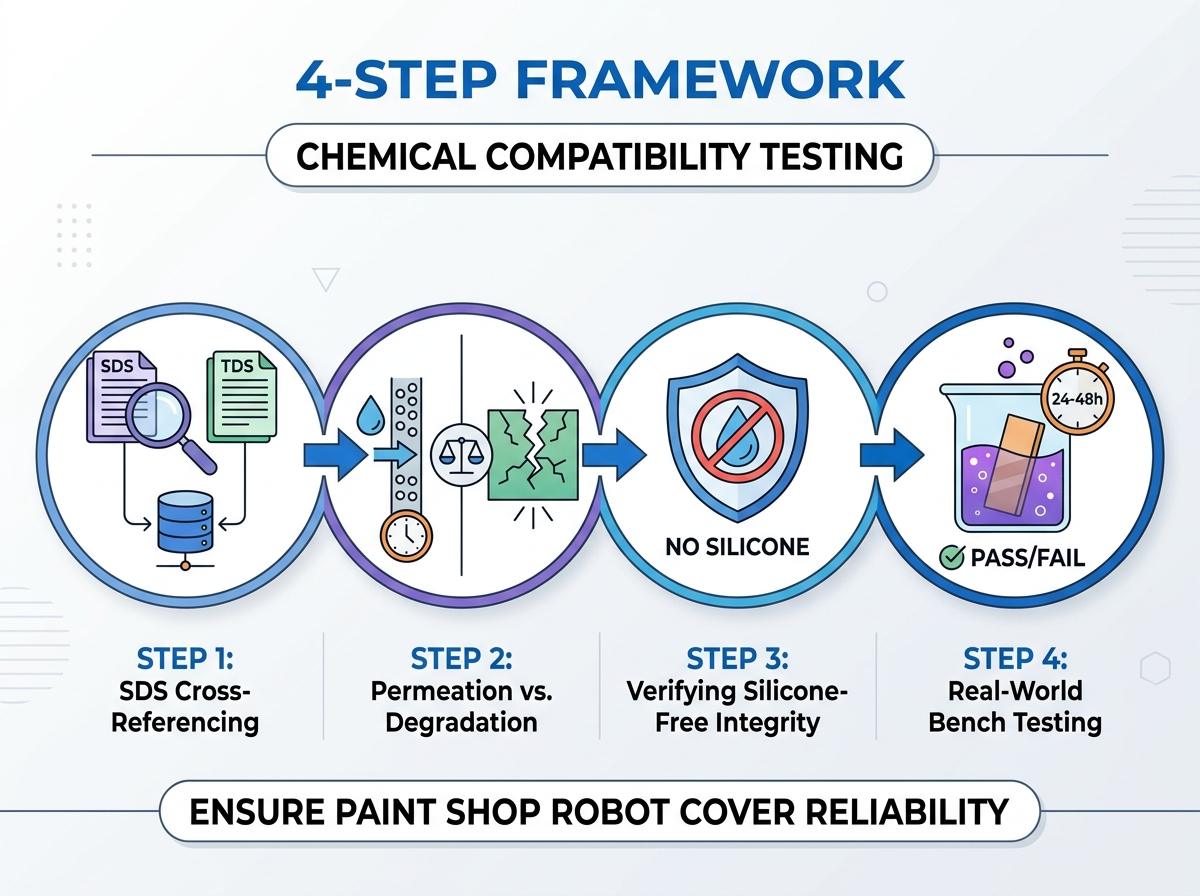
Do not rely on generic labels from standard suppliers. You need a structured, empirical testing framework. Use these four steps to guarantee true chemical compatibility in your facility.
Map the specific chemical compounds in your paint and solvents. Pull your facility's internal Safety Data Sheets (SDS). Compare these specific chemicals against the manufacturer’s technical data sheets (TDS) for the cover fabric. Look for known polymer incompatibilities. If your primary solvent contains heavy ketones, immediately rule out basic PVC materials.
You must evaluate both permeation rate and physical degradation. Permeation measures how fast a chemical passes completely through the material on a molecular level. Industry standards like ASTM F739 help measure this breakthrough time. Degradation measures how the chemical alters the material's physical properties. Does it lose tensile strength? Does it lose flexibility? A material might stop permeation but become so stiff it cracks when the robot moves.
Ensure the manufacturer achieves chemical resistance without using silicone-based treatments. Silicone is absolutely fatal to automotive and industrial paint adhesion. Even microscopic silicone transfer alters surface tension. This causes massive cratering across the painted chassis. Only specify verified, inherently silicone-free materials for your chemical resistant robot protective covers.
Advocate strongly for localized patch testing inside your facility.
Obtain large material swatches from your shortlisted suppliers.
Soak the samples in your exact purge solvents for 24-48 hours.
Remove the samples and subject them to mechanical friction (rubbing).
Test for layer delamination, color bleed, or structural weakening.
Choosing the right base polymer dictates your operational success. Different materials offer vastly different resistance profiles. You must match the fabric to the specific chemical load.
PTFE and fluoropolymers offer near-universal chemical resistance. They possess excellent inherent non-stick properties. Paint overspray simply peels off them once cured. This makes them a premium standard for heavy solvent environments. They handle almost any aggressive purge solvent without degrading or stiffening.
Specialty coated fabrics present a strong, flexible alternative. High-grade, chemically cross-linked Polyurethane (PU) coatings work exceptionally well on dynamic robot axes. They handle moderate-to-heavy chemical exposure effectively. They balance material cost and robotic flexibility beautifully. Always ensure the PU is highly cross-linked. Standard commercial grade PU will melt upon contact with MEK.
Aramid and Kevlar blends serve a specific, demanding niche. Note their use when high-temperature baking overlaps with chemical exposure. They also handle extreme mechanical abrasion from nearby tooling while maintaining decent chemical resistance.
Finally, understand the laminate trade-off. Multi-layer laminates offer superior barrier protection against permeation. However, buyers must ensure the internal adhesives are equally robust. If the adhesives binding the layers cannot resist permeating solvents, the layers will quickly peel apart. Specify well-engineered solvent resistant robot covers that fuse layers thermally rather than relying on weak chemical adhesives.
Material Selection Matrix for Paint Shop Environments
Polymer Material Type | Ketone (MEK) Resistance | Alkaline (Water-Based) Resistance | Flexibility & Articulation |
|---|---|---|---|
PTFE / Fluoropolymer | Excellent | Excellent | Low to Moderate |
Cross-Linked PU | Good | Excellent | High |
Standard Commercial PVC | Poor (Will Melt) | Good | Moderate |
Aramid / Kevlar Blends | Moderate | Good | Low |
Chemical compatibility represents only half the equation in a paint shop. You must balance it perfectly with strict electrical safety standards.
The compliance overlap is non-negotiable. Protective covers operating in Zone 1 or Zone 2 paint shops must be inherently antistatic. A tiny spark from static discharge will ignite aerosolized solvent vapors instantly. You cannot sacrifice electrical conductivity to gain a stronger chemical barrier. They must coexist seamlessly.
We strongly warn against covers that rely on topical antistatic sprays. Harsh cleaning solvents will quickly strip these temporary treatments away during routine wiping. Once the spray washes off, it renders the cover a massive, undetectable explosion hazard. The material matrix itself must contain conductive carbon threads. It must feature inherent, permanent dissipative properties.
Verification remains your best defense. Recommend requesting third-party ATEX certification from your supplier. Demand official documentation showing the material retains its exact surface resistivity ratings. It must pass these electrical tests even after repeated, long-term chemical exposure.
Procurement requires precise, uncompromising specifications. Do not let vendors dictate terms without proving their engineering capabilities thoroughly.
Custom fit versus articulation remains a primary engineering concern. Ensure the supplier calculates material shrinkage accurately. Some synthetic fabrics stiffen considerably post-chemical exposure. The supplier must pattern the suit to maintain the robot's full range of motion. It must function perfectly even if the material hardens slightly over a rigorous six-month cycle.
Demand strict proof of claims from all vendors. Ask for detailed case studies from similar automotive or aerospace paint lines. Request independent lab test results showing permeation breakthroughs. Always secure material samples for your internal chemical compatibility trials prior to placing bulk orders.
Common procurement mistakes to avoid include:
Ignoring the chemical composition of the Velcro or zippers.
Failing to test the specific thread used in the stitching.
Assuming "waterproof" implies "solvent-proof."
Finally, check seam and closure integrity closely. Remind your buyers to verify zippers, Velcro strips, and sealed seams. These critical components must share the identical chemical resistance profile as the primary base fabric. A high-grade PTFE fabric is completely useless if the aggressive solvent melts the nylon zipper in three days.
Chemical compatibility acts as a strict, binary requirement in modern automated paint shops. Protective materials either withstand the specific solvent matrix, or they fail completely. When they fail, they introduce unacceptable risks to your production quality and facility safety. They cause defects, trigger downtime, and create severe ESD hazards.
Operators must take immediate, proactive steps to audit their current solutions. Request material samples from your shortlisted vendors today. Initiate an in-house solvent soak test alongside a comprehensive SDS review. Protect your expensive automated assets with scientifically proven, highly resilient barrier solutions. Your production line efficiency depends entirely on making the right material choice.
A: A high-quality cover should last between three to six months in heavy solvent environments. Lifespan depends heavily on cleaning frequency, mechanical friction during maintenance, and the aggressiveness of the purge solvents. Highly tailored PTFE covers can occasionally last up to a year under moderate exposure.
A: No. Chemical inertness does not equal electrical safety. A material can perfectly resist MEK but act as a dangerous electrical insulator. ATEX zones require materials that are both chemically resistant and inherently antistatic to prevent deadly solvent vapor explosions.
A: Industrial washing is rarely recommended for paint covers. Heavy laundering combined with industrial detergents degrades inherent antistatic properties and damages internal barrier laminates. Manual solvent wipe-downs in place remain the safest and most effective maintenance protocol.
A: Your cover likely contains silicone treatments or cheap plasticizers. When exposed to solvents, these incompatible chemicals leach out and become airborne. They land on the unpainted chassis, altering surface tension and causing severe fisheyes or cratering. Always specify strictly silicone-free materials.


