
English 
T: +86-21-55896873
E: info@youguard.cn
E: info@youguard.cn
8th Floor, Building 3, 999 Jiangyue Road, Minhang District, Shanghai
Views: 0 Author: Site Editor Publish Time: 2026-09-29 Origin: Site


Modern logistics rely heavily on automated systems moving at breakneck speeds. However, cable failure on multi-axis robots consistently causes major headaches. It remains a leading culprit behind unplanned downtime in high-throughput warehouses today.
Operating relentlessly, repetitive palletizing tasks put immense stress on external routing systems. Exposed wires face constant snag risks and rapid mechanical degradation. You must shift from reactive maintenance to proactive cable management to avoid disastrous operational halts.
This article provides a robust technical and commercial framework for evaluating your options. We explore how to balance initial integration costs against long-term reliability. By reading further, you will discover exactly how to implement effective safeguards for your robotic fleet.
Palletizing applications require specialized multi-axis cable management due to extreme Axis 6 rotation and continuous high-speed cycling.
Not all robot protection solutions are equal; material friction, bend radius limits, and retraction mechanisms define system longevity.
Proper integration and strain relief are as critical as the cover itself—poorly installed covers can accelerate internal cable wear.
Warehouse managers often underestimate the financial impact of poor cable routing. Snags cause immediate production stops and require manual intervention. Jacket abrasion wears down insulation over time. Core fatigue eventually breaks the internal copper strands completely. In a relentless 24/7 environment, these failures compound rapidly. Every minute of unexpected downtime drains profitability. Frequent custom replacement orders drain maintenance budgets.
Robotic palletizers feature exceptionally wide operational envelopes. They must reach across large areas rapidly and repeatedly. Aggressive acceleration and sudden deceleration place immense torsional stress on external wires. Traditional static routing methods cannot handle these dynamic forces. When a massive robotic arm pivots sharply, unsecured wires whip outward violently. This whipping action guarantees premature component failure.
Exposed lines also create significant safety and compliance risks. Collaborative robots (cobots) operate closely alongside human workers. Loose wires introduce dangerous snagging hazards into these shared workspaces. Tripping hazards or unpredictable robot movements violate strict industrial safety standards. Regulatory bodies penalize facilities failing to secure dynamic automation equipment properly. You must shield these components to maintain compliance.
Engineers have developed various robot protection solutions to address unique kinematic challenges. You need to match the specific housing type to your particular application. Understanding the differences prevents costly misapplications across your fleet.
Corrugated tubing serves well for basic, low-complexity routing. It provides excellent general protection against dust and minor impacts. Facilities use it frequently for linear, predictable movements. However, corrugated tubing has notable mechanical limitations. It remains highly prone to buckling under severe torsion. If not properly guided, ribbed hoses restrict multi-axis flexibility. They often collapse inward during aggressive articulation.
Robotic palletizers require highly engineered multi-axis energy chains. These systems manage complex three-dimensional movements effortlessly. They thrive in high-torsion environments where standard hoses fail. A primary advantage involves strictly controlled bend radii. They prevent users from bending wires past critical failure points. Compartmentalized interior separation prevents destructive cable-on-cable friction entirely. Individual dividers keep everything organized during rapid cycles.
Dynamic movements inherently generate excess slack during operation. Retraction systems actively manage this slack through spring-loaded mechanisms. They pull the housing back during inward movements. This action prevents looping safely and reliably. A tightly managed profile avoids snagging on peripheral warehouse structures. It also keeps the workspace clear around complex end-effectors. Pull-back mechanisms extend the lifespan of your external routing significantly.
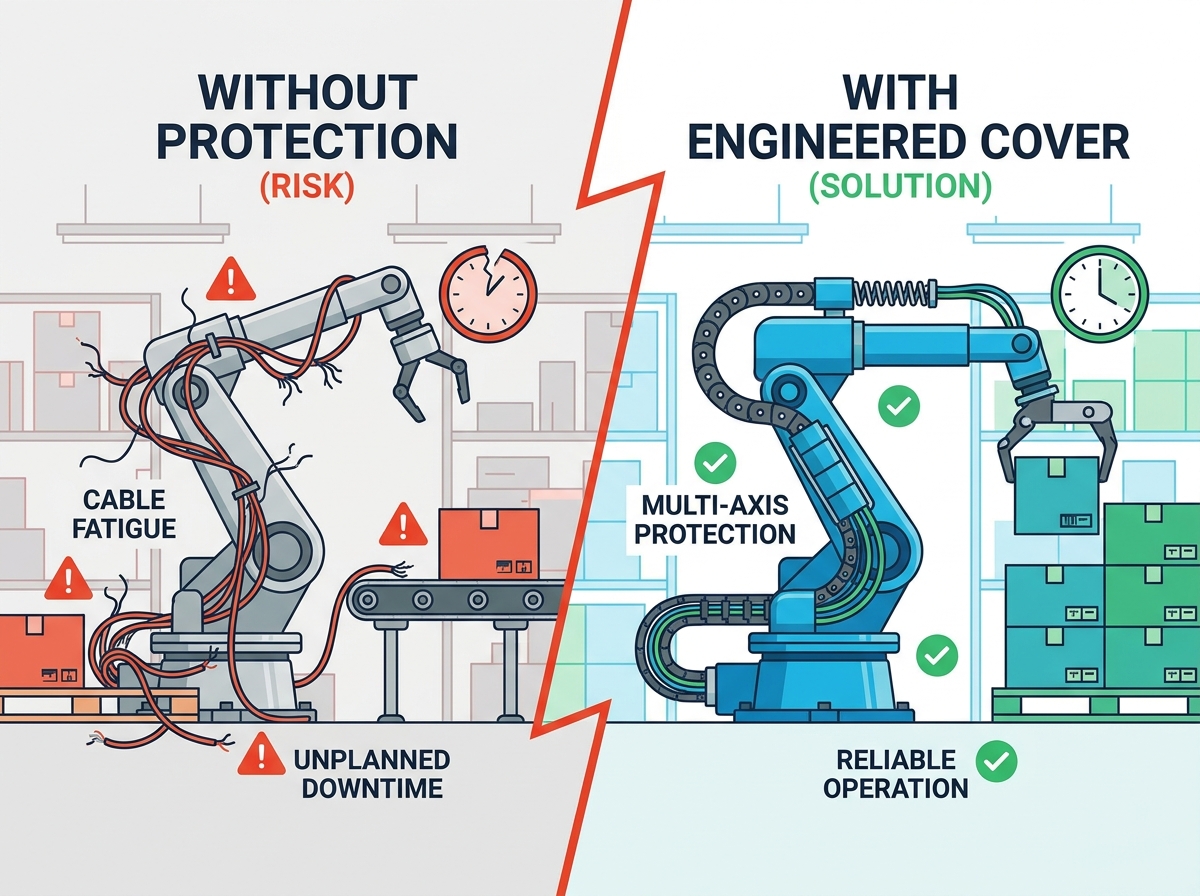
Choosing a reliable robot arm cable cover for warehouse robots demands strict engineering evaluation. You must look beyond basic marketing claims. A rigorous selection process ensures continuous operation.
You must evaluate flex-cycle ratings rigorously. Demand verifiable cycle-testing data from potential vendors. Do not accept generic durability claims without empirical backing. Manufacturers must test these components under realistic warehouse conditions. You need concrete numbers defining expected mechanical lifespan. Reliable systems often guarantee millions of cycles before failure.
Material science directly dictates abrasion resistance. You should evaluate specific polymer blends carefully. High-quality blends reduce internal surface friction significantly. They also resist abrasive warehouse dust accumulation effectively. If you operate food-grade facilities, verify material compliance strictly. Certain packaging standards require specialized, easy-to-clean polymer constructions.
Internal clearances must follow strict fill rules. Engineers recommend leaving ten to fifteen percent clearance inside the enclosure. This extra space prevents excessive internal thermal build-up. It also stops mechanical binding during complex multi-axis maneuvers. Housed components must glide freely inside their protective shell. Packing a tube too tightly guarantees rapid insulation degradation.
You must weigh the system against maximum payload limits. Calculate the total mass of your selected management assembly. Compare this figure against the maximum payload capacity. Heavy protective systems reduce available end-effector lifting capacity. Optimize material choices to maximize your robot's true lifting potential. Lighter polymer chains offer excellent strength without sacrificing payload.
Solution Category | Primary Application | Key Advantages | Major Limitations |
|---|---|---|---|
Corrugated Tubing | Linear movements, basic dust protection | Low initial cost, lightweight | Prone to buckling, poor multi-axis torsion handling |
Multi-Axis Energy Chains | Robotic palletizers, complex 3D rotation | Strict bend radius control, internal compartmentalization | Higher initial weight, requires careful payload calculation |
Retraction Systems | Managing dynamic slack at Axis 6 | Prevents snags on end-effectors, maintains tight profile | Requires additional mounting space, higher mechanical complexity |
Many warehouses operate large fleets lacking modern external protection. Upgrading these active machines introduces specific integration challenges. You need solutions tailored for minimal production interruption.
Discussing retrofit complexity reveals several engineering realities. Installing covers on existing warehouse robots often seems daunting initially. However, modern designs eliminate the need for full disconnections. Longitudinally split-tube designs snap over existing bundles instantly. Zip-open energy chains allow technicians to lay wires inside quickly. These innovations turn a massive overhaul into a brief maintenance task. Zero-downtime retrofits save thousands of dollars in lost production.
Engineers frequently face the risk of over-constraining. Anchoring covers too tightly creates a massive mechanical pitfall. This mistake shifts mechanical strain directly to sensitive connectors.
Tight anchors prevent necessary gliding during extreme arm extension.
Over-constraining forces connectors to absorb the entire twisting load.
Rigid mounting points frequently tear the outer protective jackets.
Lack of strain relief brackets guarantees eventual conductor separation.
Standardization across your facility provides immense operational value. Utilizing modular kits proves vastly superior to DIY zip-tie solutions. Improvised fixes fail unpredictably and look unprofessional. Modular systems ensure consistent, repeatable maintenance across an entire fleet. When every palletizer uses identical brackets, repair times drop drastically. Standardized parts inventory simplifies your overall warehouse management strategy.
Procurement teams often hesitate at the price of engineered systems. You must present a logical cost-to-outcome framework to justify the investment. Upfront costs pale compared to unpredictable operational losses.
Compare the upfront cost of engineered multi-axis covers against predictable failures. Unprotected systems guarantee custom replacement orders eventually. Replacing a complex multi-core harness costs significant money. Furthermore, the lost throughput during this repair period impacts revenue severely. Premium enclosures eliminate these unpredictable throughput losses entirely. They transform chaotic breakdowns into highly manageable, scheduled events.
Emphasize the importance of robust vendor support. Select vendors offering transparent supply chains globally. You need readily available replacement links and mounting brackets. A premium product matters little if spare parts require weeks to arrive. Quality vendors ship modular replacement sections overnight. This availability ensures your automated lines remain active consistently.
Advise your engineering team on proper shortlisting logic. Follow these precise steps to evaluate potential vendors efficiently:
Request detailed CAD models to verify mounting hole compatibility.
Review kinematic simulations to ensure smooth Axis 6 rotation.
Order a physical sample kit to assess polymer quality firsthand.
Run a pilot installation specifically on your highest-failure robotic node.
Monitor the pilot node for one month to verify friction reduction.
This logical approach removes guesswork from the purchasing decision. It proves the mechanical viability of the solution before facility-wide rollout.
Robust cable management constitutes a core component of robotic system architecture. You should never treat it as an aftermarket afterthought. Protecting your external routing ensures continuous, high-speed warehouse operations.
Modern solutions facilitate a critical shift in maintenance philosophy. They move facilities away from unpredictable downtime. They enable highly organized, scheduled preventative maintenance routines instead.
Treat external routing as a critical structural component.
Demand verifiable cycle-testing data before purchasing.
Utilize split-tube designs for rapid, zero-downtime retrofits.
Request a detailed engineering consultation for your specific facility.
Obtain a physical sample kit to test on your palletizing setups today.
A: The cover's radius must strictly exceed the minimum dynamic bend radius of the thickest cable housed inside. This strict clearance rule prevents internal conductor failure. It ensures the copper strands never bend past their mechanical yielding point during rapid articulation.
A: Yes, modern solutions allow seamless integration. You can utilize longitudinally slit corrugated tubes and snap-open energy chains. Manufacturers design these specific components for zero-downtime retrofits. Technicians simply press the existing wires into the housing without disconnecting any primary control terminals.
A: No. Properly engineered and tension-relieved systems never restrict kinematics. They accommodate the full operational envelope effortlessly. However, improperly sized DIY solutions frequently cause severe mechanical binding at axes 4, 5, and 6, which drastically reduces overall robotic speed.


