
English 
T: +86-21-55896873
E: info@youguard.cn
E: info@youguard.cn
8th Floor, Building 3, 999 Jiangyue Road, Minhang District, Shanghai
Views: 0 Author: Site Editor Publish Time: 2026-10-31 Origin: Site


Sourcing protective gear for robots in ESD-sensitive or ATEX zones leaves zero margin for error. A single electrostatic discharge event can instantly destroy thousands of dollars in microelectronics. Worse, it can ignite combustible vapors in volatile manufacturing environments.
Procurement teams often face a critical blind spot when evaluating these essential garments. You simply cannot verify dissipative properties through a quick visual check. Relying solely on unchecked vendor claims exposes your entire facility to severe safety hazards and catastrophic yield losses. The stakes require undeniable proof over mere marketing promises.
In this guide, we explore the exact validation metrics you must demand from suppliers before approving a purchase order. We will detail essential electrical property baselines, mechanical stress endurance tests, and lifecycle degradation audits. Read on to master the vendor documentation requirements needed to secure a fully compliant and safe robot fleet.
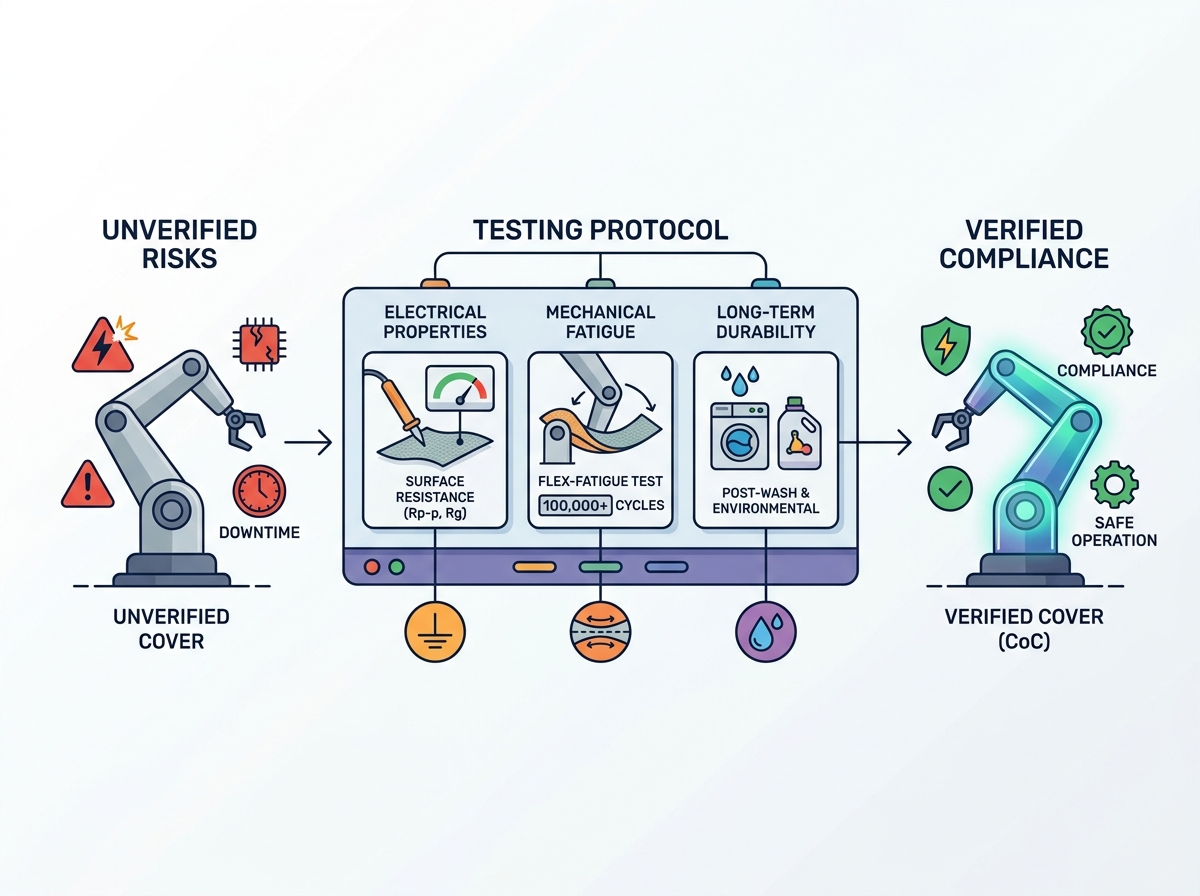
Validation requires both initial baseline testing and post-stress testing to ensure ESD properties survive continuous robotic articulation.
The primary metric for evaluation is the surface resistance of antistatic fabrics, measured according to standardized protocols (e.g., ANSI/ESD S20.20 or IEC 61340).
Comprehensive robot cover quality inspection must include mechanical flex-fatigue tests, as constant stretching can break the conductive grids within the fabric.
Legitimate vendors provide third-party Certificates of Conformity (CoC), not just internal marketing claims.
Operating industrial robots in explosive atmospheres or precision electronics lines requires immense caution. A robot moving continuously generates massive amounts of static electricity through friction. If the protective cover cannot bleed off this charge safely, the resulting arc becomes a severe liability.
Relying on vendor promises without requesting rigorous test data exposes facilities to massive hidden risks. Unverified covers frequently lead to fried electronic payloads during assembly. In combustible environments like paint or resin lines, a rogue spark can trigger devastating fires. These incidents cause prolonged, unplanned downtime. They halt production lines completely.
A qualified protective garment must predictably dissipate static charges across its entire exterior. It must do so without shedding particulate matter into cleanrooms. It also must never restrict the cobot or industrial robot’s axis limits. Designing a cover to meet these overlapping demands takes precise engineering.
We must view rigorous anti static robot cover testing as mandatory rather than optional. This validation is not just for basic quality assurance. It acts as the backbone for maintaining facility-wide ISO and ESD compliance certifications. External auditors will demand proof. If your protective gear lacks documented electrical validation, your facility risks losing its operational certifications entirely.
Electrical baseline testing provides the fundamental proof you need. It reveals exactly how a specific fabric safely bleeds off static electricity before a spark occurs. We rely on these metrics to predict performance on the factory floor.
The primary metric for validation is the surface resistance of antistatic fabrics. Engineers measure this resistance under controlled laboratory conditions using standardized ohmic protocols. We primarily look at two specific resistance pathways:
Point-to-Point Resistance (Rp-p): Testers place two electrodes on different areas of the cover. This measures the resistance between these points. It proves the woven conductive grid remains entirely contiguous across the fabric surface.
Resistance to Ground (Rg): This verifies the electrical pathway from the exterior fabric surface down to the robot’s dedicated grounding point. It ensures the charge actually leaves the system safely.
Understanding acceptable ohmic ranges is crucial for procurement teams. Materials typically require a resistance between $10^5$ and $10^9$ ohms to be classified as static dissipative. If a material falls below $10^4$ ohms, it becomes too conductive. Highly conductive materials drain charges too rapidly, which creates an unacceptable hard spark risk. Conversely, materials above $10^{11}$ ohms act as insulators. Insulators trap static charges on the surface until they arc unpredictably.
Table: Electrical Resistance Classifications and Safety Implications
Resistance Range (Ohms) | Classification | Performance Outcome | Safety Verdict for Robots |
|---|---|---|---|
Less than $10^4$ | Conductive | Drains charge instantly | High arc/spark risk. Not recommended. |
$10^5$ to $10^9$ | Dissipative | Releases charge slowly and safely | Ideal and compliant. |
$10^{10}$ to $10^{11}$ | Anti-Static (Marginal) | Slow, unpredictable drainage | Borderline. Requires frequent re-testing. |
Greater than $10^{11}$ | Insulative | Traps charge on surface | Dangerous. High risk of catastrophic discharge. |
Beyond surface resistance, buyers must request triboelectric charge generation data. As a robot moves, the fabric rubs against the metal chassis and internal cabling. This friction generates voltage. Laboratory tests must show exactly how much voltage the fabric generates during this movement. Superior fabrics generate minimal triboelectric charges natively, reducing the overall burden on the grounding path.
Implementation realities on the factory floor look very different from controlled laboratory settings. Robots move continuously across multiple axes. A successful static test on a flat, pristine piece of fabric does not reflect daily operational realities.
A robust robot cover quality inspection evaluates how fabrics endure relentless stretching. Buyers should demand flex-fatigue testing data. You need to know how the fabric's conductivity holds up after 100,000 or more articulation cycles. Constant bending easily fractures delicate carbon threads. It can also crack superficial conductive coatings applied to cheap materials. Once the grid breaks, the fabric develops dead zones where static accumulates dangerously.
Tensile strength and seam integrity play a massive role here. Quality inspection protocols must include rigorous seam testing. Seams represent the most common failure point for protective garments. They fail mechanically through tearing. They also fail electrically if the manufacturer uses non-conductive stitching threads. If the thread does not carry the charge across the seam, the protective grid breaks.
Extreme applications demand even higher mechanical endurance. Consider robots working in die-casting cells or near heated resin tanks. These environments expose covers to intense friction and ambient heat. Procurement teams must request data showing how the fabric handles friction-induced heat. Inferior materials will melt their internal conductive matrix when exposed to continuous rubbing. High-quality covers maintain structural and electrical integrity even under significant thermal stress.
Common Mistakes to Avoid: Do not accept mechanical strength data that ignores electrical continuity. A fabric might survive 200,000 flex cycles without tearing physically, but its internal carbon grid might shatter entirely after just 10,000 cycles. Always request post-flex electrical resistance data.
Facility managers face significant adoption risks when selecting budget-tier protective covers. Many low-cost options rely on topical anti-static chemical treatments. Manufacturers spray or dip the fabric in these solutions to pass initial tests. However, they lack inherently woven conductive fibers.
Topical treatments wash off quickly. They also evaporate over time. When evaluating long-term viability, buyers must request comprehensive post-wash resistance testing data. Ask vendors for surface resistance readings taken strictly *after* 5, 10, and 20 industrial wash cycles. If the resistance spikes into the insulative range after three washes, you have purchased a disposable product.
Environmental degradation adds another layer of complexity. Factories expose these fabrics to harsh airborne chemicals. We must understand how this exposure alters performance. You should audit how the cover responds to:
Chemical Solvents: Exposure to cleaning agents can strip protective outer layers.
Cutting Fluids: Airborne oil mist can coat the fabric, creating an insulative barrier over the conductive grid.
Resin Overspray: Sticky particulates can bind to the fibers, hardening the material and accelerating mechanical fatigue.
How do these elements impact the anti-static properties over a standard 6- to 12-month lifecycle? Trustworthy vendors address this directly. They operate with transparent assumptions. They acknowledge that all protective covers eventually degrade due to mechanical and chemical wear. Legitimate suppliers provide expected lifecycle data curves. They will never claim to offer "lifetime" anti-static properties in a heavy industrial setting.
Procurement teams need a reliable vendor assessment framework. You must separate legitimate manufacturers who engineer their own textiles from white-label resellers who merely import standard covers. Proper documentation eliminates the guesswork.
Do not accept internal quality assurance stamps as definitive proof. Internal marketing claims hold no weight during safety audits. Build a strict required documentation checklist for all potential suppliers.
Third-Party Laboratory Reports: Demand test results from independent, accredited testing facilities. These reports must reference specific standards like ANSI/ESD S20.20.
Certificate of Conformity (CoC): Require a CoC for every specific batch or lot you purchase. This ensures the production run matches the initial prototype testing.
Material Safety Data Sheets (MSDS) and Technical Data: These documents must detail the exact composition of the conductive grid. They confirm whether the protection is inherently woven or merely topical.
Once a vendor passes the documentation phase, move to pilot testing. This is a critical next-step action. Order a single cover for a 30-day facility stress test. Install it on your most active robot.
Audit this pilot cover diligently. Use an in-house calibrated megohmmeter to measure surface resistance on day one. Run the robot normally for 30 days. Remove the cover, launder it according to the manufacturer's instructions, and test it again. Compare the post-pilot ohmic readings to the baseline. Only scale the purchase to your entire fleet if the post-stress numbers remain within the safe dissipative range.
Verifying the safety of anti-static covers requires looking far past the initial specification sheet. Procurement teams must demand undeniable proof of both mechanical endurance and electrical durability. Without this data, you expose your facility to catastrophic risks.
Always establish an electrical baseline using standard surface resistance metrics.
Insist on flex-fatigue data to prove the conductive grid survives robotic articulation.
Verify that performance persists through multiple industrial wash cycles.
Reject vendors who cannot supply independent, third-party laboratory certifications.
Take immediate action on your next procurement cycle. Reach out to your current or prospective vendors with a specific request for their "post-stress surface resistance data." This simple request will immediately weed out unqualified suppliers and protect your automated production lines.
A: Perform a baseline test upon initial delivery. Follow this with periodic checks, typically on a quarterly basis. You must also test the cover immediately after any industrial laundering. Always use a calibrated surface resistance meter for these in-house audits.
A: They differ by ohmic ranges. Conductive materials (under $10^4$ ohms) drain charges instantly, creating an arc risk. Dissipative materials ($10^5$ to $10^9$ ohms) offer a slower, controlled charge release. Dissipative is always preferred over highly conductive to ensure optimal robot protection.
A: Yes. Micro-fractures in internal carbon threads frequently occur during movement. Additionally, the evaporation of topical chemical dips easily renders a cover insulative. The garment might visually appear pristine while entirely lacking protection. This is why electrical testing remains mandatory.


