
English 
T: +86-21-55896873
E: info@youguard.cn
E: info@youguard.cn
8th Floor, Building 3, 999 Jiangyue Road, Minhang District, Shanghai
Views: 0 Author: Site Editor Publish Time: 2026-10-26 Origin: Site


In extreme manufacturing environments like heavy machining and automated painting, the weakest link in robot protection is rarely the base fabric. It is almost always the seams and closures. When a protective suit fails, it usually happens at these critical junction points. Penetration by abrasive swarf or atomized paint solvents typically occurs exactly where different fabric panels meet.
Evaluating these closures is absolutely critical for long-term operational success. Strong seams prevent catastrophic joint failure inside the mechanical arm. They directly reduce Mean Time Between Failures (MTBF). Reliable closures also help facilities avoid highly costly unscheduled downtime. Without proper structural integrity, even the most advanced technical fabrics become useless.
We need to take a purely objective look at how you specify these closure mechanisms and structural seams. You will learn how to evaluate different manufacturing techniques properly. We will explore how to balance the need for absolute containment with the practical realities of everyday maintenance accessibility.
Robot cover seam design dictates the true ingress protection (IP) limits of a protective suit in high-particulate environments.
Sealed robot protective covers offer superior chemical and dust resistance but introduce thermal management challenges for servo motors.
Removable robot covers require specific closure redundancies (e.g., overlapping storm flaps over zippers) to prevent particle bridging during dynamic kinematic movements.
Standard static containment fails when applied to industrial automation. A 6-axis robot moves dynamically through complex, programmed tool paths. This constant range of motion aggressively stresses both stitched and welded joints. When fabrics fold, stretch, and compress thousands of times per shift, the physical joints weaken. This repetitive stress eventually leads to micro-tears in the material. Once micro-tears form, capillary action easily pulls coolants and fine liquids directly into the internal motors.
You must also account for specific contaminant behavior. Different manufacturing debris attacks closures in entirely different ways.
Abrasive Dust and Swarf: Metallic shavings and cast-iron dust show a strong propensity to accumulate. They pack tightly into exposed zipper teeth. They also bind to the tiny fibers of hook-and-loop fasteners. This dangerous buildup compromises the physical seal over time, forcing closures to separate during fast robot movements.
Atomized Paint and Solvents: Chemical sprays do not just sit on the surface. They possess the chemical ability to degrade standard adhesives. Atomized solvents will quickly dissolve untreated threading, causing full structural failure within days.
Engineers must define strict success criteria before specifying any protective suit. You need to define acceptable leakage rates for your specific environment. You must also determine the required lifespan under continuous operation. Finally, consider the human element. Establish the maximum allowable installation and removal time for maintenance crews. Balancing these three variables is the core engineering challenge.
Best Practice: Always request articulation testing data. Do not accept static IP ratings. You need proof the seams hold under continuous dynamic flexing.
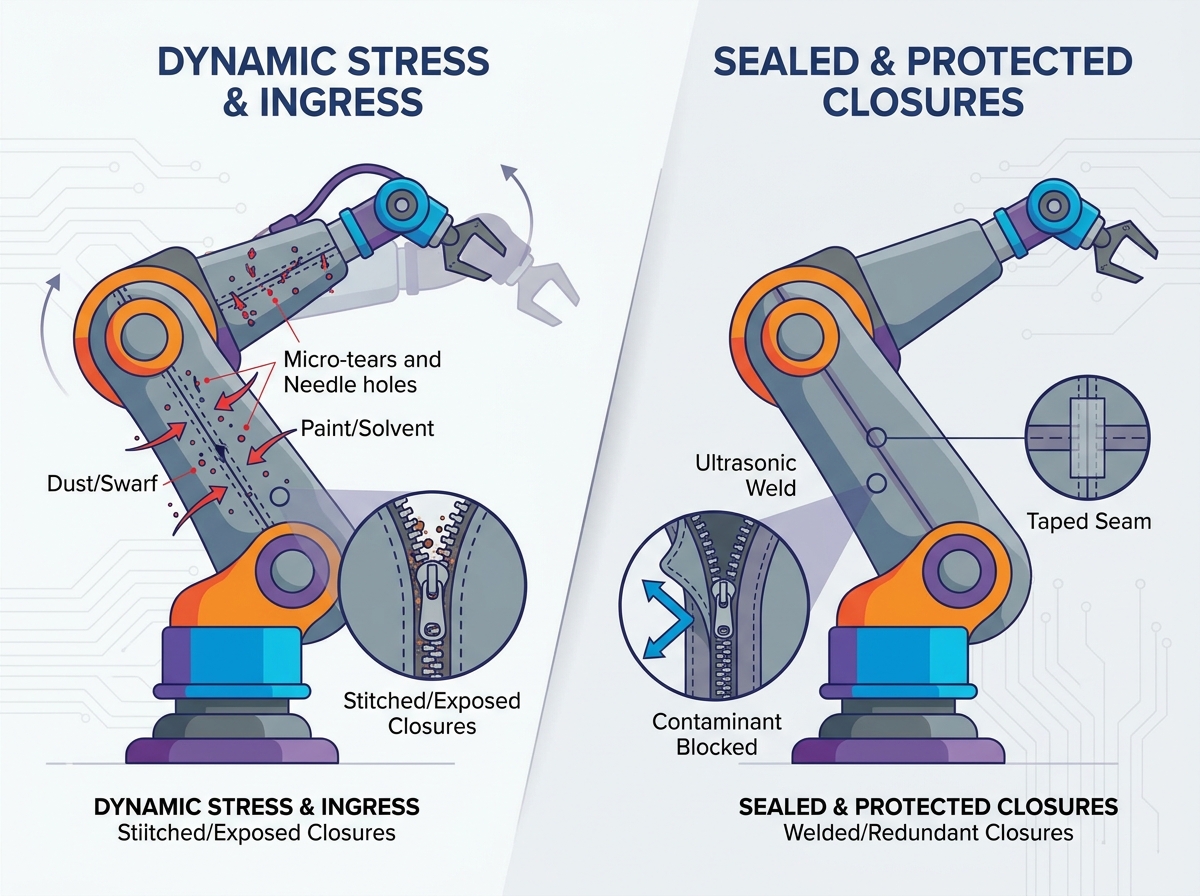
When environmental conditions demand absolute isolation, manufacturers turn to permanent seam constructions. Understanding how these joints are built helps you predict their failure modes on the factory floor.
Welding provides the highest level of structural integrity. The mechanism works by fusing thermoplastic materials together at the molecular level. This process entirely eliminates the need for needle punctures. Without needle holes, liquids cannot find an entry path. This use case is absolutely essential for automated paint lines. It is equally critical in wet-machining environments where heavy fluid pooling occurs on top of the robot arm.
Another common method involves applying a chemical-resistant barrier tape directly over structural stitches. The mechanism relies on heavy-duty adhesives to lock the tape down. However, taped seams carry distinct limitations. The adhesives remain highly vulnerable to specific chemical solvents. If a solvent melts the glue, the tape peels away, exposing the vulnerable threads beneath. You must perform rigorous chemical compatibility mapping before choosing this method.
Sometimes welding is impossible due to the base fabric material. For high-heat and heavy-abrasion environments like foundries or heavy metal machining, you must rely on advanced stitching. Manufacturers use Kevlar or PTFE threads to resist extreme temperatures. However, raw threads face rapid destruction if struck by flying metal chips. A strict design requirement here is the use of folded "blind seams." This structural fold hides the actual threads deep inside the fabric layers, shielding them from direct physical abrasion.
Common Mistake: Relying on standard nylon threading in welding environments. A single stray spark will burn through nylon instantly, opening the entire seam.
While permanent joints offer excellent protection, technicians still need access to the machine. Removable suits rely on temporary closures. Each technology presents unique benefits and distinct vulnerabilities.
Zippers offer the most familiar access method. Their primary advantage is rapid access for maintenance technicians. A worker can open a zipper in seconds to inspect a joint. However, the cons are severe in dirty environments. Zipper teeth remain highly vulnerable to fine dust binding. Liquids easily bypass standard zipper tracks. To mitigate this risk, zippers must be heavily shielded. You must specify double-overlapping protective flaps to cover the zipper track entirely.
Hook-and-loop closures remain popular for their flexibility. The main pro is that they are highly adjustable. They easily forgive minor misalignments during fast installation procedures. Unfortunately, their cons become apparent quickly in machining centers. The loop side collects fabric lint, metallic dust, and oily residue. As debris packs into the loops, the closure loses its shear strength over time. Eventually, sudden robot movements will pop the closure open.
Some designs incorporate heavy industrial magnets or mechanical snaps. You should limit their use case strictly to localized inspection ports. They are ideal for covering a small flap used to access a specific servo motor or a grease zerk. You should never use magnets or snaps for full-suit removal. They cannot maintain a continuous, fluid-tight seal over long distances.
Closure Mechanism Comparison
Technology Type | Primary Advantage | Major Vulnerability | Recommended Mitigation |
|---|---|---|---|
Industrial Zippers | Rapid maintenance access | Teeth bind with fine dust | Double overlapping storm flaps |
Hook-and-Loop | Adjustable and forgiving fit | Loses strength when dirty | Strict regular cleaning routines |
Magnetic Clasps | Instant opening/closing | Cannot form continuous seals | Limit use to small inspection ports |
You cannot use the same closure strategy for every manufacturing process. The physical behaviors of dust and paint require entirely distinct engineering approaches.
Automated painting environments present unique chemical and explosive hazards. The first strict requirement is ATEX compliance. Your seams and closures must be completely anti-static and non-sparking. A static discharge from a zipper could ignite solvent vapors. The second requirement involves surface purity. You must demand silicone-free construction for every thread, tape, and adhesive. Even trace amounts of silicone leaching from a seam will cause severe paint cratering, commonly known as fish-eyes, on the production line.
Heavy machining requires mechanical toughness. Consider large-scale applications like an ABB IRB 6700 robot grinding cast iron. The first requirement here is deflection geometry. Seams must be intentionally oriented vertically. They should always face away from the primary trajectory of flying metallic swarf and high-pressure coolant spray. If a seam faces the spray directly, it will eventually fail. The second requirement is high tensile strength. Seams must physically withstand the heavy weight of accumulated wet dust before daily cleaning protocols occur.
Designing a perfect seal on a computer monitor is easy. Keeping that seal intact on a chaotic factory floor is much harder. You must navigate several practical implementation realities.
There is an inherent conflict between absolute containment and machine health. Highly sealed, continuous welded seams severely restrict natural airflow around the robot. Servo motors generate intense heat during rapid cycling. If the cover traps this heat, the robot will experience frequent thermal faults. You must discuss the necessity of integrating engineered breather vents. These vents allow heat to escape while blocking particles. In extreme cases, you must run forced-air cooling lines directly into the suit to keep the internal motors safe.
Maintenance teams often destroy protective covers inadvertently. Factory cleaning protocols often conflict with seam longevity. High-pressure washdowns easily peel back seam tapes. Aggressive solvent wiping will degrade closure adhesives prematurely. You must align your cleaning protocols with the physical limits of the cover. Train operators to wipe seams gently rather than blasting them with a 3000-PSI pressure washer.
Do not wait for a seam to split open completely. Establish a strict visual checklist for your maintenance crews. They need to identify minor thread fraying early. They must look closely for early signs of weld delamination. Spotting these small issues allows you to patch the suit before a catastrophic fluid ingress event destroys an expensive servo motor.
Check zipper storm flaps for tearing or curling edges.
Inspect hook-and-loop tracks for metallic dust packing.
Verify all taped seams lie flat without bubbling.
Confirm breather vents remain unclogged by debris.
Choosing the right vendor requires moving past marketing brochures. You must interrogate their engineering data to ensure the product survives your specific application.
Many procurement teams buy off-the-shelf covers to save money. These generic covers often fail rapidly at the seams. They suffer from poor kinematic tailoring. If the fabric does not match the exact length of the robotic arm, the joints will stretch the seams until they snap. You must know when to invest in custom-templated covers. Custom covers factor in the exact bulk of your specific tooling and wire dress packages.
Never assume a suit works just because it looks heavy-duty. Demand comprehensive vendor data on joint articulation tests. A credible manufacturer should run their cover design through your robot's exact programmed tool path in a simulation. They must prove the fabric folds correctly without pinching or stressing the welded joints.
Before placing your next order, conduct a forensic audit of your current robot failures. Go to the maintenance bay and examine the broken suits. Determine exactly which joints are failing from contamination. Are the wrists tearing? Are the base zippers bursting? Use this forensic data to dictate the exact closure strategy and material upgrades for your next procurement cycle.
Effective robotic containment is never just about base material selection. A heavy-duty Kevlar fabric is completely useless if the stitches holding it together dissolve in coolant. True containment is defined entirely by the integrity of its seams and the reliability of its closures under constant dynamic stress. When fabrics fold and stretch thousands of times a day, every closure becomes a potential failure point.
Going forward, always prioritize closure redundancy in your specifications. Demand welded seams combined with flap-protected zippers. Factor in the realistic maintenance behaviors of your factory floor. If your team uses high-pressure hoses, specify closures that can survive that exact pressure. By treating seams and closures as critical engineering components, you will dramatically extend the life of your robotic assets.
A: Needle punctures from traditional stitching create micro-voids. Without taping or ultrasonic welding, the cover cannot achieve higher IP ratings (like IP65 or IP67) against liquids and fine dust, regardless of the base material. The seam itself determines the true environmental seal.
A: They can be, provided the design utilizes overlapping baffle flaps over closures (like zippers or Velcro) to create a tortuous path that prevents direct contaminant ingress. However, they require stricter maintenance discipline to ensure flaps are closed properly after inspections.
A: In severe applications (e.g., cast iron machining or heavy grinding), closures should be visually inspected during weekly PMs (Preventative Maintenance) to check for abrasive particle packing in zippers or thread degradation. Catching fraying early prevents complete joint failure.


