
English 
T: +86-21-55896873
E: info@youguard.cn
E: info@youguard.cn
8th Floor, Building 3, 999 Jiangyue Road, Minhang District, Shanghai
Views: 0 Author: Site Editor Publish Time: 2026-10-17 Origin: Site


Cable failure stands as one of the leading, highly preventable causes of unplanned downtime in industrial automation. When an unprotected cord snaps, the entire production line grinds to a sudden, expensive halt. Multi-axis movement subjects umbilical cords and dress packs to brutal physical conditions daily. They endure constant torsional strain during high-speed cycle times. They face extreme friction rubbing against sharp castings or end-of-arm tooling. Harsh environmental exposure degrades standard cable jackets quickly over time. We need better ways to shield them from these realities.
Purpose-built robot arm cable covers play a massive role in extending Mean Time Between Failures (MTBF). They absorb the physical damage instead of your expensive internal wiring. They stabilize production throughput efficiently. In this guide, you will learn exactly how to classify, evaluate, and install the right protection. We will cover material selection, routing best practices, and maintenance routines to keep your automation running smoothly.
Unmanaged cable friction and snagging lead to premature core rupture and costly production halts.
Selecting the right robot cable protection sleeves requires balancing mechanical protection with dynamic flexibility to avoid over-constraining the robot.
Material selection must align strictly with the operating environment (e.g., extreme heat, chemical washdowns, or cleanroom standards).
Proper installation routing is just as critical as the cover material; incorrect tensioning can accelerate internal cable wear.
Industrial robots execute complex, repetitive motions thousands of times daily. This constant movement places extreme physical stress on unprotected cables. We routinely see umbilical cords fail due to continuous bending. Twisting, also known as torsion, destroys internal copper conductors from the inside out. External jackets face constant, aggressive abrasion. They rub forcefully against rigid robot castings. They also scrape against sharp end-of-arm tooling (EOAT). The outer jacket wears down rapidly. Eventually, the exposed copper shorts out.
A typical 6-axis machine features a complex wrist. This wrist rotates continuously during pick-and-place operations. It spins endlessly during arc welding. The dress pack must flex perfectly every single time. Small routing errors compound over millions of cycles. The internal friction generates massive heat. Heat breaks down the internal insulation quickly. The copper strands eventually snap under the pressure.
Snagging presents another massive operational risk. Engineers sometimes leave cable loops too loose. These loose loops create dangerous catch-points during fast sweeps. They hook onto surrounding safety fences. They catch on workpieces or bulky assembly fixtures. A sudden snag can rip a heavy-duty connector straight from its port. It often causes immediate, catastrophic damage to the robot arm.
Premature cable degradation carries severe business costs. You face the immediate price of expensive replacement parts. Maintenance teams must spend hours diagnosing and re-routing complex lines. The biggest penalty comes from lost manufacturing yield per hour. Automotive plants lose thousands of dollars per minute. Food packaging facilities face massive spoilage risks. You must factor in emergency shipping for replacement components. You must pay technicians overtime wages for weekend repairs. Preventive physical shielding eliminates these massive financial leaks.
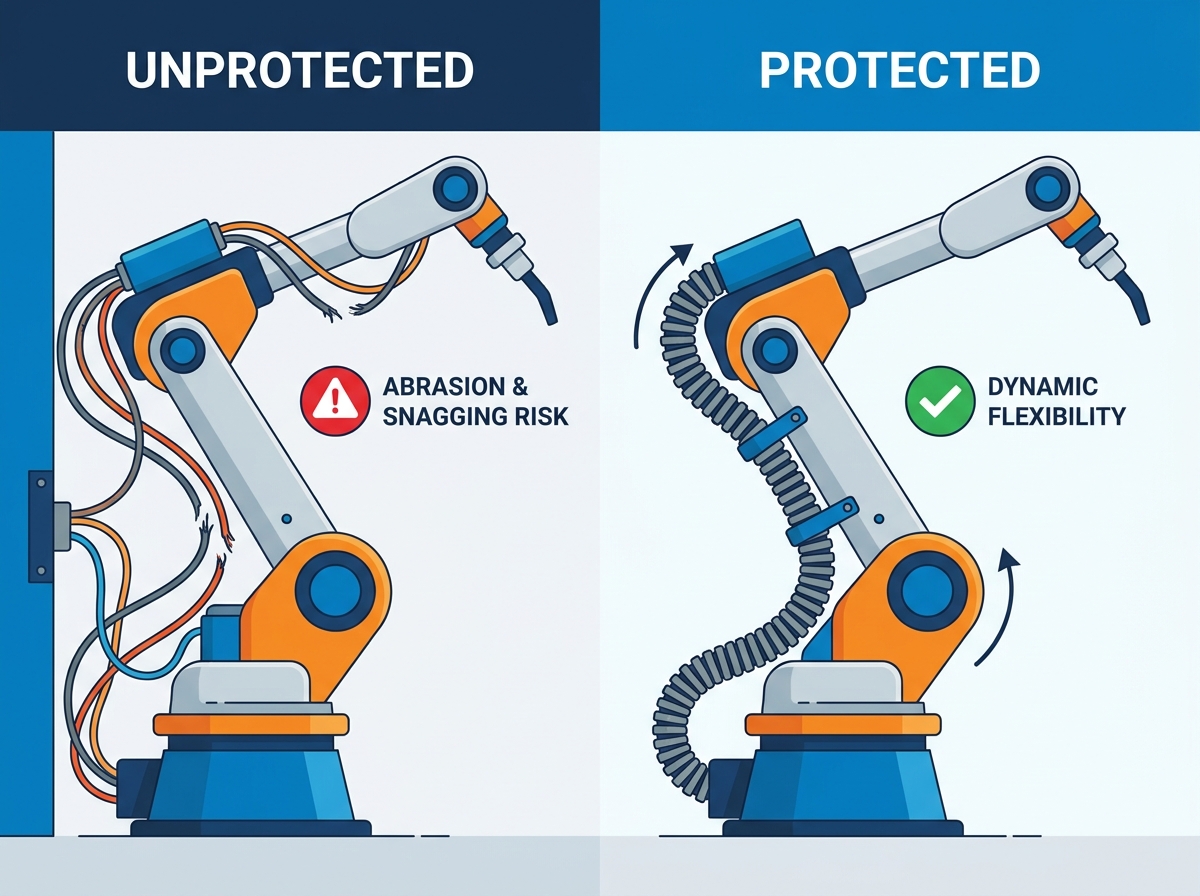
Automation engineers rely on several specific categories of robot cable protection sleeves. Each type serves a distinct mechanical purpose on the floor. You must match the protective material directly to the environmental hazard.
This rigid option works best for heavy industrial environments. It provides excellent high-impact protection against falling debris. Facilities using heavy machining or heavy stamping prefer polymers. However, it carries distinct mechanical trade-offs. Polymer tubing can be quite stiff. It requires specific routing hardware to prevent kinking during sharp turns. Engineers often use dedicated retraction systems here. These spring-loaded mechanisms keep the corrugated tubing under constant tension. They pull the slack back safely when the arm retracts.
These lightweight options suit collaborative robots (cobots) perfectly. They also work exceptionally well for highly articulated 6-axis robots. These dynamic machines require minimal motion restriction. Premium flexible robot cable covers prevent surface abrasion beautifully. They eliminate dangerous snagging hazards effortlessly. They offer lower impact resistance compared to hard polymers. However, their dynamic freedom remains unmatched in the industry. They wrap tightly without fighting the servo motors.
Standard jackets melt quickly in harsh conditions. Welding cells require Kevlar blends or specialized heat-resistant fabrics. They must deflect hot slag continuously. Food and beverage production lines demand FDA-compliant materials. Washdown-ready sleeves must resist harsh, caustic cleaning chemicals. Cleanrooms require specialized low-particulate emission covers. These maintain strict ISO sterile conditions by trapping internal dust effectively.
Choosing the right sleeve requires highly careful evaluation. You must align physical features directly with desired automation outcomes. Never select a cover based on upfront price alone.
Dynamic bend radius compatibility requires strict attention. A rigid cover might force internal wires to bend too sharply. The internal copper will exceed its rated bending limits. This restricts the robot's programmed joint movements. It induces early internal conductor failure. Ensure the jacket bends easier than the wire inside it.
Next, analyze weight and inertia impact closely. Every protection system adds physical mass to the moving arm. This extra weight affects payload capacity directly. It can slow down cycle time efficiency significantly. Heavy protective tubes force delicate servo motors to work harder. They increase wear on the robot's physical gearboxes. Keep added mass as low as functionally possible.
Environmental resistance dictates material survival on the line. We use standard frameworks for assessing IP ratings accurately. You must verify chemical compatibility based on your specific manufacturing floor. Assess thermal thresholds if extreme heat exists nearby.
Environmental Assessment Framework for Cable Protection
Environment Hazard | Critical Assessment Factor | Recommended Material Properties |
|---|---|---|
High Heat / Spot Welding | Slag deflection, flammability rating, thermal limit | Kevlar blend, dense silicone coating |
Chemical Washdown | IP69K compliance, caustic fluid resistance | Smooth FDA-grade polymers, sealed seams |
Abrasive Dust / Machining | Particulate sealing, high tear strength | Tightly woven nylon, robust polyurethane |
Avoid false claims promising an "indestructible" solution. Every cover acts as an intended sacrificial layer. It takes the beating so your expensive wiring survives. Protection systems extend lifespan significantly. They do not grant infinite durability. They will eventually wear out and require replacement.
Proper installation often matters much more than material quality. Poor routing destroys premium materials incredibly quickly. Many lines fail simply due to bad installation habits.
Beware the dangerous "over-constraining" trap. Many technicians bundle wires too tightly inside a sleeve. They mistakenly think tight bundles look cleaner. This severely restricts independent wire sliding. When the robot bends, internal wires experience severe friction. They rub aggressively against one another. This leads directly to "corkscrewing". Conductors break rapidly inside the jacket. The whole bundle becomes twisted and unusable.
Routing best practices prevent mechanical stress effectively. Follow these guidelines closely:
Maintain adequate service loops at all critical joints.
Leave deliberate slack near Joint 3 and Joint 6 to allow full articulation.
Always use dedicated strain relief hardware at termination points.
Partition air hoses from data wires internally to stop cross-abrasion.
Allow wires to twist naturally without restrictive zip ties.
Consider the realities of retrofitting versus OEM dress packs. Installing aftermarket covers on existing lines takes patience. You must carefully work around established tooling. Retrofitting requires precise field measurements. You cannot simply guess the required lengths. You must account for existing brackets. You must navigate around bulky pneumatic valves.
Specifying dress packs during initial integration is much easier. OEM installations occur in a controlled environment. The engineers calculate kinematics perfectly before delivery. It ensures perfect length matching from day one. Always ask your integrator about dress pack options during the initial purchase phase.
Finally, establish strict inspection intervals immediately. Do not wait for a sudden machine fault. We highly recommend a routine visual inspection. Catch jacket wear early. Look for fraying or deep scratches. Replace the sacrificial layer before it compromises the core internal conductors.
Systematically narrowing down your options saves massive engineering time. Follow a strict logic path for smooth integration. Do not guess on dimensions or materials.
Audit the Application: Define the maximum payload accurately. Outline the specific robot kinematics involved. A SCARA robot requires different routing than a Delta or 6-axis unit. Document all environmental hazards present in the cell thoroughly. Note any chemical sprays or welding sparks.
Measure and Size: Calculate the internal bundle diameter carefully. Always leave 10 to 20 percent free space inside the jacket. This crucial space allows independent wire sliding. Measure the necessary cover length. Be sure to include proper joint slack in your final numbers.
Pilot Testing: Never skip the crucial trial phase. We recommend testing the cover on a single cell first. Run it through its full range of motion safely. Operate at actual production speed. Monitor mechanical performance before authorizing a plant-wide rollout.
Take decisive action based on solid data. Prompt your team to consult an automation specialist. Utilize a dedicated configuration tool online. Verify component compatibility before making large bulk purchases.
Investing in proper cable management acts as a low-cost insurance policy. It protects against high-cost downtime perfectly. Purpose-built covers keep machines moving profitably. The best protection strategy seamlessly integrates mechanical durability. It respects the specific kinematic requirements of your robotic application. Stop treating wire routing as a mere afterthought. Give it the focused engineering attention it deserves.
Direct your engineering team to take proactive steps today. Request a formal technical consultation. Download a comprehensive sizing guide. Review precise product specifications closely to secure your production line's future.
A: Modern covers rarely cause interference. Lightweight, low-friction designs minimize mechanical drag on the moving arm. This ensures the robot's internal torque sensors remain highly accurate. Safe human-robot collaboration depends entirely on precise force feedback. Choosing pliable textiles prevents false collision alarms while protecting fragile cords.
A: Replacement frequency depends heavily on cycle counts. It relies on environmental harshness rather than a fixed calendar date. High-speed welding lines might require replacement every six months. Cleanroom applications often last for years. Always monitor visual wear indicators. Replace the sleeve immediately when you see fraying or surface thinning.
A: Yes, you can bundle them together safely. However, you must use internal partitioning. Different jacket materials rub against each other during movement. This friction causes aggressive cross-abrasion. Providing sufficient volumetric clearance also helps. Keep the bundle loose so lines can slide independently without grinding.


