
English 
T: +86-21-55896873
E: info@youguard.cn
E: info@youguard.cn
8th Floor, Building 3, 999 Jiangyue Road, Minhang District, Shanghai
Views: 0 Author: Site Editor Publish Time: 2026-10-22 Origin: Site


Protecting expensive robotic welding torch components from extreme heat and spatter remains a primary engineering challenge in modern manufacturing. High-volume production demands exact precision, and automated welding cells operate in punishing environments. Selecting the wrong cover often leads to snagging, premature material degradation, and increased downtime. This completely negates the purpose of your initial automation investment.
When spatter accumulates on critical components, routine maintenance schedules derail. If a protective sleeve binds during complex joint maneuvers, robots crash and production halts entirely. Specifying the correct protective gear eliminates these severe operational risks. This article provides a practical, engineering-focused framework to evaluate, select, and test protective covers for automated welding cells. You will learn how to match specialized materials to specific environmental threats, ensure proper fitment for unrestricted articulation, and validate your choices through strategic pilot testing to maximize your equipment lifespan.
Material selection must align directly with the primary threat (radiant heat vs. direct spatter accumulation).
Proper fitment dictates success; oversized covers risk catching on tooling or workpiece clamps during dynamic movements.
Closure mechanisms (hook-and-loop, snaps, Kevlar stitching) are often the primary point of failure and require rigorous evaluation.
Pilot testing on a single, high-spatter robotic cell is the most reliable way to validate return on investment (ROI) before plant-wide rollout.
Automated welding environments destroy exposed equipment at an alarming rate. You must contrast the frequent, recurring cost of replacing damaged torch cables, swannecks, and collision sensors against the preventative cost of a specialized cover. A single crashed robot or severed water line halts an entire assembly line instantly. These unexpected component failures drain maintenance budgets and frustrate operations teams. When you invest in proper protective equipment, you effectively buy insurance for your most vulnerable automation hardware.
To define what a successful implementation looks like, you need measurable goals. Installing a cover should yield direct operational improvements on the factory floor. Track these specific benchmarks to validate your choice:
A 30% reduction in routine cable package replacement intervals.
Complete elimination of spatter-induced false sensor trips.
Zero restriction on programmed robot speed or movement limits.
Noticeable reduction in daily scraping, cleaning, and preventative maintenance times.
Maintenance teams sometimes resort to makeshift covers when facing unexpected downtime. They might wrap cables in standard duct tape or zip-tie generic welding blankets around the torch body. We strongly advise against these DIY solutions. Makeshift materials often trap heat near the torch body, accelerating internal wear. They also lack standardized reliability and industrial flammability ratings. A generic blanket easily adds excess weight, which shifts the tool center point (TCP) and degrades weld accuracy. Purpose-built commercial covers undergo rigorous engineering to prevent these exact failures.
Selecting the right fabric dictates how well your welding spatter protection sleeves survive the cell environment. You must align the protective material directly with your primary environmental hazard.
Heavy, sticky spatter creates severe localized hot spots on exposed equipment. Silicone-coated fiberglass excels in these brutal conditions. The slick silicone outer layer repels heavy spatter efficiently. It sheds molten metal rapidly before the material hardens into slag. This prevents heavy build-up from restricting robot movement over a long shift. We often recommend silicone-coated options for high-amperage MIG welding applications where high deposition rates generate constant, aggressive flying debris.
If your application involves tandem wire welding or pre-heated heavy components, radiant heat becomes the primary threat. Aluminized Kevlar or fiberglass reflects high radiant heat away from sensitive internal cables. However, you must evaluate its vulnerability carefully. Aluminized coatings do not handle direct mechanical abrasion well. If the cover drags repeatedly across sharp tooling, the reflective layer degrades quickly. Reserve aluminized materials for high-heat, low-abrasion setups where the robot operates with ample clearance.
Leather remains a traditional option for heavy-duty mechanical protection. When blended with para-aramid fibers, it offers exceptional puncture and abrasion resistance. These blends endure severe physical abuse in confined spaces. Yet, you face clear trade-offs in weight and overall flexibility. Leather absorbs factory oils and stiffens over time. It can restrict fine articulation if not properly maintained. Use it specifically when mechanical impact outweighs radiant thermal concerns.
Cell fires pose catastrophic risks to human safety and production schedules. You must ensure all materials meet strict non-flammability standards. Look closely for self-extinguishing properties during your evaluation. If a massive slag droplet lands on the sleeve, the material must char rather than ignite into open flames. Standardizing on fire-rated fabrics protects both your expensive equipment and your surrounding facility.
Material Performance Comparison
Material Type | Spatter Resistance | Radiant Heat Deflection | Mechanical Flexibility |
|---|---|---|---|
Silicone-Coated Fiberglass | Excellent | Moderate | High |
Aluminized Kevlar | Poor | Excellent | Moderate |
Leather Blends | Moderate | Low | Low |
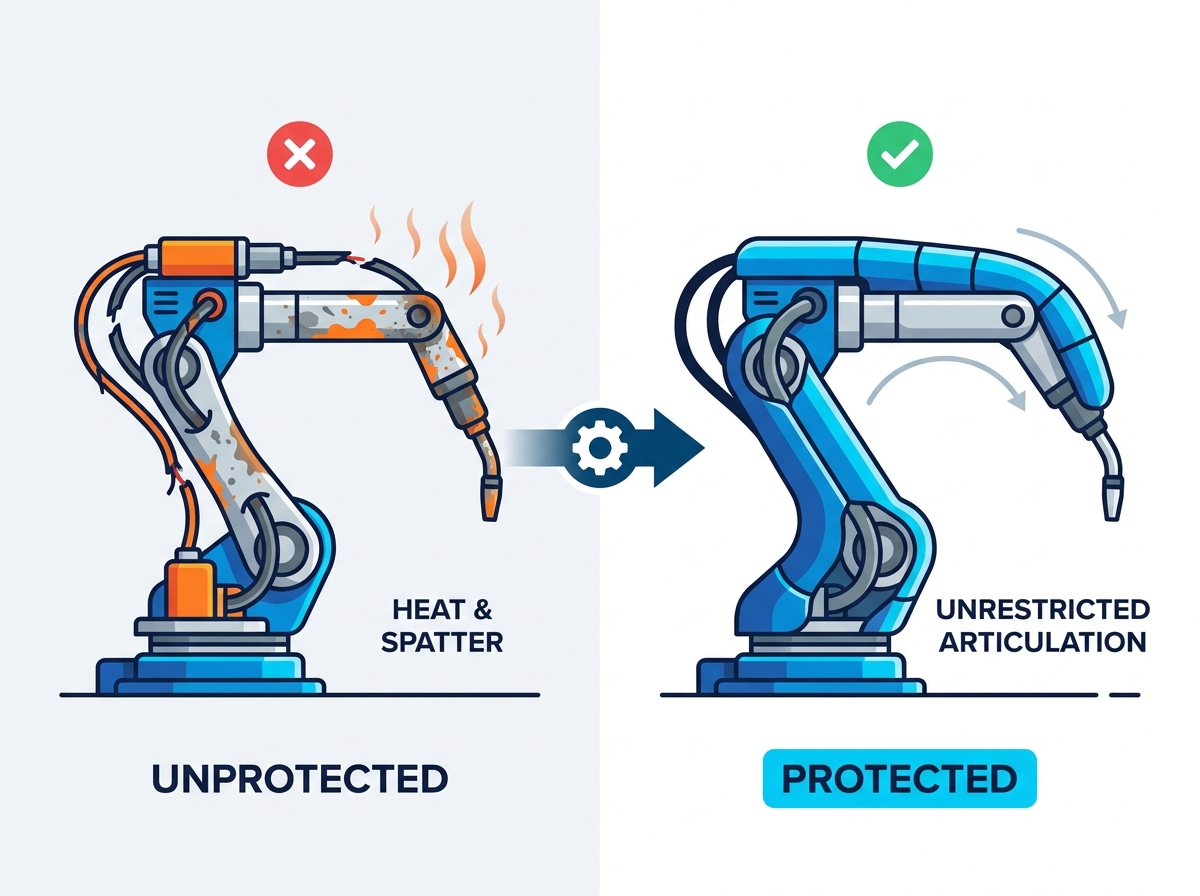
Selecting the right high-performance fabric only solves half the problem. A perfectly matched automatic welding gun cover must fit flawlessly to prevent snagging during dynamic, multi-axis movements.
You must take exact measurements around the torch body, water-cooling lines, and wire feeder connections. If a cover fits too tightly, it pinches vital water lines and restricts coolant flow, causing internal overheating. It may also disrupt wire feed speed, creating erratic arc stability. If it fits too loosely, excess fabric droops into the active weld zone. Ensure proper clearance allows internal components to slide slightly as the robot repositions.
Complex wrist rotations introduce severe mechanical stress on bulky cable packages. During Axes 4–6 movement, you face a high risk of material bunching. The cover must accommodate full articulation without creating dangerous tension on internal wiring. When fabric bunches, it creates rigid choke points. These rigid points often snag on workpiece clamps or force the robot to fault out due to unexpected servo resistance. We recommend testing maximum rotation limits manually to verify clearance before running automated programs.
Deciding between OEM-specific and universal covers requires a systematic approach. Use this simple framework to guide your purchasing choice:
Assess the Complexity: If your cell uses advanced collision sensors, bulky water-cooling blocks, or integrated fume extraction, you likely need a custom-tailored solution.
Evaluate the Duty Cycle: High-volume, 24/7 production lines easily justify the higher upfront cost of custom fitment to avoid frequent micro-stoppages.
Test Universal Viability: For simple, air-cooled torches doing repetitive, low-angle flat welds, standard off-the-shelf sizing often provides acceptable, cost-effective protection.
Even the strongest technical fabrics fail rapidly if their fastening mechanisms break. Closure systems demand rigorous evaluation because they secure the cover during aggressive robot articulation.
You must assess the hidden failure points of common fastening methods before buying. Fasteners often sit exposed to ambient heat and flying debris. When a fastener fails, the cover flaps open, exposing internal cables to immediate, irreversible damage. Maintenance technicians need secure closures that also allow incredibly quick removal during routine tip changes to maintain cycle times.
Hook-and-loop fasteners are exceptionally easy to install and adjust. However, they are highly prone to clogging with fine metallic dust generated during the welding process. Standard versions melt easily if exposed to direct, glowing spatter. If you specify this closure type, you must insist on high-temp variants. Look for industrial-grade, flame-resistant hook-and-loop designed specifically for heavy-duty welding environments.
Zippers provide a seamless, tight closure, but they can quickly fuse shut if hit by molten spatter. Once a zipper jams, technicians often cut the cover off entirely, destroying the investment. Heavy-duty metal snaps offer better overall durability against heat. Yet, snaps can create rigid pinch points along the flexing cable package. You must ensure the manufacturer places snaps strategically to avoid interfering with fine wrist articulation.
Regardless of the specific closure type you choose, construction quality dictates longevity. Emphasize to suppliers that all seams must be sewn with high-heat, flame-resistant thread. Kevlar threading remains non-negotiable in this environment. Standard cotton or polyester threads burn away instantly, causing structural blowout mid-cycle. Double-stitched Kevlar seams ensure the entire cover holds together under constant mechanical tension.
Never roll out a new specification plant-wide without conducting a field test first. A controlled pilot test validates your engineering choices and guarantees expected returns. Testing specific robotic welding torch protective covers provides hard, actionable data for major purchasing decisions.
We recommend identifying two or three specific covers for your initial trial. Base this shortlist entirely on the dominant hazard inside your cell. If radiant heat causes early cable failure, test aluminized options against each other. If heavy spatter buildup drives your downtime, focus purely on silicone-coated variants. Narrowing the field keeps testing manageable and highly focused.
Advise your team to install the covers on the worst-performing or highest-maintenance robotic cell first. Do not test on a cell that rarely experiences mechanical issues. By targeting a severe environment, you dramatically accelerate the stress test. Collect baseline data for two weeks prior to the test. If a cover survives your most demanding application, it will easily protect standard production lines.
You need concrete data to justify the final plant-wide purchase. Track the Mean Time Between Failures (MTBF) for internal torch components before and after installation. Monitor the physical cover degradation rate over a strict 30-day period. Finally, gather direct feedback from maintenance technicians on the floor. Ask them to rate the ease of removal and reinstallation during routine contact tip changes.
Specifying a cover remains a serious engineering decision, not a simple commodity purchase. A successful installation strikes a critical balance between thermal protection, mechanical durability, and unrestricted robotic movement. Treat protective sleeves as essential, highly engineered tooling rather than optional aftermarket accessories.
To move forward, audit your current robotic cell downtime logs today. Identify exactly which cells suffer most from spatter buildup or premature cable failure. These high-maintenance cells will benefit most from immediate cover implementation. If you run complex equipment with specialized sensors, contact a technical specialist today for custom fitment advice to secure your automation investments.
A: Set regular inspection schedules rather than fixed replacement dates. Replacement depends entirely on duty cycle, average amperage, and overall spatter volume. In heavy industrial use, most quality covers last between 3 to 6 months. Inspect seams and closure mechanisms weekly, replacing the unit once the outer protective coating wears thin or begins to tear.
A: Quality covers will not cause overheating. Manufacturers engineer them to breathe or maintain ambient clearances without heavily insulating the heat-generating components. The cover prevents external thermal attacks but allows internal water cooling to function normally. Ensure you do not use makeshift materials like thick welding blankets, which can trap internal heat.
A: Routine maintenance involves shaking off loose spatter or wiping down silicone coats with a dry cloth. We strictly advise against machine washing. Machine washing rapidly degrades essential fire-retardant treatments and ruins structural integrity. If a sleeve becomes heavily caked in permanent slag, it has served its purpose and requires immediate replacement.


