
T: +86-21-55896873
E: info@youguard.cn
E: info@youguard.cn
8th Floor, Building 3, 999 Jiangyue Road, Minhang District, Shanghai
Views: 0 Author: Site Editor Publish Time: 2026-11-04 Origin: Site


Robotic automation drives immense efficiency across intensive grinding, polishing, and surface finishing operations. However, these demanding applications expose high-value 6-axis robots to continuous, aggressive environmental hazards daily. Airborne micro-abrasives, flying metal swarf, and sticky polishing compounds constantly bombard delicate mechanical joints. Many facility managers incorrectly assume OEM factory seals offer sufficient baseline protection. Unfortunately, ultra-fine abrasive dust inevitably bypasses standard rubber lip seals over time. Once inside the casting, this particulate matter leads directly to premature servo motor failure. It rapidly compromises sensitive axis joints and frequently voids expensive manufacturer warranties. Production engineers and procurement managers desperately need a more reliable defense strategy. We designed this guide to provide a skeptical, evidence-based framework for evaluating industrial protection solutions. You will learn exactly how to assess material limits, thermal constraints, and structural fit securely. Applying these practical engineering insights ensures maximum equipment uptime and robust investment returns.
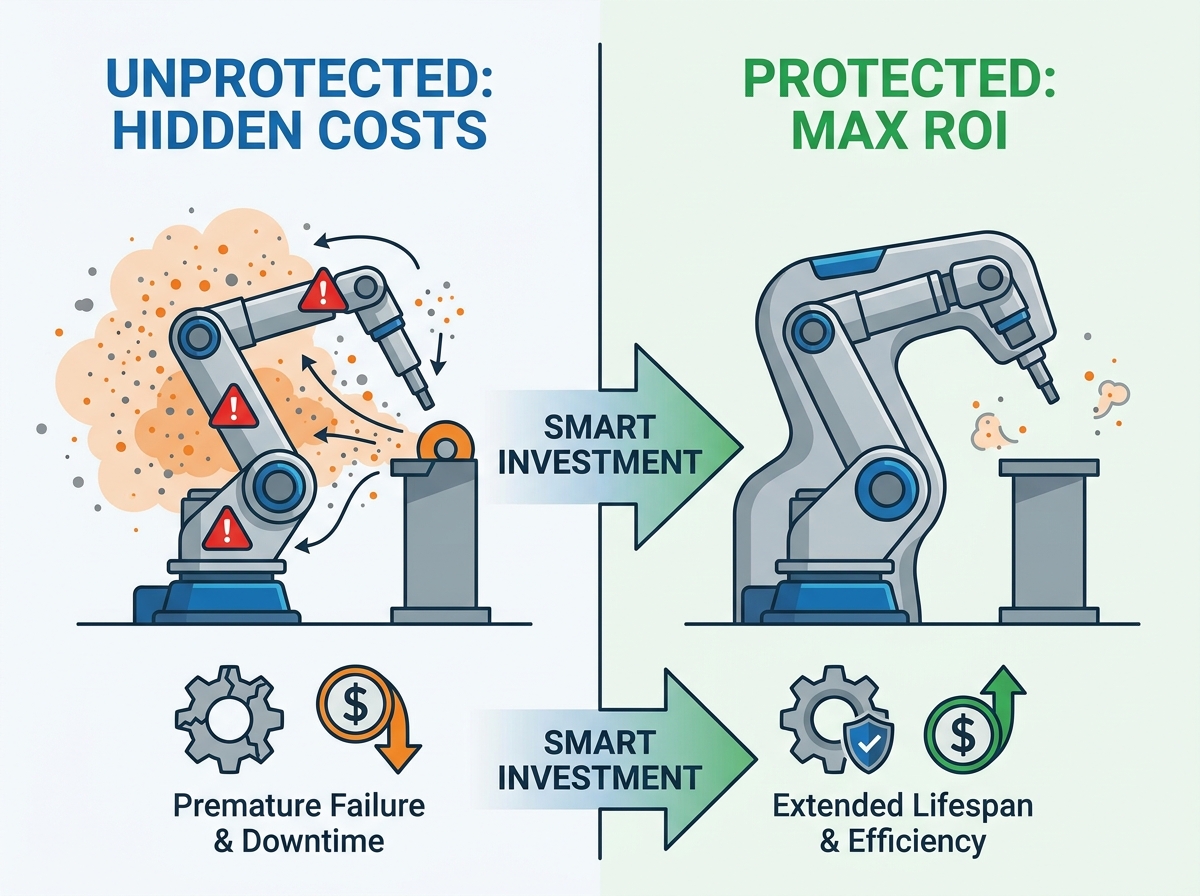
Unprotected grinding cells experience exponentially higher hidden costs due to abrasive dust penetrating robotic arm joints and destroying lubricants.
Effective dustproof robot protection clothing must balance hermetic sealing with the thermal management required for continuous grinding cycles.
Selecting abrasion resistant robot covers requires evaluating specialized fabric technical specifications, not just visual thickness.
Custom-fitted geometry significantly outperforms universal covers by preventing fabric bunching, snagging, and articulation restriction during complex polishing paths.
Operating a bare robotic arm inside a finishing cell invites catastrophic mechanical failure. We must closely examine the specific mechanisms driving these expensive breakdowns. Abrasive dust behaves like a highly destructive, invasive parasite. Micro-particles of aluminum oxide, silicon carbide, and ceramic media easily penetrate microscopic crevices along the robot body. Once inside, they infiltrate planetary gearboxes and immediately mix into specialized factory lubricants. This toxic combination creates a highly aggressive lapping paste. It actively mills away precision gear teeth during every rotational motion cycle. You eventually see rapid mechanical degradation, severe backlash, and complete axis failure.
You also face entirely different hazard profiles depending on your specific machining process. Evaluating wet versus dry environments remains a critical first step for any facility manager.
Environmental Hazard Comparison: Wet vs. Dry Operations
Environment Type | Primary Airborne Hazard | Ingress Mechanism | Core Damage Result |
|---|---|---|---|
Dry Grinding | Micro-abrasive grit, airborne metallic dust | Positive pressure forces dust past dry rubber seals | Gearbox wear, encoder failure, dry friction scoring |
Wet Polishing | Coolant mist, heavy abrasive sludge | Capillary action pulls fluid past dynamic seals | Internal corrosion, electrical shorting, lubricant breakdown |
The business case for comprehensive protection becomes undeniable when analyzing pure return on investment. Replacing a single damaged axis motor easily costs thousands in parts alone. You must also factor in exorbitant emergency technician travel fees. Consider the financial impact of unplanned downtime on your Overall Equipment Effectiveness (OEE). Every hour a cell sits idle, you lose profitable production capacity permanently. Implementing a scheduled textile replacement program stabilizes your maintenance budgets. It shifts unpredictable emergency repairs into highly predictable, manageable operational expenses.
True abrasion resistant robot covers require highly engineered technical fabrics. Visual thickness alone deceives many inexperienced buyers. High-tenacity base layers dictate real-world survival in harsh industrial zones. Engineers typically specify dense polyurethane-coated nylon or heavy-duty Kevlar blends. These advanced materials easily withstand high-velocity metallic debris. They deflect aggressive shot-blasting rebound continuously without structural degradation. The underlying woven structure resists catastrophic tearing even upon direct impact.
Effective dustproof robot protection clothing demands rigorous engineering around every single seam. Welded seams outperform traditional stitched seams drastically. Stitched thread holes naturally stretch, allowing micro-dust penetration over time. Manufacturers must shield access zippers behind overlapping, secure fabric flaps. Rotary joint closures require precise elastic tensioning or secure mechanical banding. This structural discipline prevents particulate entry during complex, high-speed rotational maneuvers.
Many cells utilize highly aggressive synthetic cutting fluids. Industrial polishing pastes often contain mildly corrosive elements. Operators also deploy harsh industrial solvents during weekly equipment washdowns. Protective fabrics must resist chemical degradation completely to remain effective. Incompatible materials turn brittle, crack prematurely, or dissolve into sticky messes. You must match the fabric surface chemistry perfectly to your specific coolant and solvent types.
Engineers often face a difficult flexibility trade-off when selecting barrier materials. Excessively rigid materials severely limit the equipment range of motion. They force delicate servos to pull much harder against stiff fabric folds. This constant, unnatural resistance increases motor stress significantly over millions of cycles. Eventually, it causes premature fabric tearing directly at primary articulation flex points. A properly designed barrier moves seamlessly alongside the robotic arm without fighting the servo drives.
Thermal management presents another massive physical reality. Grinding and polishing operations run continuously under heavy mechanical loads. Industrial robots generate intense internal heat naturally. Trapping this excessive heat inside an unventilated jacket destroys sensitive electronic encoders rapidly. Engineers must incorporate strategic breathable zones. Many extreme environments require active air-purge systems for survival. These pneumatic systems pump clean facility air inside the barrier continuously. This pressurization achieves two critical goals simultaneously:
It physically expels destructive heat outward away from the sensitive motor castings.
It maintains a positive pressure gradient, ensuring airborne dust cannot flow inward through microscopic gaps.
Surface repellency holds equal importance in dusty environments. Dust accumulation creates hidden, progressive dangers. Heavy particulate buildup adds detrimental weight across the entire kinematic structure. It shifts the payload center of gravity slowly over an eight-hour shift, reducing path accuracy. Non-stick surface coatings actively prevent this dangerous accumulation. Smooth PTFE or slick polyurethane layers encourage metallic debris to slide off immediately upon contact.
Many procurement departments attempt to save initial budgets by purchasing generic barriers. We continually observe the absolute failure of "one-size-fits-all" mentalities. Universal bags simply create excessive, uncontrolled fabric folds across the machine body. These loose folds inevitably catch on spinning end-of-arm tooling (EOAT). They snag violently on rough workpieces during complex spatial trajectories. A snagged barrier rips open instantly, destroying your entire environmental seal.
Custom geometry provides profound operational advantages. Tailored patterns map precisely to specific models, accounting for unique mechanical shapes. An ABB IRB series requires entirely different articulation allowances than a FANUC or KUKA KR series. Custom shaping allows independent, completely unrestricted axis movement. Furthermore, it easily accommodates external cabling, pneumatic hoses, and bulky spindle motors specific to grinding applications. You receive a streamlined, aerodynamic profile perfectly tailored for tight cell spaces.
Evaluating long-term operational lifespan dictates making smarter upfront investments. Custom-tailored barriers naturally carry a higher initial purchase price. However, they deliver a significantly longer operational lifespan overall. They drastically reduce snag-induced tearing risks because they eliminate sloppy excess material. Investing in precise geometry prevents the constant replacement cycles common among cheap universal bags. You recover the initial premium rapidly through uninterrupted, highly profitable production runs.
Deploying new environmental barriers introduces specific installation complexities. Maintenance teams need incredibly quick access during routine mechanical checks. Complicated lacing systems or confusing straps waste valuable production time. Look specifically for intelligent modular designs. Industrial-grade Velcro combined seamlessly alongside heavy-duty, shielded zippers works best. Trained technicians can strip the entire barrier away in mere minutes. They can perform necessary greasing, then re-install the jacket swiftly before the next shift starts.
You must establish strict inspection protocols immediately. Protective barriers naturally introduce a dangerous "out of sight, out of mind" risk. A pristine outer shell easily hides severe internal mechanical issues. Undetected oil leaks ruin internal electronics if left completely unchecked. We strongly recommend implementing a numbered inspection process:
Open primary access panels weekly to inspect for internal moisture or dust bypass.
Verify all rotary joint seals remain perfectly intact and properly tensioned.
Check the bottom drainage ports to ensure no internal oil pooling occurs.
Inspect the exterior impact zones for early signs of micro-abrasion wear.
Finally, clearly communicate the consumable lifecycle to your finance teams. Transparently state that barriers operating inside harsh grinding environments serve as consumable items. They absorb brutal abuse specifically to spare your million-dollar capital equipment. Establish clear baseline expectations for routine replacement cycles. Most heavy-duty industrial applications require replacements every six to twelve months. Lighter duty polishing cycles might extend lifespan to eighteen months reliably. Plan your procurement schedules accordingly to avoid operating without protection.
High-performance grinding barriers act as highly engineered environmental shields. They do far more than merely bag the equipment for aesthetic purposes. They actively maintain your critical production throughput while safeguarding fragile internal robotics. A properly specified barrier prevents abrasive paste formation, manages thermal loads, and allows full kinematic freedom.
We advise taking deliberate shortlisting next steps before issuing any purchase orders. Take time to audit your specific work cell hazards rigorously. Document the operating temperatures, primary coolant types, and precise machine models deployed on the floor. Understand exactly whether you face wet coolant spray or dry airborne grit. You should always request tailored material sample swatches to perform localized scratch and chemical tests.
Stop allowing microscopic dust to destroy your automation investments quietly. Connect directly to specialized application engineers for a detailed operational assessment today. Prioritize proactive defense strategies to keep your manufacturing lines running profitably and smoothly.
A: Replacement frequency depends heavily on abrasive media type, daily duty cycles, and specific material grades. Heavy industrial grinding using aggressive aluminum oxide typically demands replacement every six to twelve months. Lighter polishing operations may stretch lifespans safely up to eighteen months. Consistent visual inspections ultimately dictate your exact replacement timeline.
A: Trapped heat can damage internal servo motors if ignored completely. Quality industrial designs incorporate positive air-purge systems directly into the suit. These systems pump clean, cool facility air inside the barrier continuously. Others utilize thermally conductive textiles alongside strategic breathable zones. Proper engineering easily solves this common thermal management challenge.
A: No. Welding applications require materials optimized strictly for extreme heat and heavy molten spatter deflection. Grinding applications demand extremely high mechanical abrasion resistance and hermetic micro-dust sealing. Using a welding jacket for a grinding application allows ultra-fine dust penetration, eventually ruining internal gearboxes.
A: Maintenance depends entirely on your specific cell hazards. Dry grinding cells usually require simple compressed air blow-offs directly between operating shifts. Wet polishing applications involving sticky ceramic sludge may require specialized industrial washing. Always consult the manufacturer guidelines carefully before applying any harsh chemical solvents to the fabric.


