
English 
T: +86-21-55896873
E: info@youguard.cn
E: info@youguard.cn
8th Floor, Building 3, 999 Jiangyue Road, Minhang District, Shanghai
Views: 0 Author: Site Editor Publish Time: 2026-08-28 Origin: Site


Unplanned downtime in an automotive spray painting workshop destroys profit margins rapidly. Dress pack and energy chain failures often cause these expensive stoppages. Assembly lines bleed thousands of dollars every minute a robotic cell sits idle. Unprotected cables face brutal daily conditions on the line. They suffer from rapid paint accumulation and aggressive solvent degradation. They also endure extreme mechanical stress during continuous multi-axis articulation.
This guide provides a strictly technical and commercial evaluation framework for engineers and plant managers. It helps you carefully select a robot cable cover for automotive painting. You must balance vital protection, dynamic flexibility, and rapid maintenance access. We will explore material compliance, mechanical design, and cost-efficiency models. This approach ensures your production line maintains high uptime and delivers defect-free automotive finishes.
Silicone-free and anti-static materials are non-negotiable baselines for compliance and defect-free finishes in automotive paint cells.
Overspray accumulation changes the weight and bend radius of cable tracks; covers must shed paint while resisting harsh cleaning solvents.
Closure mechanisms (hook-and-loop vs. zippers) directly impact mean time to repair (MTTR) during routine dress pack inspections.
Automotive paint cells present a uniquely hostile environment for standard robotics equipment. Off-the-shelf corrugated tubing and basic polyurethane jackets fail predictably when exposed to continuous atomized coatings. Understanding these failure modes helps you design better protection strategies.
Atomized paint coats everything inside the booth. Cured paint gradually increases the rigidity of external energy chains. This overspray hardens over weeks of production. It fundamentally alters the dynamic bend radius of the dress pack. The stiffened tracks resist normal robotic articulation. This resistance leads to premature cable strain. Wires inside the track begin to crack. Eventually, they snap completely. A severed control cable stops the entire painting process instantly.
Paint lines use aggressive line-flush solvents and highly volatile organic compounds (VOCs). Continuous exposure to these chemicals attacks standard polyurethane (PU) or PVC cable jackets. The solvents extract plasticizers from standard plastics. This extraction leaves the cables brittle and prone to micro-fractures. Standard protective sleeves simply absorb these solvents. They melt, warp, or lose structural integrity within weeks.
Multi-axis robot movement generates constant friction. Six-axis arms execute complex, high-speed twists continuously. Unprotected cables rub aggressively against the aluminum robot casting. This friction creates severe abrasion. It also generates particulate contaminants. These micro-dust particles float through the booth and land on wet clearcoats. Dust inclusions ruin automotive paint finishes and cause costly vehicle rework.
A successful protective implementation meets strict operational metrics. First, you must achieve zero paint-related cable faults. Second, the fabric itself must generate zero cover-induced shedding or linting. Third, you should measure a distinct reduction in maintenance intervention time. Your team must clean, inspect, and reset the robotic arm faster than before.
Material science dictates the success or failure of any protective garment in a paint booth. You cannot compromise on chemical compliance or electrostatic safety.
Any cover introduced into your facility must remain strictly free of paint-wetting impairment substances (PWIS). Even microscopic silicone traces alter the surface tension of wet paint. Silicone contamination causes cratering and fisheyes in the automotive clearcoat. These defects force entire car bodies back through the sanding and repainting process. Manufacturers must provide certified silicone-free documentation for all textiles used.
Paint booths operate as highly flammable, solvent-rich Class 1 or Zone 1 environments. Multi-axis movement generates static electricity rapidly. You must use anti-static fabrics to prevent catastrophic static discharge. High-quality covers incorporate carbon-threaded textiles. The carbon grid dissipates electrical charges safely. It prevents sparks from igniting airborne solvent vapors.
Base materials determine longevity and cleaning efficiency. Polytetrafluoroethylene (PTFE), commonly known as Teflon, offers superior non-stick properties. Dried overspray simply flakes off the PTFE surface during normal robot articulation. PTFE also delivers exceptionally high chemical resistance against harsh thinners. Lighter coated nylons provide a cost-effective alternative initially. However, nylon degrades much faster under heavy solvent use. It often requires frequent replacement.
Standard woven fabrics degrade and release microscopic fibers into the air. Fiber shedding poses a massive risk to wet paint. You must demand continuous-filament textiles. Continuous filaments do not break down into short, airborne lint particles. This construction keeps the booth environment pristine and prevents fabric-induced paint defects.
Material Type | Solvent Resistance | Non-Stick Properties | Durability | Ideal Application |
|---|---|---|---|---|
Standard Nylon | Low | Poor | Low | Dust protection only |
Coated PU Nylon | Moderate | Moderate | Medium | Primer booths, low-volume lines |
PTFE / Teflon | Exceptional | Excellent | High | Clearcoat, high-volume automation |
Best Practice: Always request a material safety data sheet (MSDS) and a PWIS-free certificate before testing any fabric inside your facility.
Superior materials fail if the engineering design restricts robotic movement. The cover must adapt seamlessly to the kinematics of the machine.
A properly engineered suit allows full range of motion (ROM) for complex robot wrists. Axis 4, 5, and 6 perform extreme torsion and bending. The cover must not bunch up during these maneuvers. It cannot snag on the robot arm casting. It must never artificially limit the bend radius of the internal energy chain. Tight covers cause cable strain. Loose covers catch on nearby fixtures.
Maintenance teams need fast access to internal cables. The closure mechanism dictates your mean time to repair (MTTR).
Industrial Hook-and-Loop (Velcro): This system offers extremely fast access. Technicians can rip it open in seconds. However, it remains prone to clogging. Paint seeps into the hooks if the fabric does not overlap properly.
Concealed Zippers and Press Studs: Zippers provide a highly secure seal against heavy spray. They offer a cleaner profile. Unfortunately, they require physical clearance to operate. Zippers can also jam permanently if cured paint penetrates the interlocking teeth.
Evaluate the maintenance advantage of modular designs. Paint buildup concentrates on specific high-wear zones, typically around axis 3 through 6. A modular design allows technicians to swap out just the heavily soiled wrist section. Single-piece suits require removing the entire unit for localized repairs. Modular replacement saves significant labor time and reduces consumable waste.
Sealing the ends of the cover presents a distinct engineering challenge. Open ends allow paint mist to drift inside the jacket. Integrated rotary collars solve this problem. These engineered end-rings seal the fabric tightly against the robot casting. They utilize internal bearings or slip-rings. This allows the cover to remain stationary while the robot axis rotates freely underneath.
Design Feature | Speed of Access | Protection Level | Maintenance Risk |
|---|---|---|---|
Hook-and-Loop Closure | Very Fast | Moderate | Clogging over time |
Flapped Zipper Closure | Slow | High | Jamming from paint |
Single-Piece Suit | Slow | High | Full removal required |
Modular Suit | Fast | High | Joints may leak if misaligned |
Procurement teams often struggle to evaluate the true financial impact of cable protection. You must look beyond the initial purchase price. Labor, downtime, and replacement frequency drive the real costs.
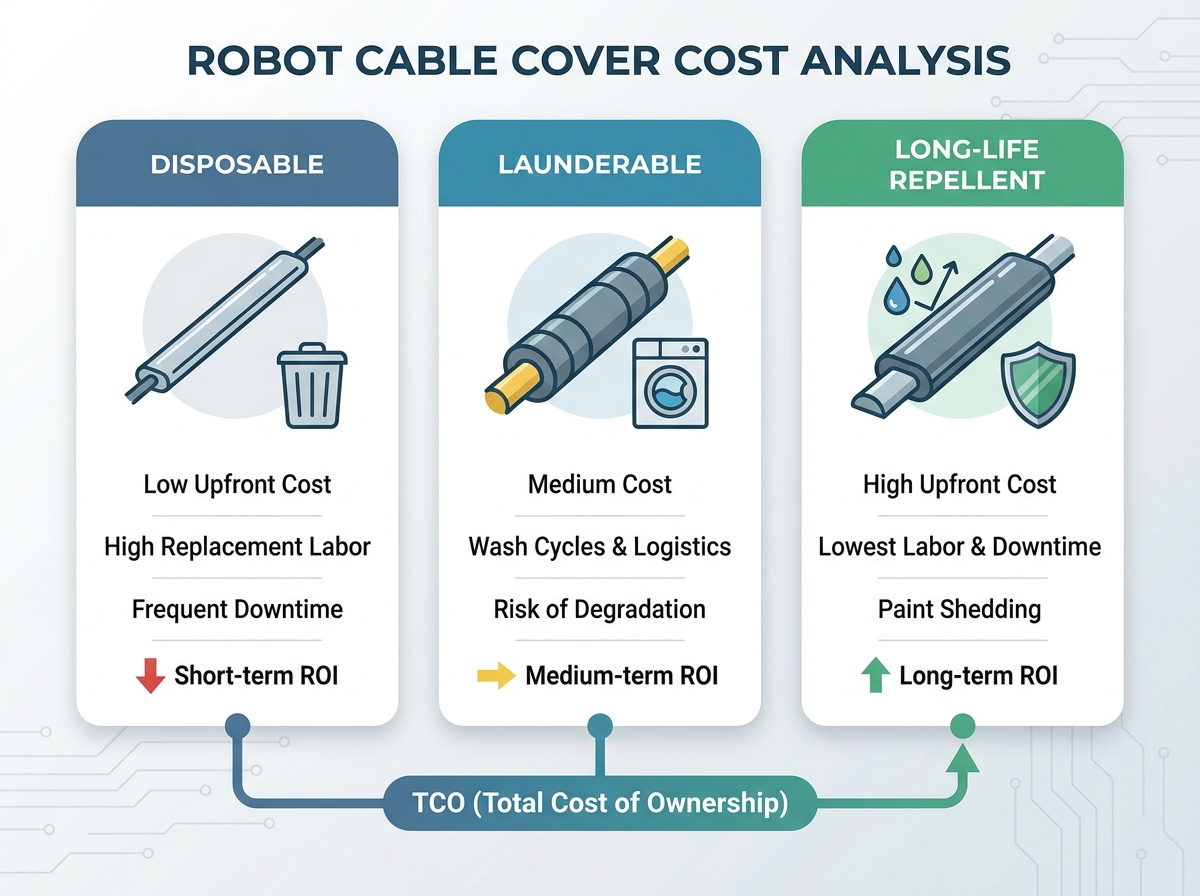
Disposable covers utilize lightweight, low-cost materials. Facilities throw them away when they become heavily caked with overspray. This model appears attractive due to an extremely low initial unit price. However, assumption checks often reveal a different reality. Frequent replacement labor costs accumulate rapidly. Stopping the line every Friday to cut off and tape on new covers destroys production efficiency.
Launderable models utilize thicker, durable fabrics. Manufacturers design them to withstand aggressive industrial chemical washing. This model extends the lifespan of each suit. Yet, it introduces significant risk factors. Fabrics often suffer shrinkage during the chemical wash cycle. They may also lose their critical anti-static properties after repeated laundering. Furthermore, you must manage the logistical overhead of shipping soiled suits to specialized industrial cleaners.
High-end PTFE covers represent the long-life model. They shed paint mechanically through normal robot movement or routine air blow-off procedures. This approach requires higher upfront capital expenditure (CapEx). However, it delivers the lowest labor and downtime costs over a three-year period. Maintenance teams rarely stop the line to swap suits. The superior chemical resistance eliminates the need for frequent washing or disposal.
Calculate the exact unit price of the proposed protective cover.
Determine the expected operational lifespan in weeks before replacement or washing becomes mandatory.
Measure the precise labor minutes required for two technicians to safely remove and install the unit.
Multiply the installation time by your facility's hourly downtime cost rate.
Compare the total operational expense of disposable suits over one year against the CapEx of a long-life PTFE cover.
Common Mistake: Purchasing agents often select the cheapest nylon cover available. They ignore the thousands of dollars lost monthly to premature cable failures and extended installation times.
Selecting the right product represents only half the battle. Poor implementation strategy often ruins excellent engineering.
We strongly warn against "one-size-fits-all" sizing models. Precision matters in robotics. Undersized covers restrict cable movement and induce severe strain. The energy chain will snap if it cannot flex fully. Conversely, oversized covers create a dangerous parachute effect. Excess fabric balloons outward during fast arm movements. The baggy material snags easily on jigs, nearby fixtures, or the vehicle body itself. You must demand millimeter-accurate sizing.
Never upgrade an entire facility simultaneously without testing. We highly recommend a phased rollout strategy. Install the new cover on a single high-wear robot first. The clearcoat applicator usually provides the harshest test environment. Run this test cell for 30 to 60 days. Monitor paint shedding, monitor static build-up, and check internal cables for dust. Proceed with a plant-wide upgrade only after verifying these results.
Use these strict criteria to evaluate potential suppliers before signing a contract:
Do they provide independently certified silicone-free (PWIS-free) documentation for all materials and threads?
Can they custom-engineer closure mechanisms based on your existing dress pack brands, such as igus or Leoni?
Do they deploy engineers for on-site measurement?
Do they offer a written fitment guarantee to prevent the parachute effect?
Are their fabrics tested for ATEX Zone 1 static dissipation?
Choosing the right cover for your robotic equipment is an exercise in strict risk mitigation. You are protecting your facility against catastrophic downtime and expensive paint defects. A severed cable stops production instantly, while fabric lint ruins premium clearcoats.
Facility managers should firmly prioritize silicone-free certification and verifiable anti-static properties. You must evaluate your team's capacity for ongoing cover maintenance. Decide clearly between disposable systems, launderable logistics, or high-CapEx repellent models. Always demand precise, custom-fit designs to eliminate snagging and cable strain.
Take action today to secure your production line. Request a physical material sample to verify non-stick properties. Download a comprehensive sizing guide for your specific robot model. Schedule a technical consultation to audit your current cell environment and identify hidden abrasion risks.
A: Replacement frequency depends heavily on production volume, paint type, and cover material. Cheap disposable covers often require weekly replacement due to rapid overspray buildup. High-end PTFE covers can last six months to a year, as they mechanically shed dried paint during daily articulation.
A: You should avoid washing standard covers with aggressive line-flush solvents. Solvents break down basic polyurethane and nylon rapidly. This degrades structural integrity and destroys embedded anti-static (ESD) properties. Only wash fabrics specifically engineered and certified for industrial chemical laundering.
A: Your current cover likely contains paint-wetting impairment substances (PWIS), such as silicone. Off-the-shelf industrial covers often use silicone-based lubricants during the textile manufacturing process. Even microscopic silicone transfer alters wet paint surface tension, creating craters and fisheyes.
A: Yes. Even if you spray waterborne basecoats, most automated facilities still utilize highly flammable solvent-based clearcoats and aggressive line-cleaning agents. Multi-axis robot friction builds dangerous static rapidly. You must deploy ATEX/ESD-compliant covers to prevent sparks in these hazardous zones.


