
English 
T: +86-21-55896873
E: info@youguard.cn
E: info@youguard.cn
8th Floor, Building 3, 999 Jiangyue Road, Minhang District, Shanghai
Views: 0 Author: Site Editor Publish Time: 2026-09-18 Origin: Site


Unplanned downtime in automated facilities often traces back to a highly preventable point of failure. Cable harness degradation destroys productivity and disrupts production schedules. Facility managers must address this vulnerability proactively before it causes severe equipment damage. Standard protective sleeves suffice for basic applications where motion remains limited. However, complex articulation and harsh environments demand purpose-built solutions. Welding spatter, chemical washdowns, and extreme temperatures quickly destroy generic tubing. Your robotic cells need reliable defense against these daily operational hazards. Selecting a specialized robot arm cable cover supplier requires moving beyond basic brochures. This checklist provides a robust framework for evaluating technical capabilities, production reliability, and long-term partnership viability. You will learn how to source custom industrial orders effectively and secure seamless automated operations.
Custom industrial robotics require covers engineered for specific kinematic movements and environmental hazards, making standard off-the-shelf sleeves a high-risk compromise.
Supplier vetting must prioritize verifiable material testing (e.g., torsion life, abrasion resistance) and industry compliance (UL, CE, ISO).
A mature OEM robot protection service will collaborate on design and prototyping before committing to full-scale production.
Preparing a structured RFQ with precise mechanical and electrical constraints is critical to accurately evaluating a supplier's pricing and lead times.
Off-the-shelf covers frequently restrict robot articulation. They also degrade prematurely under specific industrial stresses. The right supplier must demonstrate engineering agility. They should adapt their products to your unique operational parameters. Generic tubing often fails because it ignores the multi-axis rotation of modern robotics. A dedicated partner engineers around your specific mechanical constraints.
Assess their ability to tailor closure mechanisms perfectly. Options like industrial zippers, high-cycle Velcro, and Kevlar stitching matter greatly. Dimensional tolerances must fit your exact robotic models. Standard sizes often leave gaps or bundle cables too tightly. This improper fit causes internal friction among individual wires. A competent supplier designs covers matching the exact contours of your equipment. They ensure closures withstand continuous flex cycles without bursting open during operation.
Look for clear evidence of deep mechanical expertise. The supplier must understand dynamic bend radiuses and complex torsion stress. Protective covers interact directly alongside existing cable management systems. They also interface closely alongside drag chains. A poor design causes external friction and premature wear on the robot exterior. You should ask potential vendors how they calculate flex-cycle endurance. Their engineers must anticipate where material bunching occurs during full-axis extension.
Determine their true market function before signing contracts. Do they operate purely as a wholesale distributor? Look instead for a genuine OEM robot protection service. They must be capable of reverse-engineering solutions from your operational failure data. They should analyze broken harnesses directly. From this failure analysis, they design targeted structural upgrades. This capability separates true engineering partners from simple commodity sellers.
Evaluate the supplier’s material portfolio against specific operational threats. Different environments require vastly different defense mechanisms. A one-size-fits-all material strategy always leads to premature failure. You must demand exact material formulations matched to your factory floor conditions.
Welding & Foundry: High-temperature resistance and slag repellency are non-negotiable. Silicone-coated fiberglass and aramid fibers excel here. They prevent molten metal from burning through the inner cable jacket.
Cleanroom & Food Grade: Particulate shedding limits dictate material choices strictly. FDA-compliant washdown resistance ensures thorough sanitation. The cover must survive harsh caustic chemicals without degrading.
Machining: Resistance to cutting fluids, synthetic oils, and sharp metal swarf extends equipment life. Polyurethane blends often provide excellent defense against abrasive metal shavings.
Demand transparent documentation for every material used. Ask for flame retardancy ratings like UL 94 V-0. Require RoHS and REACH compliance certificates for global operations. Antistatic properties are vital where static discharge threatens sensitive electronics. ESD-safe materials prevent sudden electrical shorts in explosive environments. If a supplier hesitates to share certification documents, eliminate them from your shortlist immediately.
Reject suppliers relying entirely on generalized material claims. Stating a fabric is "heat resistant" means nothing without technical data sheets. Require verifiable environmental testing results. Ensure they provide laboratory test reports matching your exact working conditions. What to watch out for: suppliers passing off generic nylon as industrial-grade aramid. Always demand laboratory validation.
Table 1: Common Industrial Hazards and Recommended Cover Materials
Industrial Environment | Primary Hazard | Recommended Material Formulation |
|---|---|---|
Heavy Welding / Foundry | Molten slag, extreme heat (up to 1000°C) | Silicone-coated fiberglass, Kevlar thread |
Cleanroom / Pharmaceuticals | Particulate shedding, caustic washdowns | PTFE, FDA-compliant polyurethane |
CNC Metal Machining | Cutting fluids, abrasive metal shavings | Oil-resistant reinforced PVC, Nylon blends |
Automotive Assembly | Constant torsion, repetitive abrasion | High-flex polyester, Cordura fabric |
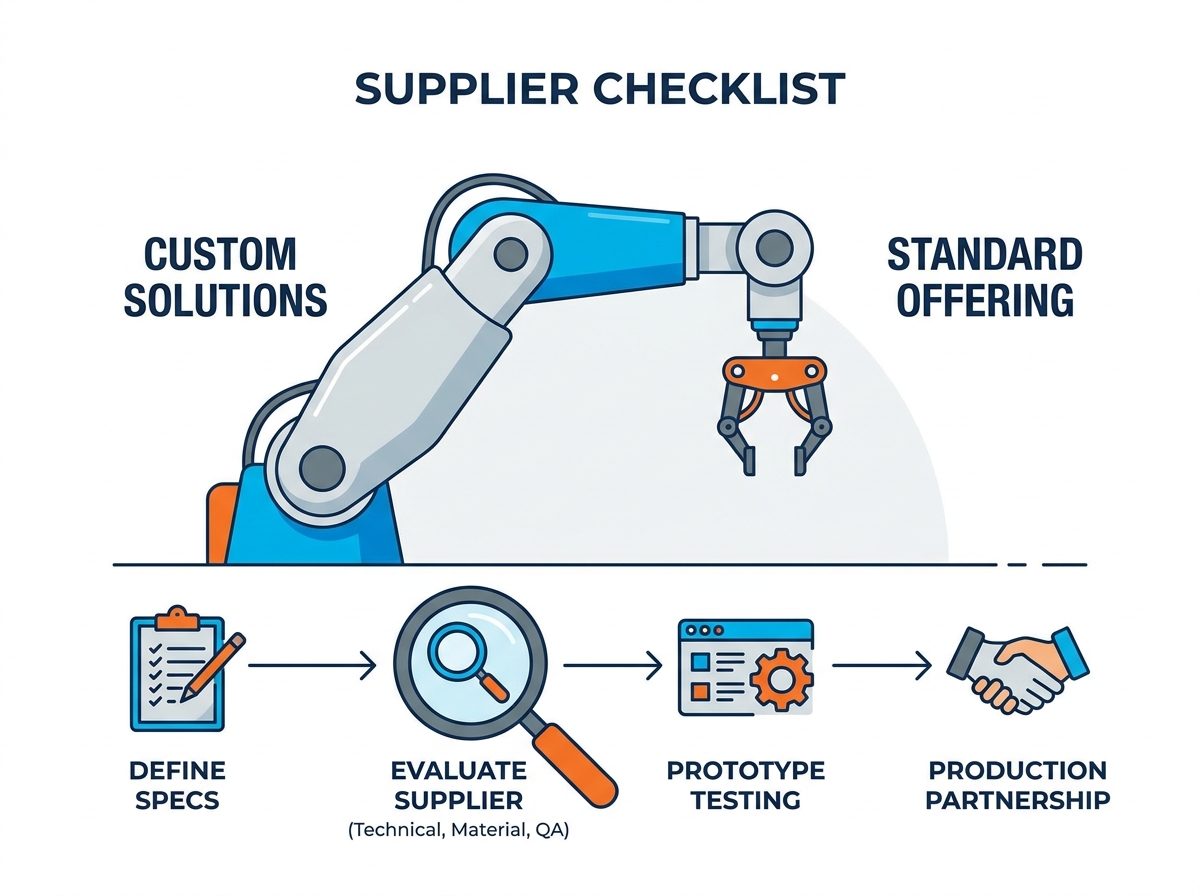
Consistent manufacturing quality determines the lifespan of your cable protection. A single weak seam can expose crucial wiring to harsh chemicals. You must audit their quality assurance protocols thoroughly before placing large orders.
A credible supplier provides comprehensive lifecycle testing data proactively. Ask for metrics on absolute flex-cycle limits. Request abrasion tests conducted under simulated heavy loads. Real-world motion creates intense localized friction points. Laboratory torsion testing verifies material endurance before actual factory deployment. They should simulate the exact movement paths your robots execute daily. This predictive data prevents unexpected mid-shift breakdowns.
Look for ISO 9001 certification as a non-negotiable baseline. This certification ensures highly consistent manufacturing processes. It also guarantees systematic defect tracking across their production lines. When a defect occurs, ISO-certified facilities can trace it back to a specific material batch. This traceability protects your facility from widespread equipment failures.
Evaluate their physical sampling process closely. Can they provide a fast-turnaround prototype? Field testing is critical before you commit to high-volume manufacturing. A quick prototype allows your maintenance team to verify fit and articulation. You install the sample on a pilot robot and run it through a standard shift. This physical test reveals measurement errors hidden during the CAD design phase.
Look for established and rigorous manufacturing standards. Facilities operating at the level of a Youguard robot manufacturer maintain strict traceability. They utilize precise lot control and enforce multi-stage QA inspections. They inspect raw materials upon arrival and perform pull-tests on stitched seams. This multi-layered rigor prevents defective batches from reaching your factory floor.
Technical capability matters little if the supplier cannot deliver on time. Your factory cannot pause production waiting for delayed protective covers. Evaluating their supply chain resilience ensures steady operational continuity.
Clarify standard lead times versus custom engineering lead times early. Complex specialized materials take significantly longer to source globally. Assess their inventory buffers for raw textiles and closure hardware. Do they keep your specific materials in stock year-round? This transparency prevents supply chain bottlenecks during critical facility upgrades. You need a partner who anticipates material shortages and holds safety stock.
Evaluate their flexibility on initial order sizes carefully. Ideal partners support low-volume custom runs for pilot work cells. You usually need to test just one robotic cell first. Once this cell proves successful, they should offer scalable pricing. Facility-wide rollouts require volume discounts. Avoid suppliers demanding massive minimum orders for untested custom designs.
Define the support structure clearly if a custom cover fails prematurely. A reliable supplier treats the first deployment as an iterative process. They stand firmly behind their structural warranties. If a seam tears under unforeseen stress, they redesign the closure mechanism. They do not just ship a replacement of the same flawed design. True engineering partners investigate failures and improve the next iteration continuously.
You must prepare a highly structured Request for Quote (RFQ). This approach gets you an accurate quote quickly. It also instantly tests a potential supplier's technical competence. Vague requests yield vague pricing and unreliable delivery estimates. Provide a comprehensive RFQ package including the specific parameters below.
Robot Specifications: Detail the exact make, model, and payload capacity. Specify which exact axes require protection. Common mistake: Forgetting to mention aftermarket attachments altering the robot's default profile.
Cable Harness Data: Measure the outer diameter of the entire bundle. Note the absolute minimum bend radius allowed. Detail any bulky connectors requiring special cover expansion zones.
Operational Environment: Document ambient temperature ranges accurately. List all specific chemical exposures, including exact coolant brand names. List all mechanical hazards present in the cell.
Motion Profile: Define the duty cycle and maximum movement speed. Map out specific complex articulation paths. Common mistake: Underestimating the torsion strain during tool-change sequences.
Volume & Timeline: State your prototyping deadlines clearly up front. Include your projected annual volume to secure tiered pricing structures. Specify required delivery cadences.
Table 2: RFQ Supplier Evaluation Scoring Matrix
Evaluation Criteria | Low Score (1-3) Indicator | High Score (8-10) Indicator |
|---|---|---|
Custom Engineering | Offers only standard sizes, relies on zip-ties. | Provides CAD mockups, custom zipper/Velcro closures. |
Material Data | Vague claims ("heat resistant"). | Provides UL/ISO lab test reports, material data sheets. |
Prototyping Speed | Requires full MOQ for first run, takes 8+ weeks. | Delivers single pilot prototype within 2-4 weeks. |
Quality Auditing | No formal QA documented. | ISO 9001 certified, full batch traceability. |
Sourcing custom robotic cable covers acts as a direct investment in facility uptime. Evaluating suppliers on material science, QA protocols, and custom engineering capabilities filters out high-risk vendors easily. You must look beyond standard catalog offerings to protect expensive capital equipment. Insist on laboratory-tested materials matching your exact environmental hazards. Require fast-turnaround prototypes to validate fit and kinematic freedom physically. Use the RFQ preparation checklist provided above to build your technical requirements document today. Begin initiating structured, data-driven conversations with your top shortlisted suppliers. Book technical consultation calls to review their prototype sampling processes and secure reliable factory automation.
A: Depending on material availability and design complexity, a reliable OEM supplier typically delivers an initial prototype for field testing within 2 to 4 weeks.
A: Standard protection usually involves generic, cut-to-length corrugated tubing or wraps. Custom solutions are dimensionally tailored to specific robot geometries and engineered with multi-layered materials to withstand unique environmental hazards without restricting movement.
A: Beyond the robot make and model, the most critical details are the exact environmental hazards (e.g., chemical types, max temperatures) and the dynamic movement profile, as these dictate the base material and closure mechanisms required.
A: While exact lifespans vary based on duty cycles and environmental severity, reputable suppliers will provide estimated flex-cycle data based on standardized torsion and abrasion testing of the chosen materials.


