
English 
T: +86-21-55896873
E: info@youguard.cn
E: info@youguard.cn
8th Floor, Building 3, 999 Jiangyue Road, Minhang District, Shanghai
Views: 0 Author: Site Editor Publish Time: 2026-10-08 Origin: Site


In automotive paint lines, static electricity presents a severe safety hazard due to highly combustible solvent environments. It also creates a massive quality control liability by constantly attracting dust and overspray. Manufacturers often struggle to maintain a clean application zone while protecting expensive robotic assets.
Specifying the right protective barrier requires balancing robotic articulation, chemical resistance, and rigorous electrostatic discharge (ESD) standards. Standard plastic sheeting or generic textiles simply cannot handle these extreme operational demands safely. They generate friction, build up dangerous charges, and shed micro-fibers into fresh clearcoats.
This guide outlines the technical criteria, compliance requirements, and implementation realities necessary to evaluate and source reliable anti-static covers for industrial painting environments. You will learn to navigate material specifications, understand fitment challenges, and establish proper grounding protocols. Implementing these strategies will protect your equipment, ensure worker safety, and dramatically reduce costly post-paint rework.
Compliance is non-negotiable: Covers must meet ATEX or local hazardous location standards for explosive atmospheres.
Material dictates performance: Lint-free, solvent-resistant fabrics with embedded conductive threads are required to dissipate static effectively.
Grounding is a system-level issue: A cover is only effective if properly grounded to the robot and the booth infrastructure.
Fit impacts ROI: Poorly fitted covers restrict multi-axis movement, causing premature tearing and workflow interruptions.
Automotive finishing demands absolute perfection. Unmitigated static acts like a powerful magnet inside the application zone. Airborne particulates cling directly to the exposed robot arms. When sudden robotic motion shakes these particles loose, they fall directly onto the fresh vehicle body. This phenomenon leads to severe paint inclusions. You must then pay for costly post-paint polishing, manual buffing, or complete rework. Purpose-built robot painting protective covers mitigate this problem completely. They actively bleed off charges before dust can accumulate.
Combustible solvents fill modern paint booths constantly. This environment creates a recognized high-risk zone for any manufacturing facility. Standard plastics generate frictional static buildup easily during routine movement. A simple unseen spark can instantly ignite lingering solvent vapors. The resulting explosion risks human lives and destroys millions in facility infrastructure. Implementing specialized ESD fabrics becomes a mandatory risk mitigation strategy rather than an optional upgrade.
Unprotected robots require frequent and aggressive cleaning downtime. Paint accumulation damages sensitive robotic joints over time. Solvents used for manual cleaning degrade servo seals. Properly specified barriers reduce these workflow interruptions. They physically block overspray from reaching crucial mechanical components. This proactive barrier extends the mean time between failures (MTBF) significantly. Your production line runs smoothly, safely, and predictably across multiple shifts.
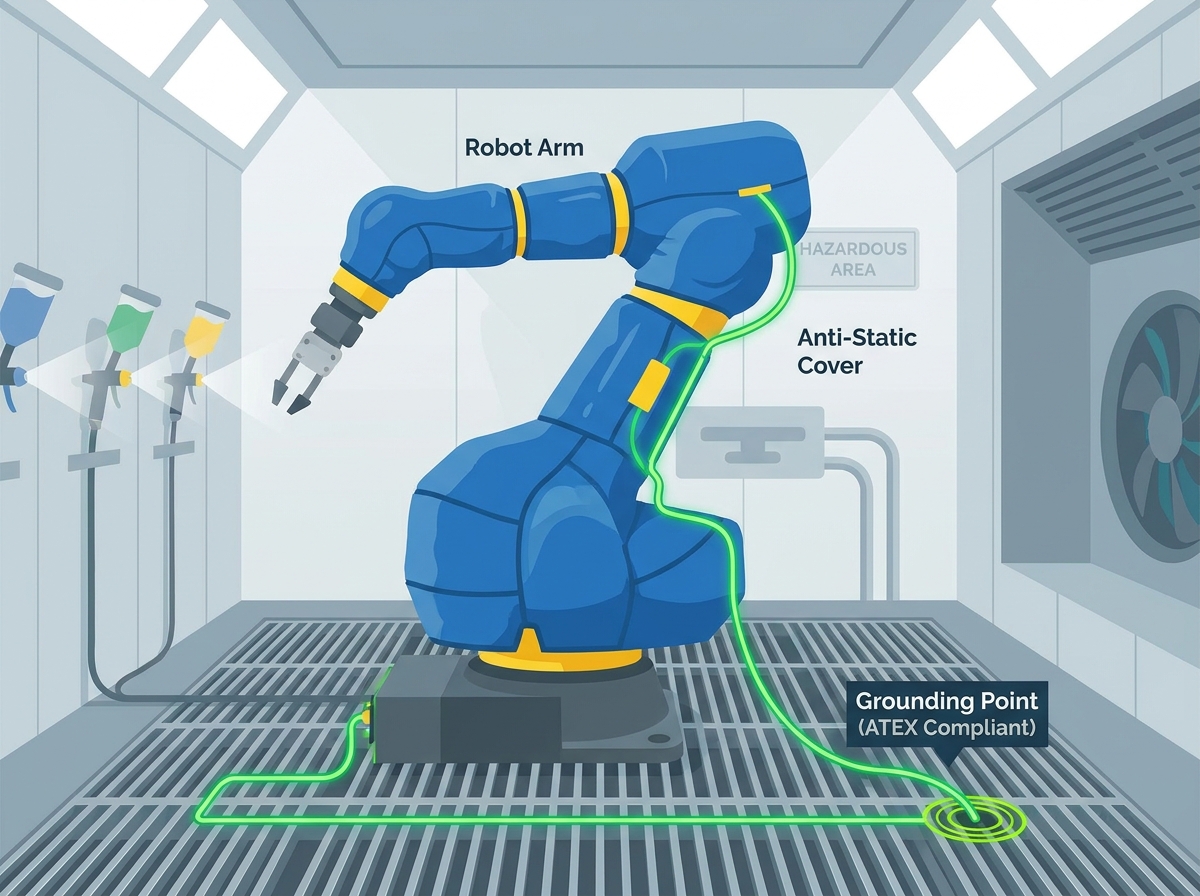
Material composition dictates both safety and functional performance. We define acceptable ohms-per-square ranges to classify industrial fabrics accurately. True static-dissipative materials must fall between 106 and 109 ohms per square. They bleed electrical charge slowly and safely to the ground. Conductive materials transfer charge too fast, causing micro-sparks. Simply calling something an "anti-static" product is never enough for compliance. You need highly specific surface resistivity thresholds.
Booth environments remain incredibly harsh on textiles. Covers endure prolonged daily exposure to automotive clearcoats and heavy basecoats. Aggressive cleaning solvents like Methyl Ethyl Ketone (MEK) and Isopropyl Alcohol (IPA) easily degrade weak fabrics. Premium anti-static robot covers withstand these potent chemicals seamlessly. They retain their physical integrity and conductive properties over thousands of motion cycles.
Shedding microscopic fibers will ruin any pristine paint job immediately. Therefore, fabrics must feature inherently continuous-filament construction. Spun yarns break easily under tension and release lint. Specialized polyesters utilizing woven carbon grids perform best here. They ensure no foreign fibers ever drop into the wet finish.
Modern servo motors generate significant internal heat during rapid painting trajectories. A completely solid, impermeable barrier traps this heat inside the casing. This thermal buildup triggers unexpected motor faults and emergency line stoppages. Engineers must balance heavy overspray protection against required breathability. Advanced microporous layers allow heat dissipation while successfully blocking liquid paint penetration.
Material Specification Assessment Criteria
Performance Metric | Required Standard | Operational Impact |
|---|---|---|
Surface Resistivity | 106 to 109 ohms/sq | Prevents sudden, high-energy static discharges. |
Solvent Resistance | High (MEK, IPA compatible) | Ensures longevity during intensive daily cleaning. |
Particle Shedding | ISO Class 4 equivalent | Eliminates fiber contamination in fresh paint. |
Thermal Breathability | Permeable to air/vapor | Prevents servo motor overheating and faults. |
Choosing between a custom and universal fit determines long-term success. Generic robot covers for paint booths often fail during the first week of operation. They suffer from terrible joint bunching at complex angles. They severely restrict critical axis movements. Automotive lines utilize highly agile 6-axis robots. A "one size fits all" approach stresses the mechanical joints and tears the fabric prematurely.
We specify engineered covers utilizing strategic expansion pleats. Dynamic joint designs accommodate extreme reach and complex trajectory angles. They allow full 6-axis articulation safely. The robot moves freely without stressing the protective fabric. Custom tailoring accounts for bulky air lines, fluid hoses, and external wiring harnesses.
Fastening mechanisms require careful evaluation before deployment. Zippers, Velcro strips, and metal snaps hold everything together. However, they introduce hidden risks. Fasteners must remain strictly non-sparking. They need exceptionally high paint resistance. Secure overlapping flaps should cover them entirely. This prevents fasteners from accidentally catching on nearby hoses or cables during high-speed rotations.
Shift changes happen fast, making ease of maintenance crucial.
Assess the total time required for installation.
Ensure a single operator can easily install or remove the unit.
Verify zippers flow smoothly around complex wrist joints.
Confirm routine maintenance ports remain accessible without full removal.
Cumbersome designs waste valuable labor hours. Routine maintenance intervals require quick, unhindered access to the machine underneath.
A highly conductive cover does absolutely nothing if left physically isolated. It must establish a continuous path to the earth. You must connect it directly to the robot grounding system or the booth floor grates. We specify integrated grounding cables stitched securely into the fabric. Define clear, bare-metal contact points for every installation.
Vendor safety claims require strict independent verification. Look for explicit ATEX Zone 1 or Zone 2 compliance ratings. North American facilities usually require equivalent Class I Division 1 ratings. These standards govern equipment used in explosive atmospheres. Relying solely on internal vendor marketing puts your facility at immense legal and physical risk.
Do not accept verbal promises regarding electrostatic discharge capabilities. Request independent laboratory testing reports immediately. Verify all ESD properties and surface resistivity measurements. Check specific flammability ratings before you finalize any procurement orders. Keep these compliance documents securely on file for future safety audits.
Real-world conditions constantly threaten to degrade established grounding paths. Several common installation mistakes occur regularly:
Operators attach grounding clips over painted metal surfaces.
Heavy overspray coats the grounding contact points over time.
Moving cables snag and sever the thin grounding wires.
Laundering damages the internal conductive carbon threads.
Cured paint acts as a highly effective electrical insulator. It easily breaks the grounding path. Maintenance teams must clean these connection points diligently.
Never procure a fleet-wide solution blindly based on paper specifications alone. Order a prototype sample cover for a single cell first. Test the fitment during actual, high-speed production runs. Monitor the fabric behavior during complex trajectory painting. Observe if it bunches up around the wrist or restricting base movements. Field testing reveals design flaws rapidly.
Lifecycle and laundering capabilities determine long-term operational feasibility. Can you wash the covers safely in commercial facilities? Removing heavy overspray is periodically necessary. However, rigorous laundering must not wash out the embedded anti-static properties. Determine your expected fabric lifecycle early. You must decide between lightweight single-use disposables and robust reusable options. Reusable options require a dedicated logistics loop for cleaning and inspection.
Evaluate your chosen vendor's overall supply chain capacity. Can they handle immediate fleet-wide rollouts? Fast delivery matters when unpredictable damage occurs. They must quickly replace torn units locally. Delayed replacement shipments cause unacceptable line stoppages. Consistent product availability ensures continuous production without unexpected interruptions. Ask about their localized inventory holding strategies.
When shortlisting partners, request detailed material data sheets immediately. Ask for reference contacts from similar automotive facilities. Verify their past performance resolving fitment issues. A reliable vendor acts as an engineering partner, not just a textile supplier. They should offer iterative design improvements based on your specific robotic programming.
Specifying anti-static covers is a highly specialized engineering task. It directly impacts plant safety and final finish quality. Precision matters immensely when dealing with explosive atmospheres and pristine automotive clearcoats. Standard textiles simply introduce unacceptable operational hazards.
Take immediate action to secure your production lines. First, advise procurement and engineering teams to audit current static mitigation strategies. Next, request technical material data sheets from prospective vendors to verify ATEX compliance. Finally, initiate a limited pilot program in a single paint cell. Monitor the results, verify grounding continuity, and scale the successful solution across your facility.
A: Variables heavily dictate their lifespan. Daily paint volume, chemical solvent exposure, and laundering frequency matter most. Typically, they last anywhere between 3 to 12 months. Routine visual inspections and proper laundering techniques help maximize this duration safely.
A: Resistance ranges define their performance. Dissipative materials offer resistance between 106 and 109 ohms. Conductive materials have much lower resistance. Dissipative fabrics are preferred in paint booths because they bleed charges slowly. This controlled bleed prevents rapid, high-energy sparks.
A: Use integrated grounding straps sewn into the cover. Ensure clean, bare metal-to-metal contact between the cover clip and the robot base or booth grates. Beware of heavy overspray. Cured paint acts as an insulator, breaking the vital grounding path over time.
A: Cheap chemical coatings wash off easily after a few cycles. Premium covers use woven-in carbon or metallic threads. These physically embedded threads offer permanent protection. They withstand rigorous commercial laundering and harsh solvent exposure without losing their efficacy.


