
English 
T: +86-21-55896873
E: info@youguard.cn
E: info@youguard.cn
8th Floor, Building 3, 999 Jiangyue Road, Minhang District, Shanghai
Views: 0 Author: Site Editor Publish Time: 2026-09-15 Origin: Site


Unplanned downtime caused by severed or shorted dress pack cables represents a highly preventable operational failure. Manufacturing plants lose significant revenue when automated lines halt abruptly due to avoidable harness damage. We often forget protective covers serve as consumable wear parts rather than lifetime components. Their primary function requires them to sacrifice themselves. They shield sensitive internal harnesses from extreme industrial environments and mechanical friction.
To maximize equipment lifespan, you need a standardized inspection framework. This framework eliminates guesswork when assessing cover degradation. This guide explores how to evaluate static wear, check dynamic fit, and determine precise replacement intervals. You will learn actionable steps to transition your facility from reactive fixes to predictive, highly reliable maintenance routines.
Effective robot arm cable cover maintenance prevents unexpected cable failure and expensive production halts.
Inspection requires assessing both static wear (abrasions, tears) and dynamic fit (bunching, snagging during full-range articulation).
Replacement decisions should be driven by hard triggers—such as closure failure or substrate exposure—rather than subjective estimates.
Upgrading cover materials based on specific environmental stressors (e.g., weld spatter vs. chemical washdown) improves overall MTBF (Mean Time Between Failures).
Degraded cable covers lead directly to premature cable fatigue. When industrial environments compromise an outer sleeve, internal wires suffer rapid abrasion. This exposure causes axis binding and creates severe electrical compliance hazards. Exposed shielding acts as an immediate safety violation on the factory floor. Plant managers must treat degraded covers as urgent systemic risks.
Defining success in this domain requires a paradigm shift. True success means predicting and scheduling replacements during planned downtime. Proactive scheduling protects Overall Equipment Effectiveness (OEE). You maintain continuous production flow when you remove reactive maintenance from the equation. Operational stability relies heavily on this predictive approach.
Inadequate attention to robot protective cover maintenance impacts adjacent machinery negatively. Snagged dress packs add tremendous physical strain to servo motors. These motors draw excessive current when fighting against bound cables. This added friction triggers overload alarms and burns out expensive robotic joints. Furthermore, compromised covers trap hazardous debris. This trapped debris ruins production batches in cleanroom environments. Fast-moving consumer goods (FMCG) lines also face strict hygiene failures when torn covers shed particulate matter.
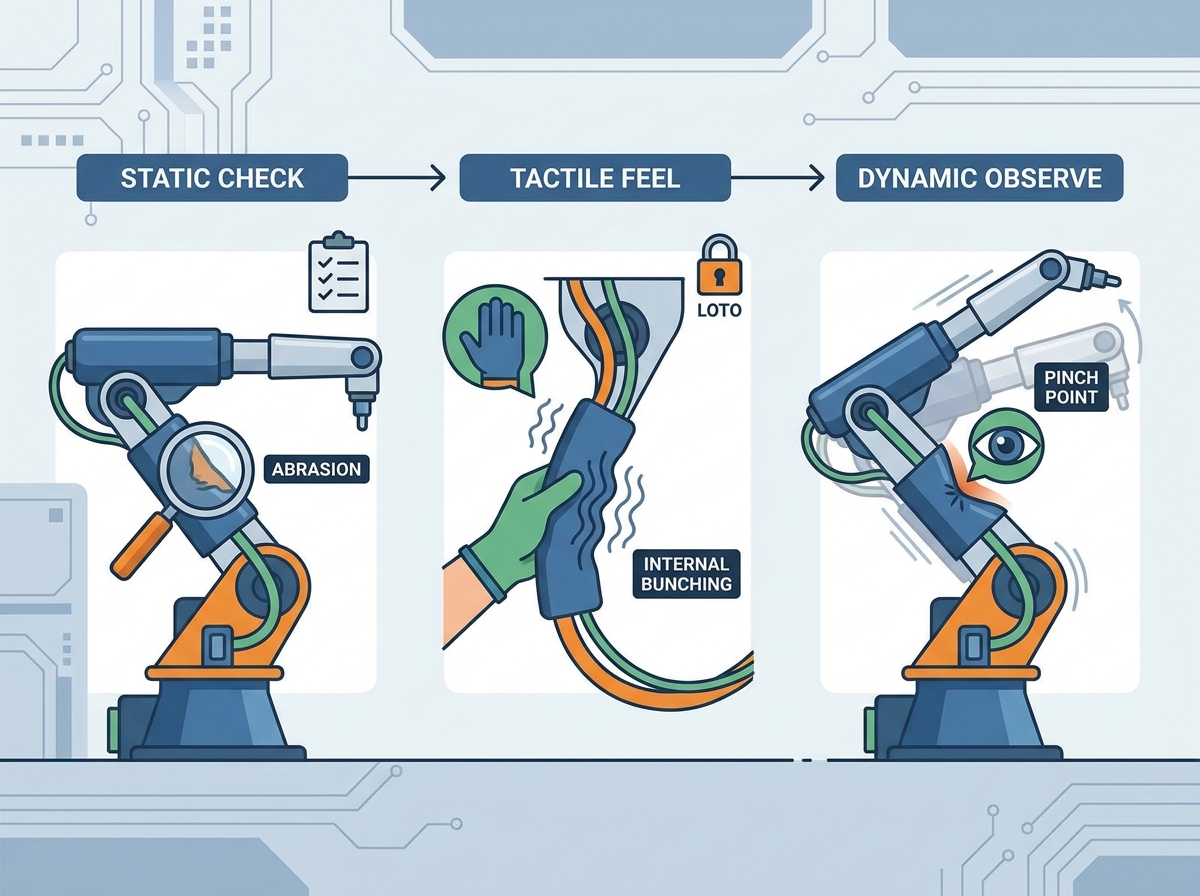
Executing thorough robot arm cable cover maintenance requires a methodical approach. You must evaluate the equipment in multiple states to capture all potential failure points. Follow these distinct phases to ensure complete inspection coverage.
You must prioritize safety before touching any robotic cell. Engage strict lock out / tag out (LOTO) protocols immediately. Verify zero residual energy remains in the system. Tactile inspections place technicians directly inside the robot envelope. Complete immobilization guarantees technician safety during close-proximity evaluations.
Perform a comprehensive visual scan before manipulating the fabric. You should look for obvious signs of environmental damage. Pay special attention to high-stress articulation zones.
Inspect Axes 3 through 6 closely. These joints experience the most severe articulation.
Check the entire surface for chemical degradation or discoloration.
Identify localized melting spots caused by weld spatter or hot debris.
Note any fabric fraying near mounting clamps and rotary rings.
Visual checks alone miss critical internal failures. You must use your hands to assess material integrity. Feeling the cover reveals hidden degradation.
Feel along the internal cavity for cable bunching.
Check for hardening of the cover material. Stiff fabric indicates severe thermal or chemical aging.
Test the physical integrity of all closure systems.
Verify Velcro grip strength remains strong against pulling forces.
Ensure zipper teeth align perfectly without missing segments.
Confirm all snap buttons lock securely into place.
Static checks cannot simulate production stresses. You must observe the equipment in motion to spot binding issues. Clear the cell and restore power safely.
Run the robot slowly through its most extreme programmed path.
Look closely for dangerous pinch points around joint housings.
Observe if the cover drags against end-of-arm tooling.
Identify any excessive tension pulling on the mounting brackets.
Maintenance technicians often struggle to decide when to discard a cover. You need hard evaluation dimensions to remove subjective guesswork. Standardizing these decisions prevents both premature disposal and catastrophic failure.
Evaluation Dimension | Visible Symptoms | Required Action |
|---|---|---|
Acceptable Wear | Minor surface discoloration; slight fuzzing of outer textiles; localized superficial scuffs. | Keep in service. Log condition in maintenance software. |
Marginal (Watch/Repair) | Small isolated punctures not exposing cables; minor loss of elasticity in dynamic zones. | Apply localized patch (per facility SOP). Monitor weekly. |
Hard Trigger: Structural | Any tear exposing internal wiring, pneumatic lines, or shielding. | Replace immediately before next production shift. |
Hard Trigger: Closure | Failure of the seam, broken zipper, or compromised Velcro allowing contaminants inside. | Replace cover. Internal harness is no longer protected. |
Hard Trigger: Material | Material embrittlement; cover cracks audibly when flexed by hand. Irreversible contamination (e.g., saturated by cutting fluids). | Scrap and replace. Upgrade material specification if necessary. |
Understanding these triggers saves time and money. Minor surface discoloration requires no intervention. You can safely patch small isolated punctures depending on your facility guidelines. However, you must enforce strict hard replacement triggers. Any tear exposing internal wiring demands immediate replacement. Seam failures allow aggressive contaminants inside the dress pack. Material embrittlement causes the fabric to crack during basic flexing. Irreversible contamination from cutting fluids destroys the protective barrier completely.
Implementation realities dictate clear mechanical rules. A poorly fitted cover causes just as much damage as operating without one. You must balance slack and tension perfectly to ensure maximum longevity.
Applying too much tension restricts joint articulation severely. This tightness causes premature pulling on sensitive cable connectors. Excessive tension also limits maximum robot reach during complex paths. Conversely, applying too much slack creates a dangerous parachute effect. Loose material risks catastrophic snags on external machinery. Baggy covers catch easily on safety fencing or passing raw materials.
You must verify all mounting points carefully. Ensure rotary rings, clamps, and strain reliefs secure the cover properly. They must hold the fabric firmly without crushing the internal dress pack. Over-tightening clamps crushes pneumatic airlines and breaks fiber optic strands.
Validating fitment requires careful observation after making physical adjustments. You must test the new fitment under real-world conditions. Run a dry cycle at full operational speed. Observe the real-time aerodynamics of the fabric. Check mechanical clearance around tight corners. Adjust the mounting clamps until the cover flows smoothly through the entire robotic envelope.
Operationalizing the inspection process across a large fleet requires scalable procedures. You cannot rely on individual memory to trigger inspections. Structured maintenance schedules prevent catastrophic mid-shift failures.
Interval | Personnel Level | Action Items |
|---|---|---|
Shift / Daily | Machine Operator | Quick visual check for catastrophic tears, obvious dragging, or loose closure mechanisms. |
Monthly / 500-Hour | Maintenance Technician | Tactile inspection of material. Joint-articulation observation during slow jogging. Verify clamp torque. |
Annual / Teardown | Automation Engineer | Complete cover removal. Deep internal cleaning. Detailed electrical harness inspection. Install new cover if degraded. |
Machine operators handle the daily shift checks. They look for catastrophic tears or loose closures before starting production. Technicians manage the monthly tactile inspections. They feel for internal bunching and observe joint articulation closely. Engineers handle the annual teardowns. They remove the cover completely to inspect the bare harness.
Computerized Maintenance Management System (CMMS) integration drastically improves reliability. You must log specific wear rates directly into your maintenance software. Documenting these patterns helps transition your team from reactive scrambling to predictive scheduling. Data-driven insights reveal exactly when a cover will fail before it actually breaks.
When inspections trigger a replacement, you must evaluate current solution categories. Simply reordering the exact same part number often repeats past failures. Evaluate if the current cover specification truly matches your actual application.
Material selection dictates long-term survival in aggressive environments. Welding and foundry applications require extreme heat resistance. You should select Kevlar or aluminized fiberglass to repel molten spatter effectively. CNC machining environments deploy heavy coolants and oils. You need polyurethane-coated fabrics to resist continuous chemical breakdown. FMCG and food-grade sectors operate under strict hygiene regulations. You must choose FDA-compliant, washdown-ready, non-shedding materials to prevent product contamination.
Evaluate closure systems carefully to minimize implementation risks. The closure type directly impacts your required installation downtime. Zippers and industrial Velcro allow quick in-situ installation. Technicians can wrap these around existing harnesses without disconnecting any cables. Conversely, solid-tube covers provide seamless protection but demand extensive labor. Installing them requires complete dress pack teardowns and connector unpinning.
Apply logical shortlisting when selecting your final product. You must balance upfront material costs against installation labor. Factor in the expected lifespan operating within your specific manufacturing environment. A slightly more expensive Velcro-based cover often saves thousands in reduced installation labor.
Standardized protective sleeve inspections serve as a low-cost insurance policy for high-value robotic assets. Implementing rigid guidelines ensures you catch minor abrasions before they escalate into severed cables and blown servo motors. You protect both machinery and overall production flow.
Take immediate action to secure your automation lines:
Audit the current physical state of all robotic sleeves on your factory floor today.
Establish clear, non-negotiable "replace" criteria for your maintenance technicians.
Update your CMMS to include shift, monthly, and annual check intervals.
Ensure your replacement inventory strictly matches the specific chemical or thermal hazards of each individual robotic cell.
A: Replacement depends heavily on environmental stressors and operational cycles, not fixed calendar dates. Harsh welding cells might require quarterly replacements, while cleanroom covers can last years. You should base replacement entirely on hard inspection triggers like material embrittlement, closure failure, or exposed substrate.
A: You should never use tape as a permanent fix. Tape changes the fabric's flexibility profile, traps unwanted heat, and leaves sticky adhesive residue on moving cables. It serves strictly as a temporary stopgap to finish a shift until a proper replacement is installed.
A: No, a tighter cover actually causes significant damage. Proper slack is an engineering necessity. It allows full multi-axis rotation without stressing internal harness connectors. Excessive tension restricts robot reach and actively pulls wiring apart during extreme articulation.


