
English 
T: +86-21-55896873
E: info@youguard.cn
E: info@youguard.cn
8th Floor, Building 3, 999 Jiangyue Road, Minhang District, Shanghai
Views: 0 Author: Site Editor Publish Time: 2025-08-15 Origin: Site


Spatter pits a wrist cover—next comes sensor drift and a quality issue. These visible signs indicate that thermal hazards on production lines are compromising your robot’s performance and reliability. Selecting the right heat-resistant robot protection is critical for preventing damage, maintaining precision, and ensuring consistent product quality in harsh welding, foundry, and other high-temperature environments. This article offers technical guidance on identifying thermal hazards, choosing suitable materials and coatings, reinforcing critical areas, and ensuring motion compatibility to safeguard your robotic investments.
Thermal hazards in industrial settings arise from several sources, each requiring distinct protective strategies. Understanding the differences between radiant heat, convective heat, and molten spatter is key to effective robot protective cover selection.
Radiant heat transfers energy through electromagnetic waves emitted by hot surfaces or flames. This heat can cause surface temperatures on robot components to rise rapidly, leading to material degradation or sensor malfunction. Reflective robot covers with aluminized surfaces are the most effective barrier, reflecting radiant energy away before it penetrates to sensitive parts.
Convective heat occurs when hot air currents or gas flows physically contact the robot’s surface, transferring heat through direct contact. Unlike radiant heat, convective heat can be localized and fluctuate with environmental conditions. Materials with insulating properties, such as aramid fabrics, help to reduce heat absorption and shield delicate electronics.
Molten spatter, produced primarily during welding or foundry operations, consists of tiny droplets of molten metal expelled at high temperature and velocity. These droplets can cause severe localized damage, creating pits, abrasions, and even holes in protective covers. Targeted reinforcements and spatter-resistant coatings are vital to absorb this impact and preserve the cover’s integrity.
Choosing the right materials for thermal protection involves balancing reflectivity, insulation, durability, and flexibility. Industry-leading fabrics and coatings offer tailored solutions depending on specific production line hazards.
Reflective aluminized layers function by bouncing radiant heat away from the robot, significantly lowering surface temperatures. These layers typically consist of aluminum foil laminated onto durable textiles, combining heat reflection with mechanical strength.
ARMATEX-style fabrics are aramid-based materials well-known for their exceptional heat resistance, tensile strength, and flexibility. These fabrics form a resilient base layer capable of withstanding convective heat and physical wear from routine robot movements.
Ceramic reinforcements, strategically applied to high-impact zones such as wrists, elbows, and end-of-arm tooling, provide enhanced protection against molten spatter. Ceramic patches resist abrasion and molten metal penetration, preventing rapid cover degradation.
Youguard integrates these materials into multi-layered protective covers, ensuring comprehensive defense against the full spectrum of thermal hazards while maintaining necessary flexibility for robotic motion.
Spatter damage is one of the most common causes of robot cover failure in welding and foundry operations. Effective spatter management involves reinforcing vulnerable areas without compromising mobility.
Wrist covers and joint areas are particularly susceptible to direct spatter exposure due to proximity to welding torches or molten metal pours. Sacrificial patches made from thicker heat-resistant fabrics serve as protective buffers, absorbing damage that would otherwise penetrate the cover.
Seams and stitch lines represent structural weaknesses where molten metal can exploit gaps. Reinforcing seams with flame-retardant tapes, double stitching, or ultrasonic welding significantly improves durability and reduces risk of spatter intrusion.
Youguard’s modular design approach enables easy replacement of sacrificial patches, allowing maintenance teams to rapidly address wear and tear without replacing entire covers, minimizing downtime.
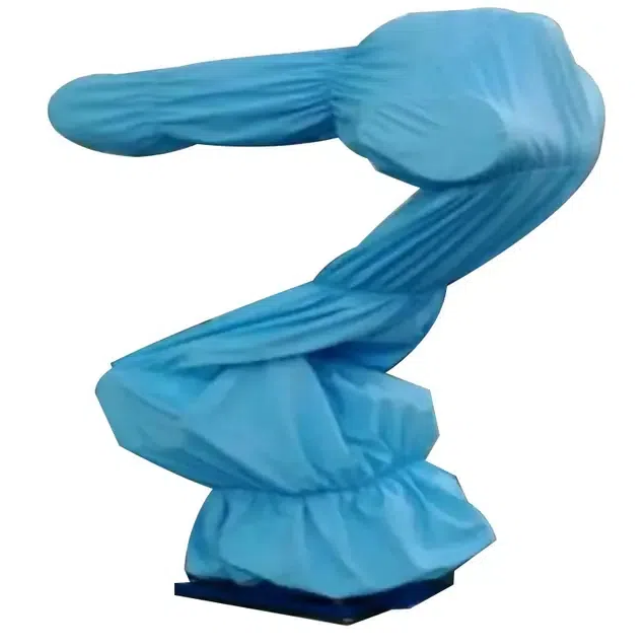
Protective covers must maintain their protective properties without hindering robotic movement, even under continuous thermal stress.
Materials exposed to high heat can become brittle or lose elasticity, increasing risk of cracking or tearing during repeated bending and twisting. Flexural failure can impair both the robot’s precision and the cover’s protective function.
Selecting fabrics with inherent flexural resilience is crucial. Aramid blends and engineered textiles used by Youguard provide excellent thermal resistance while retaining the flexibility needed for complex robot motions.
Balancing material thickness is also vital—too thin, and the cover risks premature damage; too thick, and mobility is compromised. Youguard uses layered fabric constructions to optimize this balance, providing robust thermal protection without sacrificing dexterity.
Ensuring that heat-resistant robot covers comply with safety regulations and are properly maintained extends robot life and safeguards personnel.
Covers designed for welding and foundry environments should comply with certifications like NFPA 2112 (Standard on Flame-Resistant Clothing) and ISO 15066 (Safety Requirements for Collaborative Robots). Maintaining documentation of materials and compliance supports audit readiness and workplace safety.
Scheduled inspections—monthly or aligned with planned maintenance shutdowns—should verify cover integrity, looking for heat damage, seam degradation, or signs of flexibility loss. Early detection enables timely repairs, preventing costly failures.
Youguard offers retrofit services, allowing factories to upgrade existing robot protective covers with modern temperature-controlled and flame-retardant solutions, often without halting production for extended periods.
Implementing heat-resistant covers should be coordinated with overall robot maintenance plans. Covers should be inspected during routine robot servicing to identify wear before it impacts operation.
Operators should receive training on proper cover handling, cleaning, and replacement schedules. Youguard provides detailed guidelines and support to facilitate smooth integration of protective solutions.
Every robotic deployment is unique. Youguard offers custom-fit heat-resistant covers tailored for major brands like ABB, KUKA, and FANUC. Customization ensures optimal fit, minimizing gaps that could allow heat ingress and preventing interference with robot kinematics.
Custom designs can include modular panels, quick-release attachments, and service-access openings, enhancing usability and maintenance efficiency in demanding thermal environments.
Heat-resistant robot protection offers a critical balance between safeguarding equipment and maintaining operational agility on welding, foundry, and high-temperature production lines. Youguard’s temperature-controlled and flame-retardant robot protective covers are engineered with cutting-edge materials and design innovations to meet these challenges. Protect your robotic assets, enhance safety, and maintain production quality by contacting Youguard today for tailored thermal protection solutions.


