
English 
T: +86-21-55896873
E: info@youguard.cn
E: info@youguard.cn
8th Floor, Building 3, 999 Jiangyue Road, Minhang District, Shanghai
Views: 0 Author: Site Editor Publish Time: 2025-08-27 Origin: Site


A mis-fitted robot protective cover rubbing against a gearbox might seem minor — until it causes premature abrasion and triggers program faults, halting production. Ensuring your robot cover fits precisely is critical to maintaining reliable operation and extending equipment life. Off-the-shelf covers often fall short when confronted with the unique dimensions and environmental challenges of ABB, KUKA, and FANUC robots. This article explains when custom-fit robot protective covers become necessary, how to specify them, and why Youguard’s tailored solutions deliver superior protection and serviceability.
Standard robot protective covers are designed with general dimensions and may not accommodate the exact movement patterns and component layouts of specific robot models. Several issues indicate the need for a custom cover:
If a cover restricts the robot’s full range of motion or rubs against moving parts like gearboxes and joints, it can cause abrasion, material wear, and eventually lead to mechanical failure. This kind of interference not only reduces the lifespan of the protective cover but also risks damage to the robot itself, potentially leading to costly downtime. For example, if a cover is too tight or improperly shaped, it may catch on cables or obstruct the robot arm’s reach, affecting precision and speed.
Improperly designed covers can trap heat generated by the robot or nearby processes such as welding or polishing. Heat buildup inside the protective enclosure accelerates wear on motors, sensors, and wiring. Over time, this can degrade the robot’s performance and increase the risk of unexpected failures. Custom covers incorporate ventilation solutions or use heat-resistant materials that manage thermal loads, ensuring the robot operates within safe temperature limits.
A robot protective cover that doesn’t seal correctly leaves gaps where dust, moisture, or contaminants can enter, negating its protective purpose. These leaks compromise the robot’s defense, increasing the likelihood of abrasion, corrosion, or electrical faults. Custom-fit covers are precisely tailored to the robot’s unique contours and cable pathways, providing tight seals that effectively block environmental hazards.
Crafting a custom robot protective cover requires detailed information and planning to meet both dimensional and environmental requirements.
Every robot manufacturer designs machines with different dimensions and joint configurations. ABB’s IRB series, FANUC’s LR Mate line, and KUKA’s KR robots each have distinctive kinematic envelopes—the three-dimensional space the robot occupies during movement. Accurate measurements of these envelopes are critical in ensuring the protective cover does not impede motion or cause wear.
Additionally, different models may have variations in cable routing, sensor placements, and tooling interfaces. For instance, an ABB robot may have its cables arranged differently compared to a KUKA robot, requiring the cover design to accommodate these differences. Understanding the exact model and its specifications allows for a tailored design that fits seamlessly.
The working environment greatly influences material and design choices. Robots in welding cells are exposed to high heat, spatter, and sparks. Protective covers here need to be flame retardant and spatter-resistant. Polishing or grinding operations generate fine dust and abrasive particles, requiring durable abrasion-resistant fabrics.
Food processing and pharmaceutical environments demand hygienic, waterproof covers that withstand frequent washdowns and exposure to chemicals or steam. Mapping the hazards involved helps define material properties such as chemical resistance, waterproofing, and anti-static features that are necessary for the robot cover to perform effectively.
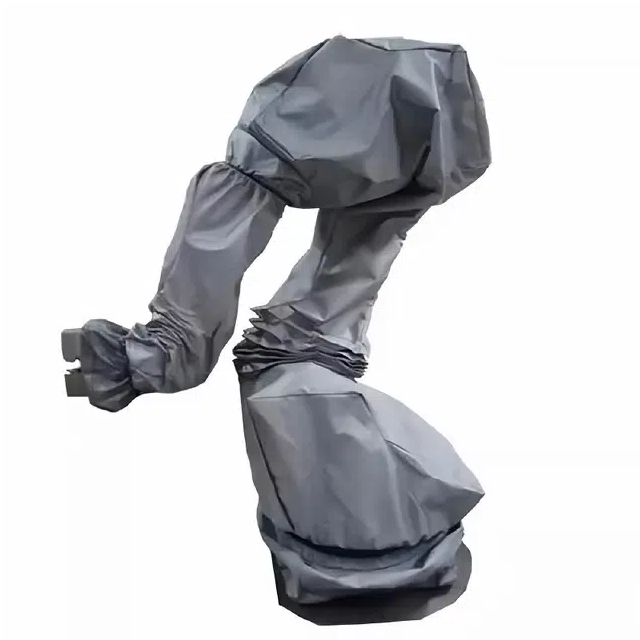
The balance between protection and usability is a key factor in custom robot protective covers.
Modular panels enable easier maintenance, allowing sections of the cover to be removed or replaced without disassembling the entire unit. This modularity can reduce downtime during repairs or inspection, providing significant operational advantages.
In contrast, full-skin suits offer seamless protection without joints or seams that can allow contaminants to enter. While this provides maximum coverage, it may complicate access to internal components for routine servicing.
Removable service panels strategically positioned at access points combine the benefits of both approaches, allowing quick access to key components such as cables or end-effectors while maintaining overall protection.
The effectiveness of a robot protective cover also depends on how easily it can be installed and removed. Common attachment methods include industrial-grade Velcro, zippers, snap fasteners, or magnetic closures. These should be robust enough to hold the cover securely during operation but allow for quick release during maintenance.
Quick-release features reduce labor time and prevent damage that might occur from forced removal. They also encourage regular inspection and cleaning, which are essential for maintaining the protective integrity and prolonging the cover’s lifespan.
Material choice is fundamental to the robot protective cover’s durability and protective capabilities.
In environments where robots undergo frequent cleaning, such as food or pharmaceutical production, covers must withstand high-pressure water jets and harsh chemicals. Laminated fabrics with waterproof coatings prevent water penetration while remaining flexible and breathable.
For robots equipped with sensitive electronics, anti-static layers prevent the buildup of static charges that can damage components or interfere with signal transmission. These layers are especially important in electronics manufacturing or cleanroom environments.
Certain areas on a robot cover are subject to increased wear, including around joints, edges, and areas in contact with tooling or the workpiece. Reinforcing these zones with tougher fabrics, double layers, or protective overlays enhances durability.
For example, welding spatter can cause rapid degradation of exposed materials if not reinforced. Youguard’s custom covers incorporate reinforcements tailored to the robot’s specific operational stress points, maximizing cover lifespan and protection.
Proper installation is essential for a custom cover to perform as intended.
Youguard employs precise template-based methods for custom cover design, starting with detailed dimensional data captured on-site. Using advanced measuring tools, engineers create an accurate 3D profile of the robot and its kinematic envelope.
Initial prototype covers are fitted on-site to verify fit and function. Feedback during this stage allows iterative refinements to ensure optimal movement clearance, sealing, and ease of maintenance. This collaborative approach guarantees the final product meets exacting standards and operational needs.
Custom-fit robot protective covers are vital for maximizing protection, functionality, and ease of maintenance, especially for ABB, KUKA, and FANUC robots with their specific size and operational nuances. Youguard specializes in tailored robot protective covers designed to meet your exact needs. Request a custom template and quote today to secure waterproof, dustproof, and durable robot protection for your robotic systems.
Explore our customization services at Youguard Custom Robot Covers or contact us for expert advice and solutions.


