
English 
T: +86-21-55896873
E: info@youguard.cn
E: info@youguard.cn
8th Floor, Building 3, 999 Jiangyue Road, Minhang District, Shanghai
Views: 0 Author: Site Editor Publish Time: 2026-05-18 Origin: Site


Automotive paint shops operate in a highly volatile, zero-tolerance environment. Vapor-rich booths continuously mix highly flammable solvents with high-speed automated machinery. This creates an extreme risk for sudden fires and massive surface contamination. You must mitigate electrostatic discharge (ESD) risks to prevent catastrophic disaster on the factory floor. Our core focus involves defining the exact engineering requirements for automobile robot anti-static protective clothing. It mitigates these dangerous ESD hazards while strictly preventing cross-contamination across your automated coating lines.
You will not find generic, surface-level advice here. This guide bypasses basic overviews to explore complex material trade-offs. We investigate stringent compliance standards like ATEX and outline the structural requirements needed for serious procurement. You will learn how to evaluate specific engineering thresholds. This ensures your highly sensitive automotive spray environments remain safe, efficient, and free from destructive coating defects.
Strict Chemical Compliance: True paint shop robot protection strictly requires 100% silicone-free materials to prevent "fish-eye" coating defects.
Certified ESD Safety: Materials must integrate verified anti-static agents meeting ATEX (ISO 80079-36) standards to operate safely in volatile solvent environments.
Low-Lint Integrity: Covers must utilize continuous-filament or specialized non-woven structures (like high-density polyethylene) to avoid particulate shedding in cleanrooms.
Kinematic Compatibility: Effective designs balance dynamic flex fatigue (at robot joints) with modular, secure closures that do not impede high-cycle spraying movements.
High-speed robot articulation generates intense friction during normal operation. This rapid movement quickly builds up dangerous static electricity across the mechanical arm. Paint booths are inherently vapor-rich environments filled with combustible atomized liquids. An unmanaged electrostatic discharge acts as a severe ignition source. It threatens both critical facility safety and human life. We must eliminate this explosion hazard entirely through proper shielding.
Beyond explosion risks, static electricity directly drives up your defect rates. A highly charged robot arm acts like an industrial magnet. It actively attracts airborne overspray and floating dust directly onto its exterior surface. Eventually, this accumulated debris flakes off mid-operation. It lands right onto the freshly painted automotive chassis below. This ruins the expensive Class-A finish and forces immediate, costly rework.
You also face severe chemical degradation on exposed robotic components. Overspray and heavy cleaning solvents often contain highly alkaline properties, regularly hitting a pH of 10 or higher. These harsh liquids aggressively attack native rubber seals and exposed cabling. Without proper defense, actuators suffer premature mechanical failure, freezing production lines unexpectedly.
Deploying specialized paint shop robot protection serves as an upfront insurance policy. You deploy it to protect against specific financial bleeding. Consider the specific returns on this investment:
Downtime Prevention: Eliminates sudden line stoppages caused by actuator chemical failure.
Defect Reduction: Drastically lowers the volume of rejected chassis requiring manual repainting.
Lifespan Extension: Shields expensive internal servo motors from corrosive atmospheric penetration.
Standard industrial shields often rely heavily on silicone. Silicone provides excellent flexibility and extreme temperature resistance. However, you cannot use it inside automotive paint shops. You must enforce a strict silicone-free mandate during procurement. Silicone contamination causes catastrophic "fish-eye" paint adhesion failures on car bodies. Instead, you should rely on specialized PES (polyester) and elastane blends. Specific safe polyurethane alternatives also work well.
You must evaluate how static dissipation actually functions within the fabric. Some manufacturers use cheap surface-level anti-static coatings. These superficial coatings degrade very quickly under frequent chemical washdowns. Inherently dissipative woven carbon grids offer a vastly superior alternative. They embed conductive threads directly into the fabric matrix. This structural approach ensures long-lasting safety that survives aggressive cleaning cycles.
Low-lint characteristics prove equally crucial for quality control. You cannot allow microscopic fibers to shed into the highly filtered paint environment. Flash-spun high-density polyethylene (HDPE) provides an outstanding aerosol barrier. It stops wet overspray without polluting the cleanroom with broken fibers.
Chemical compatibility always involves engineering trade-offs. You must carefully balance joint flex fatigue against raw solvent resilience. Daily paint line purging uses highly aggressive flushing fluids like xylene or MEK. You need high-performance antistatic materials that resist these specific chemicals without stiffening, cracking, or losing their conductive properties over time.
Material Type | Anti-Static Mechanism | Chemical Resistance | Best Application Scenario |
|---|---|---|---|
Surface-Coated Polyurethane | Chemical spray application | Moderate (Degrades under heavy wash) | Light-duty, infrequent solvent exposure |
Carbon-Grid PES/Elastane | Embedded conductive woven threads | High (Resists alkaline cleaners) | High-flex joints, standard paint booths |
Flash-Spun HDPE | Inherent low-lint structure | High (Excellent aerosol barrier) | Strict cleanroom painting environments |
Best Practice: Always request a physical material swatch. Soak it in your exact line-purging solvent for 48 hours to verify it does not stiffen or leach contaminants.
Common Mistake: Procuring general-purpose industrial shields that contain hidden silicone gaskets. Even microscopic silicone off-gassing will ruin an entire shift of painted vehicles.
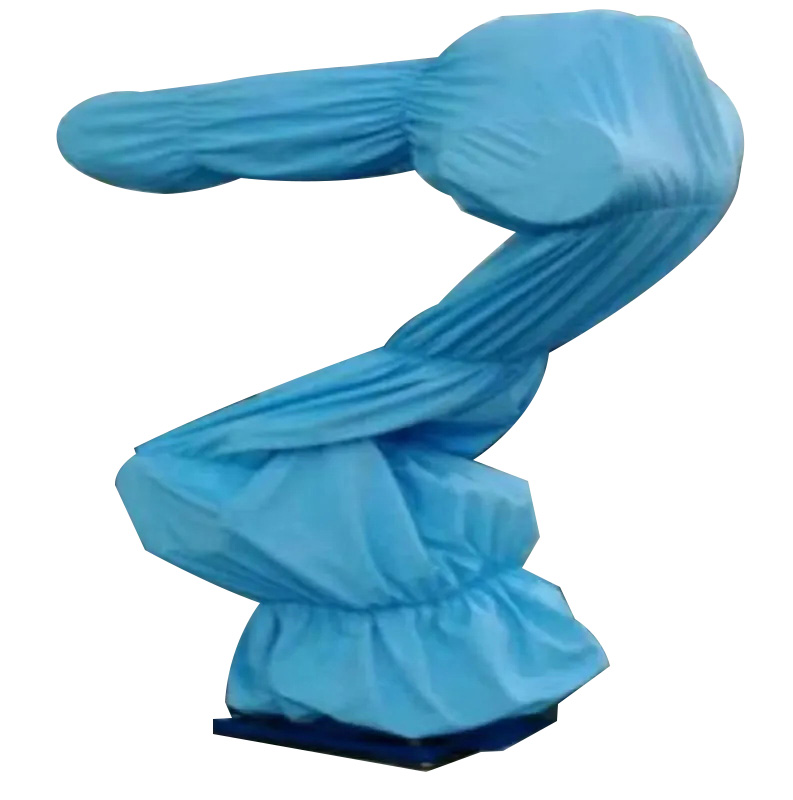
Excellent fabric choice means nothing without proper physical construction. Traditional needle stitching creates tiny micro-perforations along the material seams. High-pressure solvents easily penetrate these tiny needle holes. We strongly advocate for ultrasonic or thermally welded seams instead. Welding physically melts the fabric panels together. This modern technique guarantees a completely fluid-tight barrier against invasive chemicals.
High-frequency repetitive motion quickly destroys weak covers. You must mathematically account for dynamic joint flex fatigue. Axes 2, 3, and 5 experience the highest mechanical stress during continuous painting sweeps. You should require dual-layer reinforcement at these specific articulation points. This reinforcement absorbs the kinetic friction, preventing premature tearing and extending the suit's lifecycle.
Operators still need visual access to the equipment beneath the shroud. You should integrate translucent viewports directly into the fabric. These non-conductive, chemically resistant transparent panels typically utilize specialized thermoplastic polyurethane (TPU). They allow engineers to monitor robot diagnostics and servo readouts clearly. You never have to pause the line to remove the suit for routine visual checks.
Consider your maintenance workflow carefully before ordering. A continuous, single-piece shroud offers the absolute best environmental sealing. However, multi-section suits provide distinct maintenance advantages. Modular designs use shielded Velcro panels or antistatic zippers. They allow your technicians to execute rapid section replacement if localized damage occurs. Choose the right automotive robot cover based entirely on your specific operational priorities and acceptable downtime margins.
You cannot rely on guesswork when managing explosive atmospheres. Equipment managers must thoroughly understand strict ATEX directives. These mandatory regulations dictate safety rules for environments containing flammable vapors and mists. You need documented proof that your shielding complies with designated Zone 1 or Zone 2 hazardous classifications.
Strict adherence to ISO 80079-36 remains non-negotiable. This specific standard governs non-electrical equipment used directly inside explosive atmospheres. Proper robot anti-static protective clothing must pass these rigorous laboratory tests. Passing proves the material will not generate an incendiary spark through kinetic friction or rapid unrolling.
Do not accept vague marketing claims from unverified suppliers. "Anti-static" acts as an unregulated buzzword unless backed by hard empirical data. You should demand formal validation testing documentation immediately. Ask vendors for explicit surface resistance test results. These critical numbers should be measured clearly in ohms. Typically, safe dissipative materials register surface resistance well below 10^9 ohms. Anything higher presents an unacceptable ignition risk.
Heavy protective layers can accidentally insulate the mechanical arm. This thermal trapping prevents natural heat dissipation from the servos. It easily leads to serious motor overheating. If your robots run extreme duty cycles, you must design specific breathable zones into the fabric. In highly severe cases, you may need to integrate forced-air purge systems. These systems pump clean air inside the suit to cool the internal actuators actively.
Material thickness directly impacts robotic movement. Over-specifying thickness causes harmful movement restriction. A cover that is too rigid actively fights the robot's motors during intricate turns. This unnecessary resistance triggers constant servo overload alarms. It also degrades positional accuracy during fine painting maneuvers, leading to uneven coat thickness.
Many buyers fall into the dreaded measurement gap. They rely entirely on generic OEM templates downloaded from a website. Paint robots rarely operate in factory-default configurations. They feature highly custom dress packs, unique fluid hoses, and specialized rotary atomizers. A standard cover will never accommodate these bulky additions properly. It will either tear during the first shift or bind the arm entirely.
You need a reliable, repeatable methodology for selecting manufacturing vendors. Follow this strict framework to ensure optimal safety and performance.
Step 1: Environmental Audit. Require vendors to assess your specific solvent types. They must evaluate operating temperatures, humidity levels, and static thresholds before proposing any materials. A vendor who quotes blindly is a vendor you should avoid.
Step 2: Made-to-Measure Prototyping. Favor manufacturers utilizing a transparent, engineered design pipeline. They should visit the site to measure, build an accurate CAD model, and conduct prototype validation. This critical step accounts for your custom paint atomizers and complex dress packs.
Step 3: Verification of "Silicone-Free" Certification. Demand lab-certified proof regarding their own production facility. The manufacturing environment itself must operate as a strict silicone-free zone. This prevents invisible cross-contamination from occurring during the sewing and welding phases.
Step 4: Lifecycle & Replacement Support. Evaluate their guaranteed lead time for replacement units. Ask if they offer specific color-coding options. Color coding greatly improves visual maintenance management on the factory floor, allowing supervisors to easily identify different maintenance schedules.
Procuring these specialized protective layers involves serious, calculated engineering decisions. It is not simply buying a cheap fabric wrap. Your choices directly impact overall plant safety. They determine strict environmental compliance and ultimately dictate your final product yield.
Decision-makers must prioritize total vendor transparency above all else. You should demand formal ATEX/ISO documentation immediately. You must secure ironclad silicone-free guarantees before signing any purchase order. These factors hold far more weight than the initial unit cost. Short-term budget savings quickly vanish when an uncontrolled spark ignites a multi-million dollar spray booth.
Take decisive action today. Request an on-site kinematic measurement from a specialized manufacturer. Demand a thorough material compatibility audit to protect your critical automation assets effectively.
A: Replacement typically occurs every 3 to 12 months. This timeframe depends heavily on your robot's specific duty cycle. Highly aggressive solvents degrade materials much faster. The frequency of high-pressure washdowns also shortens the cover's lifespan. Regular visual inspections help determine your exact, optimized replacement schedule.
A: Yes, but it remains highly risky. The robot's internal motors may be perfectly sealed. However, an un-covered arm quickly accumulates highly conductive overspray. This sticky residue degrades mechanical joints over time. It also causes paint-ruining particulate drops onto your final automotive product.
A: Preventing static sparks focuses purely on facility safety. Preventing fiber shedding focuses strictly on quality control. Automotive manufacturing requires a flawless Class-A finish. Even microscopic fibers shed by a cheap cover will ruin the paint coat, leading to incredibly costly manual rework.
A: Custom covers do carry higher initial tooling and pattern costs. However, they yield a vastly superior return on investment. A tailored fit prevents dangerous servo strain. It also ensures a perfect, fluid-tight seal around your custom spray applicators, saving significant unplanned downtime.


