
English 
T: +86-21-55896873
E: info@youguard.cn
E: info@youguard.cn
8th Floor, Building 3, 999 Jiangyue Road, Minhang District, Shanghai
Views: 0 Author: Site Editor Publish Time: 2026-05-17 Origin: Site


Industrial robots face brutal conditions in modern automotive production. Welding, painting, and assembly lines expose them daily to hot spatter, extreme heat, and harsh chemical mists. These constant operational stressors degrade sensitive automated equipment rapidly. Poorly manufactured covers create major issues directly on the production floor. They often restrict crucial 6-axis articulation, limiting facility efficiency. They shed destructive fibers directly into pristine automotive paint lines. They also break down prematurely under continuous mechanical movement.
Manufacturing these covers via precision laser technology changes everything. It elevates physical performance, maximizes operational durability, and drastically improves facility safety. We shift the focus completely from basic, flimsy covers to high-performance, precision-engineered equipment. You will learn how thermal sealing entirely eliminates microscopic contamination risks. You will discover why precise modular designs offer vastly superior robotic mobility. Finally, we explore how non-contact processing handles complex automotive textiles flawlessly.
Zero Fraying & Contamination: Laser cutting thermally seals high-performance synthetic edges (like Kevlar and Cordura), preventing fiber shedding in sensitive automotive paint shops.
Unrestricted Articulation: Precision tolerances (±0.1mm) allow for the creation of multi-part, ergonomic suits that do not impede 6-axis robotic movements.
Advanced Material Integration: Non-contact processing allows for flawless integration of specialized textiles, including heat-resistant and anti-static fabrics.
Traditional blade cutting struggles endlessly against heavy-duty technical fabrics. Kevlar, Cordura, and aluminized fiberglass distort easily under physical blades. The friction of mechanical cutting creates immense stress. This constant pressure generates micro-tears along the fabric seams. Blades dull incredibly quickly during mass production. They leave ragged, weakened boundaries behind. This manual pressure severely compromises the material's structural integrity. You lose the inherent strength of the advanced textile entirely.
These frayed edges lead directly to catastrophic operational failures. A deteriorating cover sheds tiny fibers continuously over time. These airborne particulates ruin flawless paint finishes in automotive coating lines. Even minor lint contamination causes severe visual defects on car bodies. You then face costly rework and severely delayed production schedules. A single frayed seam can easily shut down an entire painting cell.
Manual or blade-cut suits suffer from incredibly poor precision tolerances. The resulting covers often feature bulky, uneven folds. Excess material catches on nearby tooling during normal operation. It restricts the robot joints and limits their full range of motion. Poor fits create unnecessary tension points across the fabric.
Traditional manufacturing methods typically fail automotive standards in three distinct ways:
Structural Degradation: Mechanical blades crush high-performance fibers, weakening the seam before installation.
Particulate Shedding: Unsealed edges release micro-lint into highly sensitive cleanroom environments.
Mobility Restriction: Inaccurate blade cuts create bulky overlaps, snagging on external cables and limiting 6-axis movement.
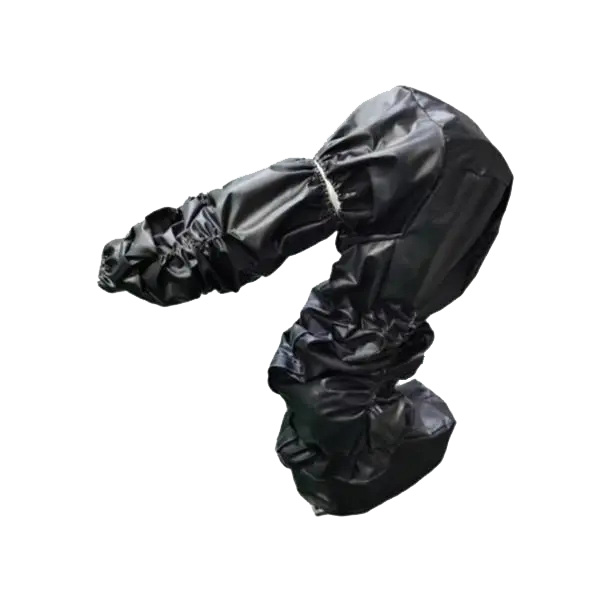
Laser cutting applies a highly focused thermal beam directly to synthetic fabrics. It melts and fuses the textile edges simultaneously during the cut. You eliminate the need for bulky hemming or extra edge taping. The physics of this thermal interaction ensure a perfectly smooth boundary. It locks the synthetic fibers tightly together at a microscopic level. It physically transforms the edge into a solid, reinforced barrier. We call this critical reaction the "sealing effect."
Thermally sealed edges guarantee a completely lint-free lifecycle. This pristine condition is critical for highly sensitive industrial environments. Modern paint shops demand absolute zero-particulate contamination to maintain quality. Facilities requiring anti-static robot clothing rely heavily on this clean-edge technology. It prevents loose threads from carrying dust or static charges into the workspace. It keeps the entire production zone clinically clean. You avoid unexplained defects on finished vehicle surfaces.
Sealed edges prevent unraveling during heavy operational cycles. Robotic movements involve constant expansion and severe contraction. A fused seam easily withstands this intense mechanical stress. It extends the operational life of the entire protective suit. You get reliable protection without worrying about sudden seam blowouts. The thermal bond flexes naturally alongside the base fabric.
Comparison Chart: Mechanical Cutting vs. Laser Cutting | ||
Performance Metric | Mechanical Blade Cutting | Precision Laser Cutting |
|---|---|---|
Edge Quality | Prone to micro-tears and rapid fraying. | Thermally sealed, completely fused edges. |
Contamination Risk | High (sheds dangerous lint and fibers). | Zero (lint-free lifecycle guaranteed). |
Durability Under Stress | Seams weaken quickly under robotic tension. | Edges withstand extreme joint expansion perfectly. |
Laser cutting relies entirely on precise digital translation. It turns complex 3D CAD patterns into exact 2D fabric panels effortlessly. The process maintains extremely tight tolerances, frequently down to ±0.1mm. Such pinpoint accuracy completely removes human guesswork from fabric manufacturing. You get highly repeatable, flawless parts every single time. Digital software guides the thermal beam with perfect mathematical precision. It ensures every panel aligns perfectly during final assembly.
Exact cuts enable far better structural designs for industrial robotics. You can construct a highly reliable modular robot protection suit. Robots no longer wear a single, restrictive, heavy bag. Instead, they receive specific covers customized specifically for the wrist, arm, and base. These targeted modules articulate flawlessly together. They move freely without bunching, stretching, or snagging on external cables. This joint-specific engineering maximizes robotic efficiency.
Laser cutting bypasses expensive physical tooling entirely. You do not need to wait weeks for custom cutting dies. This freedom allows manufacturers to iterate designs rapidly. They can customize covers for specialized automotive tooling quickly. New robot models receive tailored protection without heavy setup fees. You transition from a digital design to a physical prototype instantly.
CAD/CAM integration delivers several crucial advantages for robotic mobility:
It maps the exact rotational limits of all 6 individual axes digitally.
It perfectly accounts for external cables, fluid hoses, and bulky wire dresses.
It drastically reduces excess fabric folds, preventing dangerous snags.
It ensures uniform tension across the entire modular assembly.
Automotive environments often demand extreme, multi-layer protection. You might need a thermal barrier combined directly with strong chemical resistance. Specialized CO2 lasers cut cleanly through these stacked synthetics. The beam penetrates without applying any mechanical pressure. Layers never shift, slide, or misalign during the intricate cutting process. The composite structure remains perfectly bonded and aligned.
Many protective fabrics use delicate surface treatments. Silicone coatings repel heavy weld spatter, while special weaves dissipate static electricity. Laser cutting protects these fragile layers perfectly. The cutting tool never physically touches the active fabric. It glides steadily above the surface, preventing dragging, scratching, or abrasion. The protective coating retains its full factory integrity. You preserve the advanced chemical properties of the textile.
Modern protection requires complex functional features. You must precisely cut sensor windows and tiny drainage holes. Ventilation ports keep the internal equipment cool during long, demanding shifts. You can integrate these complex details seamlessly into an automobile robot cover. The thermal beam creates precise openings without compromising the structural integrity of the suit. Sensors function perfectly without any fabric obstruction.
Advanced Textiles and Laser Processing Benefits | ||
Material Type | Automotive Application | Laser Processing Advantage |
|---|---|---|
Aluminized Fiberglass | Spot welding (radiant heat protection). | Cuts complex composites without delaminating layers. |
Silicone-Coated Kevlar | Heavy assembly (spatter and abrasion resistance). | Prevents mechanical scratching of the silicone coating. |
Carbon-Thread Synthetics | Paint shops (static dissipation). | Seals the conductive threads securely without shorting. |
Instruct buyers to explicitly assess edge quality first. Inspect the seams and edges of any prospective cover. Look closely for laser-fused boundaries. Compare them directly against mechanically stitched hems. Stitched hems often harbor hidden dust and debris. They also fail rapidly under high-tension movements. Fused edges guarantee better long-term structural performance. They provide a clear visual indicator of manufacturing quality.
Prioritize modularity over universal fits. Advise against "one-size-fits-all" protective bags. A precisely cut modular system offers vast operational advantages. Maintenance teams can easily replace just a damaged wrist section. They do not have to discard the entire suit prematurely. This targeted replacement strategy optimizes your facility's operational efficiency. It drastically reduces waste and unnecessary inventory holding.
Verify material documentation carefully. Ensure your supplier uses the correct engineered textiles. Match the specific laser-cut fabric exactly to your designated production zone. Flame-retardant materials belong explicitly in the heavy welding cell. Anti-static fabrics suit the delicate paint booth perfectly. Always verify the technical specifications thoroughly before purchasing. Proper material alignment prevents rapid equipment degradation.
Remind buyers to factor in measurement and prototyping time. High-precision suits require accurate 3D mapping first. You must map the robotic cell's actual physical movement envelope. This initial mapping ensures a perfect fit later. Take the time to get the digital foundation exactly right. It prevents articulation issues down the line. It ensures your investment performs flawlessly under pressure.
Investing in laser cutting protective clothing is not just about aesthetics. It acts as a highly critical defense mechanism for your facility. It actively prevents unplanned downtime and severe automated equipment wear. It also blocks microscopic contamination. Airborne fibers cause incredibly costly product defects. Advanced manufacturing secures your expensive robotics assets properly.
We encourage production managers to audit their current covers today. Look closely for telltale signs of edge fraying or movement restriction. Reach out to a precision manufacturer immediately. Discuss upgrading your facility to a modular, laser-cut system. Ensure your supplier utilizes exact CAD/CAM digital mapping. Protect your robotics properly with modern, precisely engineered solutions.
A: Mechanical die-cutting dulls blades quickly against tough Kevlar fibers. This friction causes jagged edges and micro-tears. Laser cutting uses a non-contact thermal beam. It cuts easily and fuses the synthetic edges simultaneously. This thermal sealing prevents fraying entirely, increasing overall durability.
A: Yes. Laser cutting utilizes advanced CAD/CAM integration instead of physical tooling. Manufacturers create precise 2D panels directly from 3D digital models of older robots. This tool-less prototyping allows rapid, highly customized fabrication. You get a perfect, tailored fit without expensive die-creation delays.
A: No. Precision-cut modular pieces actually streamline the installation process. Each segment fits a specific joint perfectly without forceful stretching. Furthermore, modularity simplifies targeted maintenance. You can swap out a single damaged arm segment quickly without removing the entire suit.
A: Precision laser cutting operates with exact tolerances down to ±0.1mm. This eliminates excess fabric and bulky folds. A perfectly fitted cover moves seamlessly with the robot. It prevents snagging, rubbing, and tearing during 6-axis operations, dramatically extending the cover's operational lifespan.


