
English 
T: +86-21-55896873
E: info@youguard.cn
E: info@youguard.cn
8th Floor, Building 3, 999 Jiangyue Road, Minhang District, Shanghai
Views: 0 Author: Site Editor Publish Time: 2026-05-15 Origin: Site


Static electricity and electrostatic discharge (ESD) present severe challenges on the factory floor. They act as direct causes of automotive production downtime. These unseen forces create extensive paint finish defects. They also trigger catastrophic and expensive robotic component failures. Modern automotive manufacturing heavily relies on highly sensitive micro-controller units (MCUs), complex proximity sensors, and collaborative robots (cobots). Facilities frequently leave static unmanaged in environments like automated paint booths or fast-paced assembly lines. This oversight invites sudden short circuits and creates severe workplace safety hazards. Implementing purpose-built robot anti-static protective clothing directly mitigates these hidden ESD risks. This specialized gear ensures strict compliance in highly volatile zones, such as explosive ATEX environments. It also substantially extends the operational lifespan of industrial robotics. Best of all, it achieves this robust protection without sacrificing the essential multi-axis flexibility your automated lines demand.
Static buildup on automotive robots causes critical sensor failures, attracts dust that ruins paint finishes, and poses ignition risks in solvent-heavy environments.
High-grade robot anti-static protective clothing utilizes blended conductive fibers to provide continuous static dissipation while acting as a barrier against chemicals, sparks, and particulates.
Evaluating protective covers requires analyzing material composition (e.g., silicone vs. PU), environmental compliance (e.g., silicone-free, ATEX), and structural design (e.g., cone line outlets for cables).
Proper implementation balances robust protection with active thermal management and unhindered 6-axis mobility.
Manufacturers must clearly understand the exact mechanisms of static-induced failure in automated lines. We must separate the visible symptoms from the hidden financial impacts. Unseen static buildup silently compromises automotive production speeds. It drastically increases scrap rates and forces costly manual rework. Let us examine the specific threats across various factory zones.
Static charges aggressively attract airborne particulates. Unprotected mechanical arms become magnets for debris. This phenomenon leads directly to uneven paint adhesion. Microscopic dust inclusions ruin perfectly sprayed chassis surfaces. These defects create unacceptable variations in clear coats. Consequently, automotive plants face staggering rework costs. Rejecting freshly painted bodies destroys daily production quotas.
Modern mechanical arms house delicate onboard chips and precise servos. Ungrounded static discharge fries these sensitive electronic nodes instantly. A sudden voltage spike completely destroys proximity sensors within the arm. Replacing a damaged MCU halts the entire assembly line. Facilities lose thousands of dollars per minute during these unplanned electrical outages.
Solvent-rich painting and coating zones are highly volatile. A single rogue static spark can trigger a devastating explosion. Facilities must strictly manage these severe ignition risks. Combustible vapors linger around spray nozzles. Therefore, unprotected robotics pose a catastrophic threat to facility integrity. Compliance teams monitor these areas closely to prevent catastrophic fires.
Human workers increasingly operate alongside collaborative robots. Unshielded robotic arms accumulate dangerous levels of static. Workers suffer unexpected shocks during routine joint manipulation. These sudden jolts degrade workplace safety. They disrupt collaborative efficiency and lower operator confidence. Eliminating these stray shocks remains vital for seamless human-machine interaction.
How does this protective fabric actually neutralize factory threats? We must look past generic marketing claims. Evaluating true protection requires focusing on applied material engineering. High-performance fabrics rely on complex molecular bonds and precise structural layering. They solve complex environmental challenges through advanced textile science.
Engineers weave conductive threads directly into base textiles. They commonly use flexible elastane or highly durable aramid fibers. This structural integration creates a continuous static dissipation path. It safely channels dangerous electrical charges away from fragile core electronics. Unlike surface sprays, woven conductive networks never flake off. They provide permanent, reliable grounding throughout the fabric.
Advanced covers deploy multiple fabric layers to tackle overlapping threats. Each layer serves a highly specific mechanical or chemical purpose.
Base layers: These utilize stretchable, tear-resistant fabrics. They ensure full, unhindered joint articulation during complex manufacturing routines.
Coating technologies: Manufacturers apply Polyurethane (PU) or Neoprene to establish robust chemical resistance. Alternatively, they specify PTFE or silicone coatings for extreme high-heat scenarios.
Insulation barriers: Certain layers block aggressive coolants or heavy cutting fluids. They keep internal motors completely dry and free from corrosion.
Anti-static properties often serve an incredibly valuable dual purpose. They inherently function as a dust resistant robot cover. The fabric actively repels metallic shavings by eliminating electrostatic attraction. Microscopic shop dust simply slides off the exterior shell. This passive repelling action dramatically reduces daily cleaning requirements. It keeps joint bearings free from abrasive particulate damage.
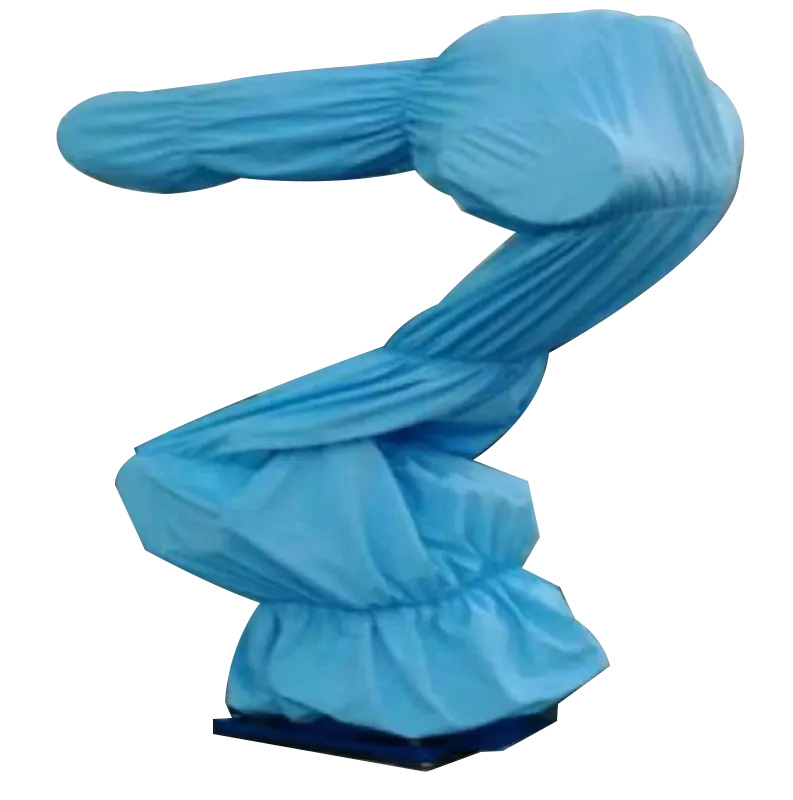
Different manufacturing zones demand distinct and uncompromising protective profiles. We can segment the automotive floor to map specific environmental threats. This mapping demonstrates how different operational zones dictate unique material requirements. A single generic cover cannot survive the diverse hazards of automotive assembly.
This critical zone requires a highly specialized anti-paint contamination suit. Procurement teams must mandate strict "silicone-free" manufacturing standards. Even trace amounts of silicone cause catastrophic paint cratering. You must combine silicone-free materials with high-grade anti-static properties. This exact combination guarantees a flawless, showroom-ready finish. It actively prevents stray paint mist from permanently adhering to the mechanical joints.
Heavy fabrication demands robust spark-proof robot protection. You need industrial materials engineered with strict V0 flame retardant ratings. These specialized fabrics easily withstand momentary thermal shocks. They repel flying weld spatter reaching temperatures up to 250°C (482°F). Advanced flame-resistant coatings prevent the fabric substrate from igniting or melting onto the machine.
These areas maintain stringent cleanroom-level requirements. Facilities must drastically minimize any microscopic particle shedding. Stringent ESD controls protect vital in-car infotainment systems during installation. They also safeguard the delicate MCU arrays controlling the vehicle powertrain. Specialized cleanroom suits trap internal robot particulates. They prevent machine lubricants from contaminating exposed automotive circuit boards.
Below is a standardized chart summarizing these core automotive applications and their specific material requirements.
Automotive Production Zone | Primary Environmental Threat | Required Protective Profile | Key Material Requirement |
|---|---|---|---|
Paint & Coating Shops | Airborne particulates, volatile solvents | Anti-paint contamination, static dissipation | Strictly silicone-free, lint-free PU blends |
Welding & Fabrication | High heat, flying weld spatter, sparks | Thermal shock resistance, spark deflection | V0 flame retardant rating, Kevlar/Aramid base |
Precision Electronic Assembly | Micro-dust, static discharge (ESD) | Cleanroom particulate control, deep grounding | Non-shedding conductive fibers, anti-static woven grids |
Plant managers and engineers need a skeptical, evidence-based checklist. You must evaluate vendors rigorously before shortlisting them for your facility. Poorly designed covers introduce entirely new maintenance problems. Therefore, decision-makers must prioritize certified safety standards, functional longevity, and exact structural fit.
Compliance & Certifications: Check for verified ATEX directive compliance (like ISO 80079-36). This certification remains non-negotiable for explosive environments. Additionally, demand transparent ISO 9001 traceability from the manufacturer. You must guarantee the fabric origin and the assembly quality.
Maintenance & Washability: Industrial laundering rapidly degrades cheap topical anti-static coatings. Assess whether the core anti-static properties survive harsh wash cycles. You need robust fabrics that retain their static dissipation ratings. They must perform perfectly even after multiple high-temperature chemical washes.
Visual Management & Fit: Evaluate innovative cover materials entering the market. Translucent anti-static polymers allow technicians to visually inspect internal robot conditions. Maintenance teams can instantly spot servo oil leaks without removing the suit. This improves daily preventative maintenance efficiency.
Customization vs. Off-the-Shelf: Generic baggy covers often snag on surrounding machinery. Choose manufacturers utilizing digital 3D patterning for exact model fits. Custom patterns for brands like FANUC, ABB, or KUKA ensure safe operations. Precision fits eliminate fabric bunching during high-speed mechanical rotations.
Engineers often raise valid objections before installing robot protective clothing. Transparency resolves these initial operational concerns. We must address heat retention, mobility restrictions, and installation downtime directly. Proper implementation eliminates these risks entirely.
Sealing a heat-generating robot can cause severe servo overheating. We acknowledge this engineering risk openly. Effective covers integrate highly active thermal controls. You will often see strategically placed breathable ventilation vents. Some environments require complex internal pressurized air designs. These active systems constantly push trapped motor heat out of the suit. They keep internal operating temperatures well within safe manufacturer limits.
Unhindered 1-to-6 axis mobility remains absolutely crucial. Restrictive fabrics strain servo motors and trigger error codes. Suits must feature engineered side-opening velcro or heavy-duty zipper designs. They also require flexible "cone line outlets" at the base. These intelligent structures prevent external wire harness tangling. They guarantee smooth, unrestricted motion during high-speed, repetitive mechanical routines.
Plant operators despise unnecessary production downtime. Manufacturers solve this using "ready-to-deploy" modular segmented designs. Technicians can securely install these split-design covers rapidly. They never need to dismantle the heavy robotic arm. You avoid the nightmare of recalibrating the entire production line. Modular designs also allow you to replace only a damaged section rather than the entire suit.
Purpose-built anti-static protective clothing is never a passive factory accessory. It serves as an active, critical preventative maintenance tool. Modern electronics-heavy automotive manufacturing requires this baseline protection to survive daily production targets. Ignoring static buildup guarantees eventual component failure and severe safety risks. Effective covers block dust, neutralize volatile static, and prevent disastrous paint contamination.
You must take proactive steps to secure your automated assets today. Audit your current robotic failure rates immediately. Focus your analysis heavily on your paint booths and welding zones. Identify exactly where static and debris cause the most downtime. Finally, consult an experienced protective clothing manufacturer. Request a custom digital 3D measurement and demand a physical prototype validation for your facility.
A: It depends entirely on the manufacturing method. Surface-treated topical coatings will wash out quickly over time. Conversely, high-quality suits utilize deeply woven conductive fibers. Because these conductive threads are physically integrated into the base material, they maintain their vital efficacy even after repetitive industrial laundering.
A: Premium cover designs tackle heat buildup through active and passive thermal management. Engineers strategically integrate breathable fabric zones around high-heat servos. For more intensive applications, manufacturers incorporate forced-air ventilation options or specific internal pressurization systems. These methods ensure constant airflow, safely exhausting excess motor heat.
A: Yes, they are highly compatible, provided you specify the correct materials. During the procurement phase, you must insist on "silicone-free" and "lint-free" fabrics. Strict adherence to these environmental material standards prevents disastrous paint cratering and surface contamination, ensuring your automated paint lines remain flawless.


