
English 
T: +86-21-55896873
E: info@youguard.cn
E: info@youguard.cn
8th Floor, Building 3, 999 Jiangyue Road, Minhang District, Shanghai
Views: 0 Author: Site Editor Publish Time: 2026-09-08 Origin: Site


Industrial robot dress packs and cables account for a staggering percentage of unplanned automation downtime. When facilities utilize incorrect protective sleeves, they significantly amplify downtime risks. Engineers constantly face a challenging dilemma in automation cell design. They frequently over-specify or under-specify material properties to manage thermal fire hazards and electrical static threats. This misalignment leaves delicate components exposed to severe damage or forces systems into unnecessary mechanical strain. We created this guide to help you build a definitive evaluation framework for your operational environments. You will learn how to align specifications tightly with non-negotiable compliance standards. Every factory floor presents unique environmental challenges. Making the right material choice ensures continuous production and superior equipment longevity. Ultimately, you will discover how to select precise material properties to safeguard your automation assets without restricting essential robot kinematics.
Primary hazard dictates the specification: Use flame-retardant covers for external thermal threats (spatter, slag) and anti-static covers for internal accumulation threats (ESD, explosive atmospheres).
Compliance standards are non-negotiable: Flame-retardant options must meet UL94 V-0 (or similar); anti-static options must align with ATEX directives or IEC 61340.
Combining properties has tradeoffs: Specifying a dual-rated cover often increases weight and reduces flexibility, which can negatively impact cable lifespan and robot articulation.
Testing validation is required: Always request material data sheets (MDS) and empirical testing data from suppliers before shortlisting.
Factory default cable sleeves often fail in specialized industrial applications. Manufacturers design standard polyurethane sleeves for basic abrasion resistance. They do not engineer them to withstand extreme environmental hazards. When you deploy standard equipment into severe environments, failure happens rapidly.
Engineers often assume factory-provided protection will suffice. You might think standard nylon or polyurethane wraps provide adequate coverage. In reality, aggressive manufacturing environments quickly degrade standard polymers. These default materials simply lack the chemical structure to handle intense heat or dissipate electrical charges. Relying on them creates a false sense of security.
Thermal degradation destroys standard dress packs in high-heat zones. Imagine a robotic welding cell. Hot spatter frequently hits the protective sleeve. Standard polyurethane melts under this intense, focused heat. Spatter eventually burns right through the outer jacket. Once compromised, molten metal reaches the delicate internal wiring. This sequence leads to catastrophic short circuits. It forces the entire automation cell to shut down abruptly.
Robotic arms articulate continuously during production cycles. Internal cables constantly rub against each other and against their protective sleeve. This constant friction generates static electricity through a process called triboelectric charging. Without a dissipation pathway, the charge builds up rapidly. Eventually, electrostatic discharge (ESD) occurs. A sudden ESD event can fry sensitive internal communication components. In worse scenarios, a static spark can ignite airborne dust or solvent vapors.
Incorrect material specification carries severe operational penalties. You will experience frequent and costly replacement cycles. You also risk violating strict facility safety compliance standards. Mismatched protection ultimately creates severe production bottlenecks. You lose critical uptime while maintenance teams continuously replace melted or statically compromised cable harnesses.
You must address external thermal threats with highly specialized materials. Selecting the right flame-retardant robot cable cover prevents structural failure during extreme heat exposure. These covers extinguish flames quickly and resist melting.
Certain manufacturing zones inherently require robust fire protection. You must prioritize flame-retardant properties in the following applications:
Automotive spot welding: High-volume robotic spot welding generates intense, localized sparks.
MIG/TIG welding and laser cutting cells: These cells produce continuous radiant heat and flying molten slag.
Foundries and forging operations: Heavy industrial plants expose robots to ambient temperatures exceeding standard polymer limits.
High-temperature heavy industrial plants: Furnaces and metal pouring stations present massive thermal radiation risks.
Not all heat-resistant materials perform equally. You must evaluate the base textile and its specific coating. Look for advanced materials like Kevlar®, para-aramid blends, or silicone-coated fiberglass. You must clearly differentiate between two thermal threats. Check for resistance to continuous high radiant heat versus intermittent direct contact. Some materials handle a steady 200°C ambient environment beautifully. However, they might fail instantly when hit by 1000°C welding spatter. Silicone-coated fiberglass effectively repels molten metal. Para-aramid fibers offer exceptional strength and resist burning.
You cannot rely on vague supplier promises regarding heat resistance. Always demand rigorous third-party certifications. An authentic flame-retardant sleeve must pass standardized vertical burn tests. Look specifically for the UL94 V-0 certification. This standard proves the material stops burning within 10 seconds after removing the flame source. It also guarantees no flaming drips occur. Additionally, verify ISO 11925 or EN 45545 compliance if those standards apply to your specific industry or geographical region. Certifications separate reliable engineering textiles from dangerous generic substitutes.
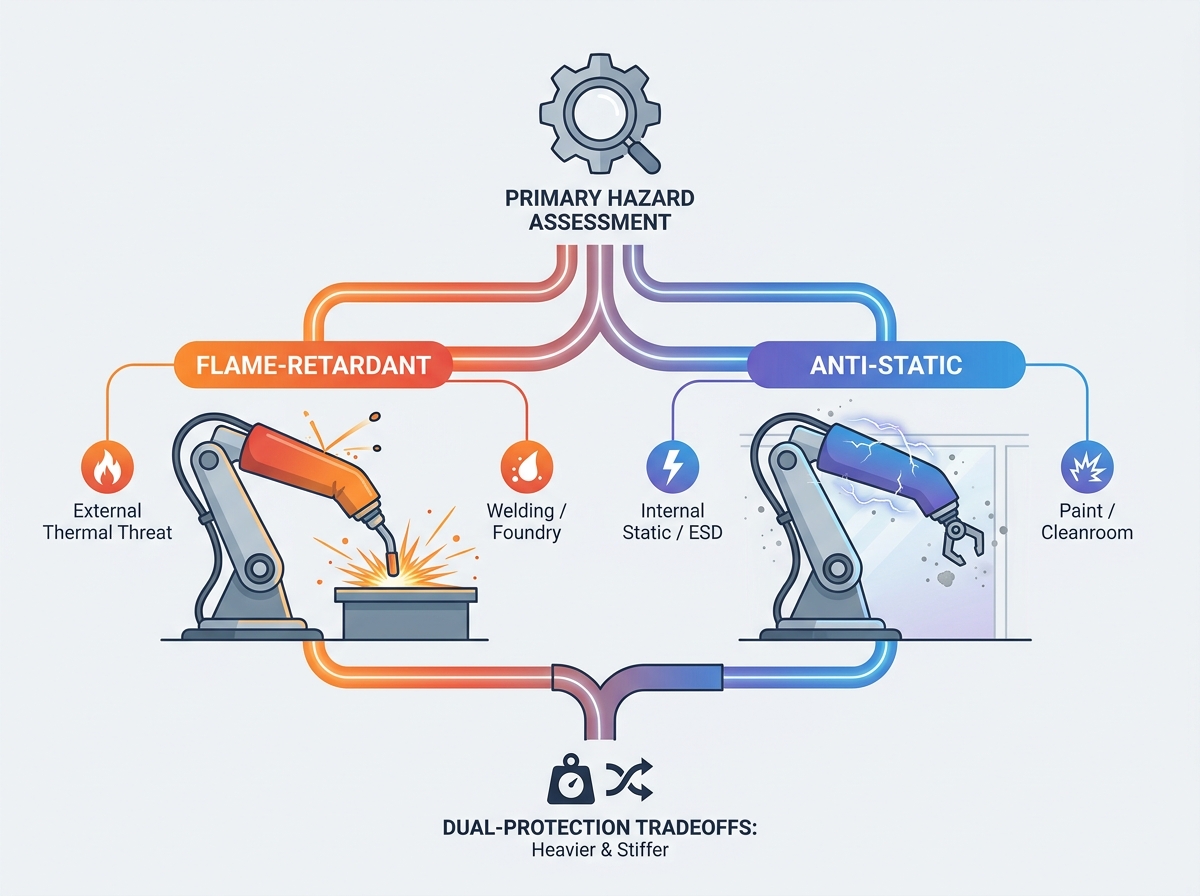
Sometimes the most dangerous threat is completely invisible. Static accumulation destroys microelectronics and causes catastrophic facility explosions. In these highly volatile environments, you must deploy proven anti-static robot protection. This protection ensures static electricity safely bleeds away before it reaches dangerous levels.
You must prioritize electrostatic dissipation in clean, volatile, or particulate-heavy settings. Static poses the primary threat in the following zones:
Paint lines and powder coating cells: These areas contain highly explosive atmospheres. A single spark can ignite airborne solvent vapors.
Semiconductor manufacturing: Cleanrooms require strict static control. Even minor ESD events easily damage microchips and ruin entire production batches.
Packaging of fine powders: Pharmaceutical and chemical packaging lines generate highly combustible dust.
Food processing: Airborne flour, sugar, and grain particles present massive dust ignition risks.
Standard plastics act as electrical insulators. They trap static charges. To combat this, manufacturers engineer specialized conductive materials. Look for carbon-infused textiles, conductive polyurethane, or inherently dissipative polymers. These materials create a safe pathway for electrons to flow to the ground. You must assess the surface resistivity target carefully. True static dissipation typically requires a surface resistance between 10^5 and 10^9 ohms per square. Anything higher acts as an insulator. Anything lower acts as a direct conductor, which presents different electrical hazards.
Authoritative compliance dictates your material choices in explosive zones. If your robots operate in hazardous atmospheres, you must demand ATEX compliance. The ATEX directive regulates equipment intended for use in explosive environments. For non-explosive but sensitive environments, look for IEC 61340 certification. This international standard governs the protection of electronic devices from electrostatic phenomena. Operating without these certifications invites massive legal and safety liabilities.
Engineers often want maximum protection for every scenario. It feels safer to request every available feature. However, combining extreme thermal resistance and electrical conductivity presents complex engineering challenges.
Many procurement teams fall into a common trap. They request a dual-rated cover just to be safe. They ask for extreme fire resistance combined with strict anti-static properties. They assume more protection always yields better results. This over-specifying mistake severely compromises mechanical performance. It forces suppliers to combine incompatible material layers.
Adding multiple protective layers creates physical consequences. You cannot ignore these performance tradeoffs. Adding both flame-retardant coatings and anti-static properties typically results in a much thicker cover. The resulting sleeve becomes noticeably heavier.
This added bulk introduces severe implementation risks. Stiffer covers inherently restrict robot kinematics. They struggle to bend cleanly around tight joints. This stiffness increases mechanical strain on the entire dress pack system. It transfers torque directly into the internal wiring. Consequently, over-specified covers often cause premature mechanical failure of the internal cables. You might solve a rare static issue but create a constant mechanical breakage problem.
You should only specify dual-protection for highly specific niche applications. Avoid it for general use. For example, painting aerospace components near active heat sources demands dual protection. In this rare scenario, facility managers strictly mandate both ATEX compliance and aggressive fire resistance. Another example involves automated powder coating ovens. Here, explosive dust mixes with high ambient temperatures. If your application does not feature both threats simultaneously, choose one primary protection type. Optimize for flexibility and longevity instead.
Choosing the correct sleeve requires methodical analysis. You cannot guess based on visual appearances. We recommend following a structured evaluation process. This framework helps you balance threat mitigation, mechanical freedom, and facility compliance.
Evaluation Criteria | Flame-Retardant Focus | Anti-Static Focus |
|---|---|---|
Primary Threat Source | External (Welding spatter, slag, furnace heat) | Internal/Ambient (Friction, explosive dust, sensitive electronics) |
Core Material Technologies | Para-aramid, Silicone-coated fiberglass, Kevlar® | Carbon-infused textiles, Dissipative polyurethane |
Key Performance Metric | Burn rate, Heat deflection temperature, Melt resistance | Surface resistivity (10^5 to 10^9 ohms/sq) |
Essential Certifications | UL94 V-0, ISO 11925 | ATEX directives, IEC 61340 |
Begin by identifying the dominant threat in your specific automation cell. Is the threat external or functional? External threats include flying molten metal, radiant furnace heat, or aggressive chemicals. Functional threats originate from the robot's operation itself. Functional threats include static buildup from continuous friction. Observe the robot running its full production program. Document every environmental stressor it encounters.
Protective sleeves must move fluidly. How dynamic is the robot's movement? A heavy welding robot might move slowly. A high-speed pick-and-place delta robot moves aggressively. You must evaluate the minimum bend radius of the proposed cover. Compare this radius against the robot's extreme axis limits. If the sleeve binds, kinks, or catches during complex maneuvers, it will destroy the internal cables. Always prioritize flexibility if the primary hazard allows it.
Never bypass your plant safety officer. Cross-reference your required material properties with internal plant safety protocols. You must also satisfy strict insurance mandates. Organizations like OSHA and NFPA enforce rigid guidelines for industrial equipment. Ensure your selected material explicitly meets these regulatory demands. Documentation protects your facility from compliance fines.
Do not trust marketing claims blindly. Mandate that your suppliers provide comprehensive Material Data Sheets (MDS). Request empirical testing data demonstrating performance under stress. Ask for documented case studies proving lifecycle longevity in similar operational environments. Reputable suppliers will eagerly provide burn test videos or surface resistivity lab reports. If a supplier hesitates to provide technical data, find a different partner.
Selecting the ideal cable protection significantly reduces your unplanned automation downtime. Flame-retardant covers act as thermal armor. They protect delicate internal wiring against external heat and molten hazards. Conversely, anti-static covers perform a critical invisible function. They safely dissipate internal static accumulation, preventing catastrophic explosion risks and electronic damage.
Your next steps require practical action. We encourage buyers to actively audit their current cable failure logs. Identify the exact root cause of your most recent dress pack failures. Once you understand the core hazard, consult with an engineered-textile or cable-management specialist. Discuss your specific kinematic requirements and environmental threats. Finally, request custom prototypes or material samples. Testing a physical sample on your factory floor remains the most reliable way to validate performance.
A: You must demand the Material Data Sheet (MDS) from your supplier. Check the documented surface resistance rating. A genuinely dissipative material will show a resistance value between 10^5 and 10^9 ohms per square. Additionally, verify that the material carries recognized third-party certifications, such as ATEX directives for explosive environments or IEC 61340 standards.
A: It depends entirely on the chosen base material. Flame-retardant covers are inherently heavier than standard nylon sleeves. However, modern para-aramid textiles are engineered specifically for robotics. They provide extreme fire resistance while maintaining acceptable bend radii for complex dress packs. Always verify the minimum bend radius specification before installation.
A: Replacement schedules depend completely on environmental severity and operational duty cycles. You should not rely on fixed calendar timelines. Instead, implement strict visual inspection protocols. Inspect the covers weekly for localized melting, severe abrasion, or compromised seams. Replace the sleeve immediately if you observe exposed internal cables or significantly stiffened material patches.


