
English 
T: +86-21-55896873
E: info@youguard.cn
E: info@youguard.cn
8th Floor, Building 3, 999 Jiangyue Road, Minhang District, Shanghai
Views: 216 Author: Site Editor Publish Time: 2026-03-30 Origin: Site


In the world of high-tech manufacturing, a single invisible spark can cause millions of dollars in damage. Electrostatic Discharge (ESD) is the hidden enemy of automated production lines. As robots move at high speeds to assemble delicate electronics, they naturally generate static electricity. Without a Custom barrier like Robot Anti-static Protective Clothing, this built-up energy can jump to a micro-circuit, frying its internal pathways instantly.
Understanding ESD in automation is not just about physics; it is about risk management. For any facility focusing on High precision assembly, static control is a baseline requirement. We are seeing a massive shift toward specialized Industrial shielding. These covers do not just keep robots clean; they act as a continuous grounding path. In this guide, we dive into how anti-static covers work and why they are the most effective tool to prevent costly micro-circuit failures.
Robots are masters of repetitive motion. However, that very motion creates friction between the robot's joints, the surrounding air, and any particles in the environment. This process, known as triboelectric charging, builds up a significant electrical potential on the robot's surface.
Traditional manual assembly allows for workers to wear grounding wrist straps. You cannot easily "ground" a moving 6-axis robotic arm without interfering with its range of motion. If the robot lacks Robot Anti-static Protective Clothing, it becomes a giant capacitor. When the arm reaches out to pick up a semiconductor or a PCB, the stored energy finds the path of least resistance—the micro-circuit.
Not all fabrics can handle this. A standard nylon cover might actually make the problem worse by generating more static. An Industrial anti-static cover uses a matrix of conductive fibers, usually carbon or silver, woven into the base material. This grid allows the static to dissipate across the surface and exit through a dedicated grounding point, keeping the High precision components safe.

The scariest part of ESD damage is that it isn't always obvious. While a massive discharge might cause a complete "catastrophic failure," most ESD events cause "latent defects." These are tiny wounds in the silicon that don't kill the device immediately but cause it to fail weeks or months later.
A latent defect is like a small crack in a dam. The product passes the factory quality test and ships to the customer. Then, under normal operating heat, the crack expands, and the device dies. This leads to:
Expensive warranty claims.
Brand reputation damage.
Costly product recalls.
By using Custom Robot Anti-static Protective Clothing, you ensure the environment around the robot's "end effector" (the hand) stays at a neutral charge. It prevents the "attraction" of dust particles, which are often charged. In a Cleanroom environment, dust is just as dangerous as the spark itself because it can cause short circuits during the soldering process.
Facilities that implement Industrial anti-static solutions see an immediate drop in "dead on arrival" (DOA) rates. When the robot is properly clothed, the electrical field stays contained. This is vital for High precision tasks where components are getting smaller and more sensitive to even low-voltage discharges (under 100V).
For electronics manufacturing, a standard factory floor is not enough. Most micro-circuits are born in a Cleanroom. This adds another layer of complexity to the protective gear. The clothing must be anti-static, but it must also be "non-linting."
A Cleanroom robot cover is made from continuous filament yarns. This prevents the fabric from shedding tiny fibers that could land on a silicon wafer. When combined with its anti-static properties, the Robot Anti-static Protective Clothing creates a sterile, electrically neutral zone.
Many Industrial environments also require the clothing to be Waterproof or resistant to chemicals used in cleaning. High-quality covers use a laminated structure. The inner layer provides the strength and anti-static grid, while the outer layer provides a Waterproof barrier. This ensures that even if a cooling line leaks or a cleaning solvent is sprayed, the High precision electronics underneath remain dry and safe.
| Feature | Standard Industrial Cover | Cleanroom Anti-Static Cover |
| Material | Polyester/Nylon | Lint-free filament + Carbon grid |
| ESD Protection | Basic Surface Coating | Integrated Conductive Matrix |
| Durability | High Abrasion Resistance | High Flexibility + Chemical Resistance |
| Application | Painting / Grinding | Semiconductor / Medical Assembly |
In some automation cells, static isn't just a threat to the circuit; it’s a fire hazard. If the robot is working with flammable vapors or fine powders, a static spark could trigger an explosion. This is why many procurement officers look for Flame retardant properties in their robot gear.
A Flame retardant and anti-static cover provides a two-in-one safety solution. It prevents the spark from happening in the first place, and if an external fire occurs, the fabric will not support combustion. This is a critical requirement for robots working in battery manufacturing or chemical processing.
We recommend checking for certifications like NFPA 701 or specific ESD standards like ANSI/ESD S20.20. When you buy Robot Anti-static Protective Clothing, it should come with a technical data sheet proving its surface resistivity.
A robot cover that is too loose can get caught in the gears. A cover that is too tight will tear, breaking the conductive path. Custom engineering is the only way to guarantee the anti-static protection remains constant throughout the robot's full range of motion.
Each joint of the robot requires "bellows" or "accordion" folds. In Robot Anti-static Protective Clothing, these folds must maintain electrical continuity. If the silver threads break at the elbow, the forearm becomes ungrounded. Custom designs use reinforced seams and flexible conductive bridges to ensure the ground path is never interrupted, regardless of how fast the robot moves.
Time is money in automation. A Custom cover is designed with high-quality zippers or Velcro closures that are also anti-static. This allows technicians to remove the cover quickly for maintenance and put it back on without needing to recalibrate the robot's weight sensors. Because it is a Custom fit, it doesn't add unnecessary bulk that could cause the robot to hit its safety limits.
Some robots don't just sit in a dry room. They work in "wash-down" areas or environments where they are sprayed with oils. For these cases, the Robot Anti-static Protective Clothing must be Waterproof to protect the internal motors while still discharging static.
Outer Layer: Waterproof coating to repel liquids and oils.
Middle Layer: Flame retardant and anti-static matrix.
Inner Layer: Soft lining to prevent scratching the robot's original paint.
An Industrial cover that is both Waterproof and anti-static is a significant investment. It pays for itself by preventing "short circuits" caused by liquid ingress. It also makes the robot easier to clean. Instead of scrubbing the robot's metal skin, you simply wipe down or replace the cover. This keeps the High precision sensors and wiring inside the arm in "like-new" condition for years.
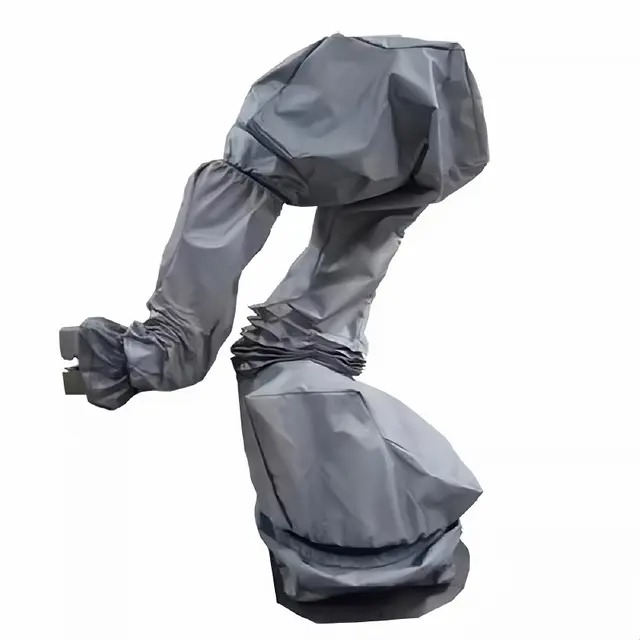
One often overlooked benefit of Robot Anti-static Protective Clothing is how it helps with sensor accuracy. Many modern robots use capacitive touch sensors or laser-based vision systems. Static fields can interfere with these signals.
A robot covered in static creates "electronic noise." This noise can cause a High precision camera to misread a coordinate by a few microns. For a robot placing micro-chips, a few microns is the difference between a perfect product and a piece of scrap. By "quieting" the electrical environment with a grounded cover, you allow the robot's internal sensors to work at their maximum theoretical accuracy.
In addition to ESD, these covers help stabilize the temperature of the robot's joints. Drastic temperature swings cause metal to expand and contract, affecting High precision calibration. An Industrial cover acts as a light insulator, keeping the robot at a steady operating temperature and reducing the need for frequent re-calibration.
If you are responsible for protecting an automated line, you need a clear path forward. Use this checklist to evaluate your Robot Anti-static Protective Clothing options.
Cleanroom Rating: If applicable, is it ISO Class 5 or better (non-linting)?
Movement Compatibility: Is the design Custom enough to handle 100% of the robot's reach?
Environmental Shielding: Does it need to be Waterproof or Flame retardant?
Grounding Method: Does the cover come with a dedicated grounding strap or a conductive connection point?
ESD is a silent killer of productivity. In the race to create smaller, faster, and more powerful micro-circuits, the margin for error is shrinking. Robot Anti-static Protective Clothing is no longer an "optional accessory"; it is a vital piece of Industrial equipment. By investing in Custom, High precision covers, you protect your electronics from instant damage and long-term latent defects. Whether you work in a Cleanroom or a heavy factory, keeping your robots grounded is the smartest way to ensure your automation pays for itself.
Q1: How often should I replace Robot Anti-static Protective Clothing?
It depends on the movement speed. For high-cycle robots, we recommend a visual inspection every 6 months. If you notice any fraying or if a resistivity meter shows the charge isn't dissipating, it is time for a replacement.
Q2: Can I wash these covers?
Most Industrial anti-static covers can be cleaned, but you must follow specific instructions. Using harsh detergents can strip the anti-static coating. Always check if the conductive grid is "topical" or "integrated" into the fiber.
Q3: Does the cover affect the robot's warranty?
Generally, no. In fact, most manufacturers prefer you use a Custom cover to prevent dust and ESD from damaging the motors. Just ensure the cover is lightweight enough not to exceed the robot's payload capacity.
At our factory, we don't just make "bags" for robots; we engineer advanced protective systems. Our facility is equipped with specialized testing labs where we verify the surface resistivity and Flame retardant properties of every fabric batch. We understand the high stakes of B2B manufacturing, which is why we focus on Custom solutions that fit like a second skin.
Our strength lies in our deep technical knowledge of both textiles and robotics. We have worked with major global brands to solve complex ESD challenges in Cleanroom environments. Because we control the entire manufacturing process from design to final QC, we can guarantee that our Robot Anti-static Protective Clothing will perform exactly as promised. We are committed to helping you protect your High precision investments with the most Durable and effective shielding available on the market today.


